
January 2, 2026 by National Taiwan University
Collected at: https://medicalxpress.com/news/2026-01-ai-stomach-cancer-remote-communities.html
In many regions, doctors practice in settings with limited medical resources. Advanced tests, specialist support, and expert guidance for complex decisions are often unavailable. Under these circumstances, accurate automated systems, especially AI, can help close the gap between limited resources and clinical needs.
How AI assists in endoscopy interpretation
Upper endoscopy lets doctors look directly inside the stomach. But learning how to read these images takes many years of experience, often with help from pathology results, because early signs of disease can be subtle and easy to overlook. Artificial intelligence can help. AI can analyze routine endoscopy images that doctors already collect in daily practice.
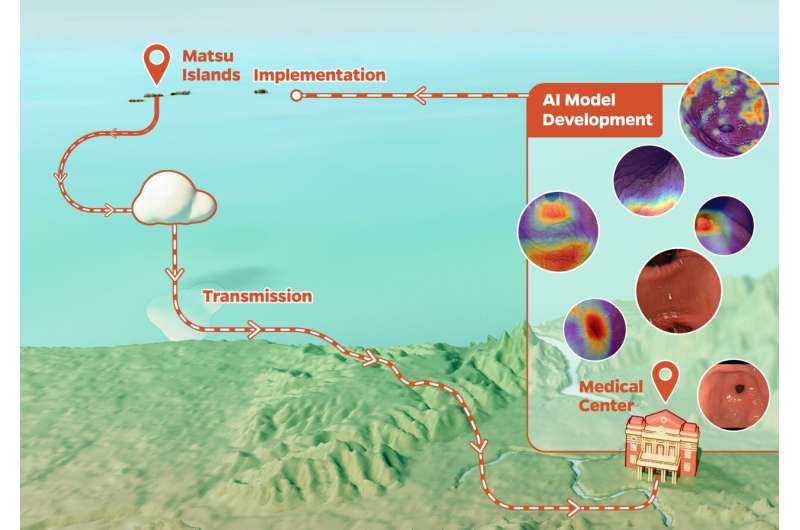
Researchers at National Taiwan University Hospital and the Department of Computer Science & Information Engineering at National Taiwan University developed an AI system made up of several models working together to read stomach images. Trained using doctors’ expertise and pathology results, the system learns how specialists recognize stomach disease. It automatically selects clear images, focuses on the correct areas of the stomach, and highlights important surface and vascular details.
Potential impact on frontline care
The system can quickly identify signs of Helicobacter pylori infection and early changes in the stomach lining that are linked to a higher risk of stomach cancer. The study is published in Endoscopy.
For frontline physicians, this support can be important. AI can help them feel more confident in what they see and what to do next. By providing timely and standardized assessments, it helps physicians determine whether additional diagnostic testing, H. pylori eradication therapy, or follow-up endoscopic surveillance is warranted. As a result, potential problems can be detected earlier, even when specialist care is far away.
“By learning from large numbers of endoscopic images that have been matched with expert-interpreted histopathology, AI can describe gastric findings more accurately and consistently. This helps doctors move beyond vague terms like ‘gastritis,’ which are often written in results but don’t give enough information to guide proper care,” says first author Associate Professor Tsung-Hsien Chiang.
“AI is not meant to replace doctors,” says corresponding author Professor Yi-Chia Lee. “It acts as a digital assistant that supports clinical judgment. By fitting into routine care, AI helps bring more consistent medical quality to reduce the gap between well-resourced hospitals and remote communities.”
More information
Yi-Chia Lee et al, A rural-to-center artificial intelligence model for diagnosing Helicobacter pylori infection and premalignant gastric conditions using endoscopy images captured in routine practice, Endoscopy (2025). DOI: 10.1055/a-2721-6552
Leave a Reply