
December 30, 2025 by National Taiwan University
Collected at: https://techxplore.com/news/2025-12-individuals-crews-ai-teamwork-productivity.html
Researchers at National Taiwan University have developed an AI system that recognizes construction activities at both the individual and crew levels using ordinary site videos. The approach reveals how teamwork shapes productivity and provides a foundation for future human–robot collaboration on construction sites.
Construction projects are built by teams, not individuals. Yet understanding how those teams actually work together on-site remains a major challenge for construction productivity research. Most productivity assessments still rely on manual field observations that are slow, subjective, and poorly suited to capturing real-time collaboration.
Although recent advances in computer vision and artificial intelligence (AI) have enabled automatic recognition of individual worker actions from construction site videos, these methods largely treat workers in isolation and fail to capture how tasks are performed collectively. The researchers from National Taiwan University have now developed an AI system that addresses this gap by recognizing construction activities at both the individual and crew levels using ordinary site videos.
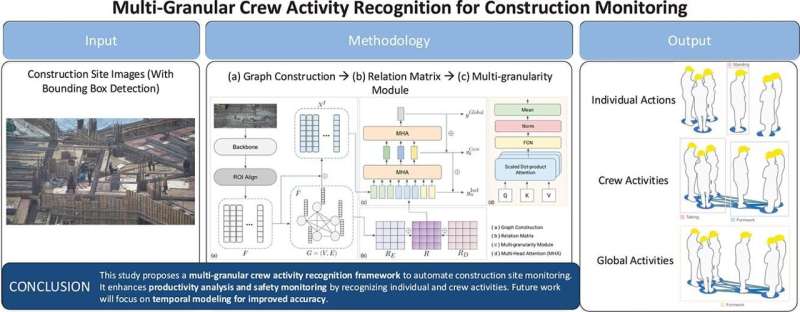
Published in Automation in Construction, the study introduces a multi-granular crew activity recognition framework that analyzes construction work at three interconnected levels. These include individual worker actions such as hammering or pouring concrete, crew level activities where groups collaborate on tasks like rebar placement or formwork installation, and overall site level operations. By linking these levels, the system provides a more realistic view of construction productivity that reflects how work is actually performed on site.
Traditional productivity assessment methods, such as work sampling and field rating, are time-consuming, subjective, and difficult to scale. While recent computer vision approaches have made progress in recognizing individual worker actions, they largely overlook collaboration, even though most construction tasks are inherently team-based.
The researchers from National Taiwan University addressed this limitation by modeling workers as nodes in a graph and learning their relationships based on both visual features and spatial proximity. This allows the AI system to infer how workers interact as functional crews.
The system was trained and validated using real construction site videos recorded in Taipei, covering major activities including rebar work, formwork installation, and concrete pouring. The proposed framework achieved an overall F1 score exceeding 73%, demonstrating reliable performance in recognizing both individual actions and crew-level activities.
More importantly, the results show that crew-based analysis provides more accurate and actionable insights than monitoring individuals alone, particularly for distinguishing value-added work from idle or non-productive time.
The study also identifies current challenges. Because the model relies primarily on spatial snapshots, it has limited ability to capture how activities evolve over time. Future research will therefore focus on incorporating temporal modeling, improving recognition of interactions between workers and objects, and expanding the dataset to include a broader range of construction tasks and site conditions.
As construction projects continue to grow in size and complexity, AI systems that understand teamwork can transform productivity analysis, safety management, and decision making on construction sites worldwide.
“If we want robots to truly collaborate with people, we must first understand how human teams work together,” says Prof. Jacob J. Lin. “Crew level understanding is essential for meaningful human-robot collaboration.”
“AI is a key enabler for construction automation,” adds Prof. Chuin-Shan Chen. “Turning site data into actionable understanding is critical for smarter and more adaptive construction systems.”
More information: Cheng Yun Tsai et al, Multi-granular crew activity recognition for construction monitoring, Automation in Construction (2025). DOI: 10.1016/j.autcon.2025.106428
Leave a Reply