
December 29, 2025 by National Institute for Materials Science
Collected at: https://techxplore.com/news/2025-12-ai-device-ion-gel-graphene.html
In recent years, power consumption by machine learning technologies, represented by deep learning and generative artificial intelligence (AI), has increased exponentially, creating a serious social challenge. To address this problem, demand is growing for AI devices with low power consumption and high computational performance.
“Physical reservoirs“—AI devices that perform efficient brain-inspired information processing called reservoir computing—have attracted attention due to their low computational load (the required number of multiply-accumulate operations) and low power consumption, but their lower computational performance compared to software processing has been a drawback.
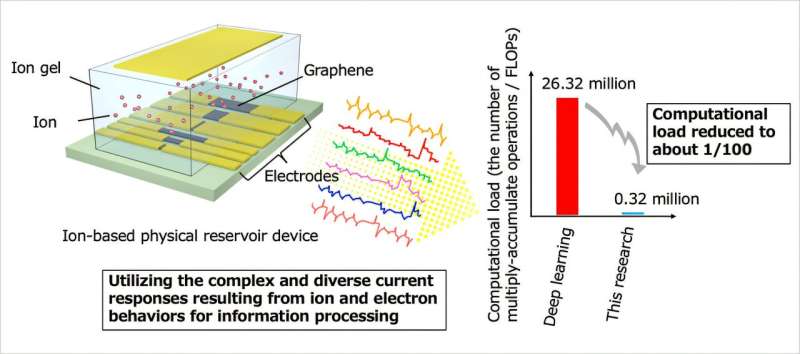
A research team from NIMS, Tokyo University of Science, and Kobe University developed a physical reservoir device utilizing ions that achieved high computational performance comparable to that of deep learning while reducing the computational load by orders of magnitude. Their research is published in ACS Nano.
By combining graphene, which has high electron mobility and ambipolar behavior, and an ion gel, various responses with different speeds (ions and electrons moving in various manners) develop through complex interactions, enabling the device to respond to input signals with time constants (rates of change) that vary over an extremely wide range.
The device exhibited the highest-level computational performance among conventional physical reservoirs, comparable to that of deep learning performed using software, while succeeding in reducing the computational load to about 1/100.
More information: Daiki Nishioka et al, Two Orders of Magnitude Reduction in Computational Load Achieved by Ultrawideband Responses of an Ion-Gating Reservoir, ACS Nano (2025). DOI: 10.1021/acsnano.5c06174
Journal information: ACS Nano
Leave a Reply