
December 29, 2025 by National Institute for Materials Science
Collected at: https://phys.org/news/2025-12-method-motion-magnetic-materials.html
NIMS, in joint research with the University of Tokyo, AIST, the University of Osaka, and Tohoku University, have proposed a novel method for actively controlling heat flow in solids by utilizing the transport of magnons—quasiparticles corresponding to the collective motion of spins in a magnetic material—and demonstrated that magnons contribute to heat conduction in a ferromagnetic metal and its junction more significantly than previously believed.
The creation of new principles “magnon engineering” for modulating thermal transport using magnetic materials is expected to lead to the development of thermal management technologies. This research result is published in Advanced Functional Materials.
Thermal conductivity is a fundamental parameter characterizing heat conduction in a solid. The primary heat carriers are known to be electrons and phonons, quasiparticles corresponding to lattice vibrations. In current thermal engineering, efforts are underway to modulate thermal conductivity and interfacial thermal resistance by elucidating and controlling the transport properties of heat carriers. In particular, heat conduction modulation focusing on the transport and scattering of phonons has been actively studied over the past decades as “phonon engineering.”
While heat carriers other than electrons and phonons also contribute to heat conduction, they have largely been disregarded as their contribution is extremely small in most materials, only being observed under extreme environments, such as at a very low temperature, if at all.
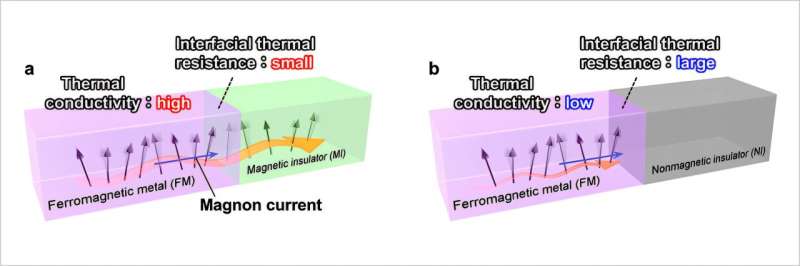
In this study, the research team demonstrated that heat conduction can be modulated by utilizing and controlling the transport of magnons—quasiparticles corresponding to the collective motion of spins in a magnetic material—in a simple structure formed by stacking a thin film of a ferromagnetic metal, such as a cobalt-iron alloy (CoFe) or a nickel-iron alloy (NiFe), on an insulator.
The team revealed that, when non-equilibrium magnon currents generated in the ferromagnetic metal propagate to the insulator (left in figure above), the thermal conductivity of the ferromagnetic metal thin film increases, compared to when they do not (right in figure above), even at room temperature, with the interfacial thermal resistance at the metal/insulator junction reduced to as low as a fraction of the original level.
The research results show that thermal transport engineering through control of magnon transport (magnon engineering) is applicable even to metals in which electrons are dominant heat carriers, upsetting the conventional wisdom that magnon contribution to heat conduction in metals is extremely small at room temperature.
Based on this research result, the team aims to further elucidate the physical origin of this mechanism, and to create new heat modulation technologies applying magnon engineering, such as a thermal switch in which the magnon transport is controlled through an external field.
More information: Takamasa Hirai et al, Non‐Equilibrium Magnon Engineering Enabling Significant Thermal Transport Modulation, Advanced Functional Materials (2025). DOI: 10.1002/adfm.202506554
Journal information: Advanced Functional Materials
Leave a Reply