
By SciTechDaily.com December 25, 2025
Collected at: https://scitechdaily.com/a-cosmic-christmas-tree-lights-up-the-milky-way/
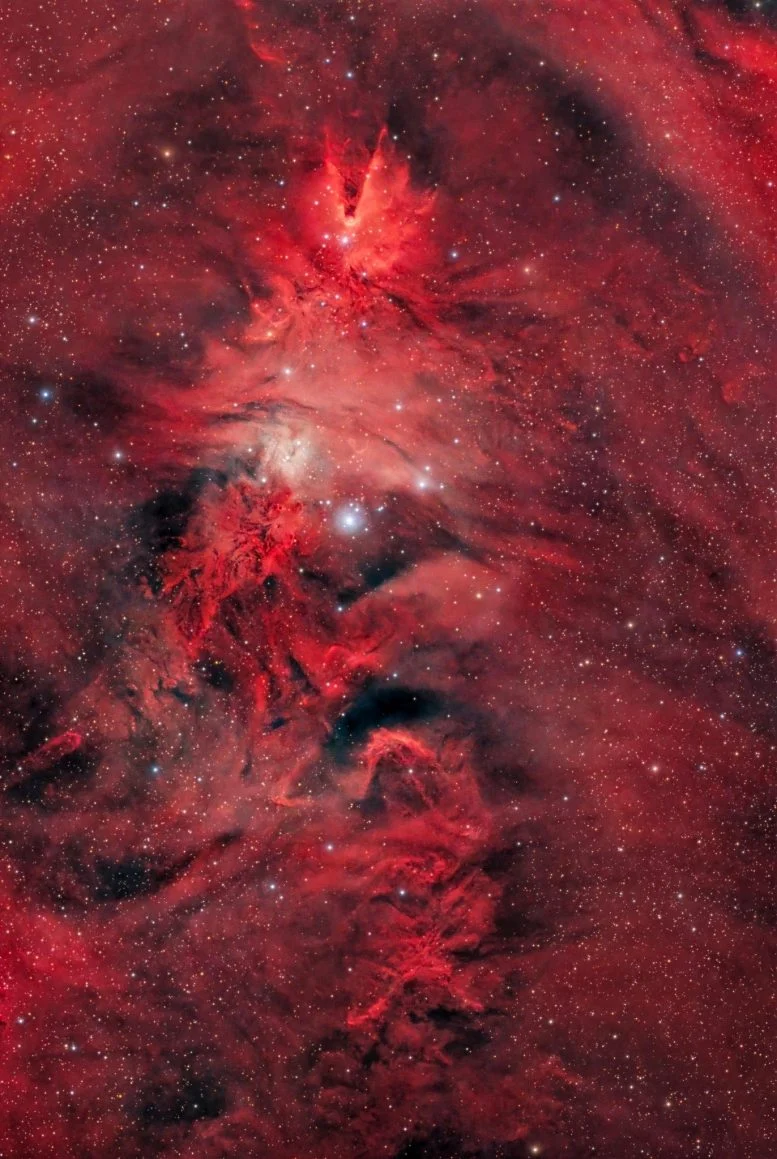
Just in time for Christmas, a vast star-forming region shaped like a Christmas tree is lighting up space 2,700 light-years from Earth.
NGC 2264 is a vast region of space where new stars are actively forming, located about 2,700 light-years from Earth in the faint constellation Monoceros, also known as the Unicorn. Astronomers use catalog names like NGC 2264 to identify and track objects beyond our solar system, and this particular one stands out for its intricate mix of glowing clouds and young stars. Positioned near the celestial equator and close to the flat disk of the Milky Way, this region is visible at certain times of year from much of the world.
How Young Stars Light Up Space
The scene is shaped by enormous clouds of interstellar gas and dust, the raw materials from which stars are born. As newly formed stars ignite, they release powerful energy that causes nearby gas to glow red, creating what scientists call emission nebulae. Dark dust clouds also weave through the area, blocking background starlight and creating striking patches of shadow. In places where these dust clouds sit close to hot, young stars, they reflect light instead of absorbing it, producing soft blue hues known as reflection nebulae.
The Christmas Tree Cluster and Its Brightest Star
Near the center of NGC 2264 lies S Monocerotis, a bright and variable star whose light fluctuates over time. It is surrounded by a blue-tinted haze formed by reflected starlight, making it a visual anchor of the region. Above this star, a group of young stars forms a loose triangular pattern. This distinctive shape has led astronomers and skywatchers to nickname it the Christmas Tree star cluster.
The Cone Nebula and the Fox Fur Nebula
At the top of this cosmic Christmas tree sits the Cone Nebula, a towering column of gas and dust shaped by intense radiation from nearby stars. Below it spreads a tangled and glowing cloud known as the Fox Fur Nebula, whose textured appearance comes from a combination of illuminated gas and dense dust. Together, these features create one of the most recognizable star-forming landscapes in the night sky.
A Vast Structure on a Galactic Scale
When viewed through a telescope, the entire region stretches about 1.5 degrees from top to bottom, roughly the width of three full moons placed side by side. At its immense distance, that apparent size translates to a physical span of nearly 80 light-years, underscoring just how enormous this stellar nursery truly is.
Leave a Reply