
December 14, 2025 by Alessio Zaccone
Collected at: https://phys.org/news/2025-12-mystery-atoms-thin-materials.html
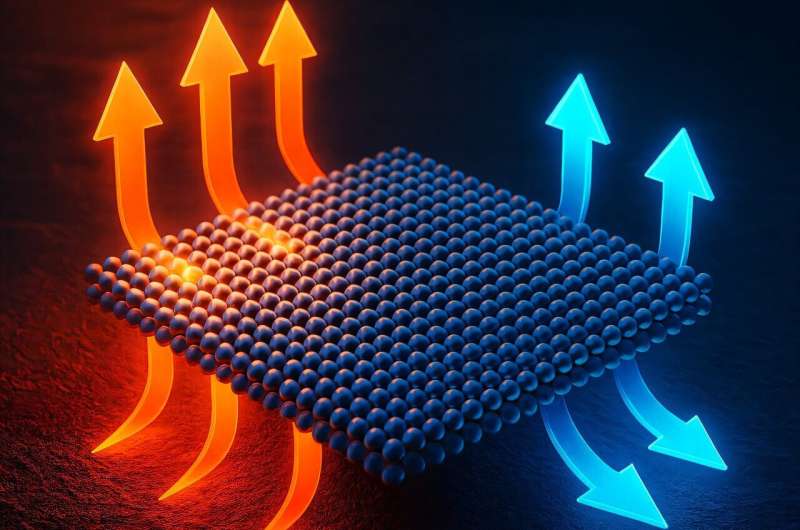
For much of my career, I have been fascinated by the ways in which materials behave when we reduce their dimensions to the nanoscale. Over and over, I’ve learned that when we shrink a material down to just a few nanometers in thickness, the familiar textbook rules of physics begin to bend, stretch, or sometimes break entirely. Heat transport is one of the areas where this becomes especially intriguing, because heat is carried by phonons—quantized vibrations of the atomic lattice—and phonons are exquisitely sensitive to spatial confinement.
A few years ago, something puzzling emerged in the literature. Molecular dynamics simulations showed that ultrathin silicon films exhibit a distinct minimum in their thermal conductivity at around one to two nanometers thickness, which corresponds to just a few atomic layers. Even more surprisingly, the thermal conductivity starts to increase again if the material is made even thinner, approaching extreme confinement and the 2D limit.
This runs counter to what every traditional model would predict. According to classical theories such as the Boltzmann transport equation or the Fuchs–Sondheimer boundary-scattering framework, reducing thickness should monotonically suppress thermal conductivity because there is simply less room for phonons to travel freely and carry heat around. Yet the simulations done by the team of Alan McGaughey at Carnegie Mellon University in Pittsburgh insisted otherwise, and no established theory could explain why.
This mystery kept pulling me back. What was happening inside these materials at the atomic scale that could cause such a nonintuitive reversal? In my new paper published in the Journal of Applied Physics as an Editor’s Pick, I set out to understand this behavior by revisiting the problem of phonons under confinement from a different perspective.
Instead of thinking in terms of discretized modes or subbands, which is a common approach in quantum well models, I looked at confinement from a geometric point of view, focusing on how the allowed momentum states of phonons are reshaped in reciprocal space.
In bulk materials, phonons occupy a spherical region in reciprocal space known as the Debye sphere. When a material becomes very thin, phonons whose wavelengths exceed the film thickness can no longer exist along the confined direction. I began to picture this as carving out two spherical “holes” inside the Debye sphere—regions of momentum space that simply do not permit any phonon states because their associated wavelengths would not fit within the physical thickness of the film.
As the film becomes thinner, these forbidden regions grow and eventually press outward against the boundary of the Debye sphere itself, distorting what is normally a simple spherical surface into a more complex shape.
This geometric distortion has profound consequences. It pushes many vibrational states toward lower frequencies, producing a density of states that increases as the cube of the frequency rather than following the usual quadratic Debye law. In simpler terms, the population of phonons becomes overwhelmingly dominated by long-wavelength, low-frequency vibrations.
These modes are exceptionally efficient at carrying heat, and their dominance becomes stronger the more confined the film is. It is this shift in the vibrational landscape that produces the unexpected minimum in thermal conductivity and the subsequent increase at extreme confinement.
When I combined this confinement-induced density of states with the standard formulas for phonon thermal conductivity, the theoretical prediction matched the simulations remarkably well. The minimum emerged naturally, without any need for adjustable parameters beyond those already known for silicon. It was deeply satisfying to see this behavior appear as a direct consequence of the reciprocal-space geometry, especially because earlier theoretical frameworks had no mechanism to reproduce it.
For me, this work highlights an important lesson about nanoscale physics: when we approach the limits of dimensionality, we need to rethink the problem at a fundamental level. The usual assumptions we rely on in bulk materials may no longer apply, and new behaviors can arise not from exotic effects but from simple geometric constraints on the allowed quantum states of the system. In this case, the redistribution of phonon momentum states was enough to explain a phenomenon that had remained puzzling for years.
The implications extend far beyond silicon films. For example, previous observations showed that in silicon nanowires this effect is even more pronounced and dramatic. Also, understanding how heat flows in nanoscale materials is crucial for many areas of technology. As electronics continue to shrink (the famous Moore’s law), efficient thermal management becomes essential to prevent overheating.
Quantum devices such as quibits for quantum computing, where even a tiny amount of excess heat can disrupt coherence, depend on precise control of phonon populations. Thermoelectric materials rely on manipulating phonon transport to improve efficiency, and the same principles may prove valuable for two-dimensional and van der Waals materials, where layered structures naturally generate confinement effects.
Looking ahead, I am excited by the many possible extensions of this framework. There is room to incorporate additional scattering mechanisms, to apply the model to different classes of thin films and membranes, and to explore how confinement affects systems relevant to superconducting devices or quantum information technologies. Each of these directions promises new insights not only into thermal physics but also into the deeper question of how materials behave when they are squeezed into the smallest possible dimensions.
In the end, what motivates me is the simple joy of uncovering how nature works when we push it to its limits. Nanoscale materials remind us that even familiar phenomena like heat conduction can surprise us, and each surprise opens the door to new physics—and perhaps new technologies we have not yet imagined.
This story is part of Science X Dialog, where researchers can report findings from their published research articles. Visit this page for information about Science X Dialog and how to participate.
More information: Alessio Zaccone, Phonon-confinement theory of thermal conductivity in ultrathin silicon films, Journal of Applied Physics (2025). DOI: 10.1063/5.0304896
Journal information: Journal of Applied Physics
Leave a Reply