
December 23, 2025 by University of Manchester
Collected at: https://medicalxpress.com/news/2025-12-ai-logic-biomedical.html
Manchester researchers have developed a systematic methodology to test whether AI can think logically in biomedical research, helping to ensure safer, more reliable applications in health care innovation.
As artificial intelligence becomes increasingly embedded in biomedical research, questions remain about how well these systems can reason logically with complex scientific information.
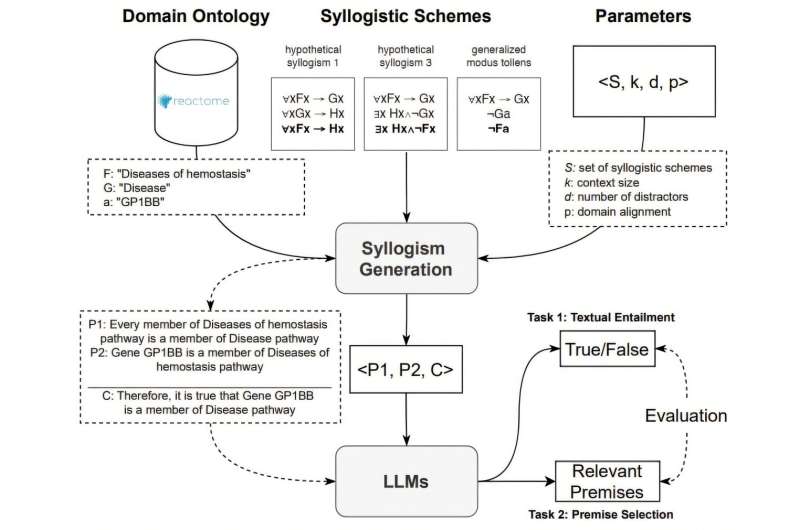
Researchers at The University of Manchester have created SylloBio-NLI, a first-of-its-kind framework that systematically tests the logical reasoning ability of AI models.
Using examples similar to classic syllogisms—”All men are mortal. Socrates is a man. Therefore, Socrates is mortal.”—the team adapted this structure to biomedical data to reveal where models succeed and where they fail.
Their findings, published in an article posted to the arXiv preprint server, show that while AI can make intuitive connections, even advanced open-source models struggle with consistent logical reasoning when applied to biomedical problems. By quantifying these limitations, the research provides critical evidence for the safe use of AI in scientific discovery and clinical decision-making.
Danilo Carvalho, Principal Clinical Informatician for the Digital Cancer Research team at the National Biomarker Center, within Cancer Research UK Manchester Institute explains, “By exposing where AI reasoning breaks down, we can build systems that support biomedical research with certain scientific evidence guarantees.”
The team’s open-access methodology offers a vital tool for improving the transparency, reliability, and future design of AI technologies used in medicine, supporting Manchester’s commitment to ensuring responsible AI and digital health innovation.
More information
Magdalena Wysocka et al, SylloBio-NLI: Evaluating Large Language Models on Biomedical Syllogistic Reasoning, arXiv (2024). DOI: 10.48550/arxiv.2410.14399
Journal information: arXiv
Leave a Reply