
December 23, 2025 by Krystal Kasal, Phys.org
Collected at: https://phys.org/news/2025-12-raindrops-sandballs-downhill-contributing-erosion.html
What happens as a raindrop impacts bare soil has been fairly well-studied, but what happens to raindrops afterward is poorly understood. We know that the initial splash of raindrops on soil contributes to erosion, but a new study, published in the Proceedings of the National Academy of Sciences, finds that the journey of the raindrop downhill might have an even bigger impact on erosion than the initial splash.
A closer look at hillside raindrops
Somewhere on the “Route de la Sorge” in Ecublens, Switzerland, members of the research team observed natural raindrops hitting the surface of a hillside and noticed that they collected particles of sand as they rolled downhill. This spurred the researchers to document the event with a camera and then take the idea to the lab.
In the lab, they constructed a 1.2 meter long bed covered with dry silicate sand and tilted at an angle of 30°. The lab conditions enabled the team to properly document the phenomenon by recording the evolution of the raindrops’ shapes as they rolled and take precise measurements of the relevant parameters. They found that each raindrop formed what they refer to as “sandballs” and that they took on differing shapes, depending on the conditions, and that the sandballs can move up to 10 times more soil than the initial splash alone.
“In the initial rolling stage, drops rapidly increase their speed and sediment entrainment rate. Under increasing centrifugal force, the rolling drops undergo a metamorphosis: Their rounded shape destabilizes, as both liquid and entrained grains drift away from the core to create sandballs,” the study authors write.
Peanut and doughnut-shaped sandballs
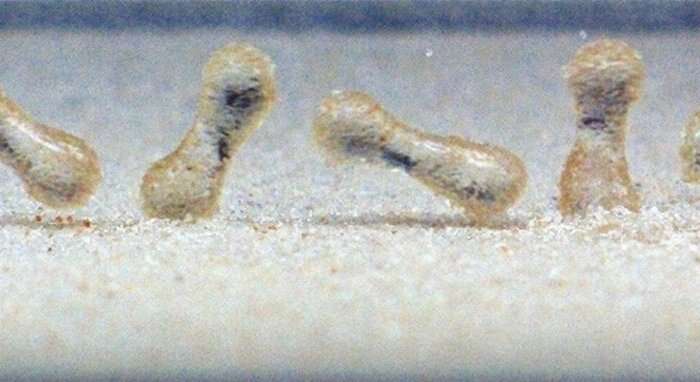
The researchers found that the sandy raindrops formed two distinct shapes: a peanut shape and a doughnut shape. Peanuts occurred at comparably lower velocities and maintained their grains at the surface of the drop. They only gather grains up to a certain point and then usually plateau.
“Once their mass plateaus, peanuts continue to increase their angular velocity as they roll; this sometimes causes a shift in their mode of motion, triggering an additional phase of mass accumulation. Other times, peanuts break, tumble slower or settle. If peanuts survive to the end of the slope and roll onto a flat surface, they immediately fall apart,” the study authors explain.
Instead of only gathering grains at the surface, doughnut-shaped drops absorb sand grains into their interior volume, making them more dense and opaque in appearance. The researchers call the emergence of these kinds of drops “unexpected.”
The team found that these drops destabilize into the doughnut shape from axisymmetric radial stretching. These shapes only occur at very high spin rates in pure-liquid drops, but occurred at slightly lower rates in the lab experiments due to the water-glycerol mixture used in the lab-based drops.
The study authors write, “Fully developed doughnuts continue to speed up (above 1 m/s), until a point where they sometimes break apart in an apparent fracture process. This breakage occurs when the tensile force driven by the centrifugal sandball stretching overcomes the strength of capillary bonds, producing child sandballs that carve their own track as they tumble down the slope.”
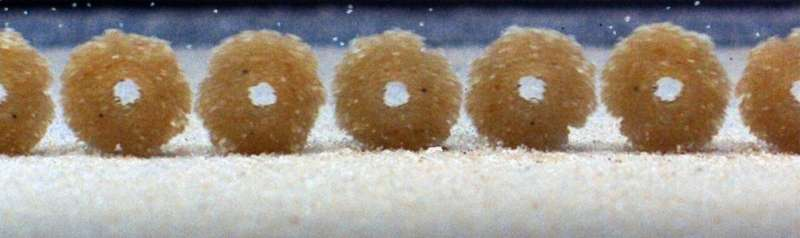
Doughnut-like sandballs originating from raindrops impacting sloping sand hills. Credit: Penn GEFLOW Lab
Why does it matter?
Studying the shapes that raindrops take on as they tumble down dry dirt hills might seem frivolous, but these dynamics have real implications for soil erosion models, which are used for predicting soil loss from rain. These models help with conservation planning, land management, and environmental assessment by estimating erosion rates, identifying more vulnerable areas, designing control measures and evaluating land health in agriculture. By showing how much more soil is displaced as raindrops travel downhill, this study can help researchers improve these models.
Furthermore, these dynamics provide insights for other fields by contributing knowledge about granulation techniques. The study authors say, “In the sandball process, however, we need only tune the initial liquid drop conditions; the mixing of liquid and particles to the critical state is self-organized, suggesting a low-energy process for granulation. This process could find applications in material science, biotechnology, pharmaceutical and food industries, and snow physics.”
More information: Bertil Trottet et al, Sandball genesis from raindrops, Proceedings of the National Academy of Sciences (2025). DOI: 10.1073/pnas.2519392122
Journal information: Proceedings of the National Academy of Sciences
Leave a Reply