
December 20, 2025 by Noah Frank, Virginia Tech
Collected at: https://phys.org/news/2025-12-quantum-entanglement-drones-disaster-relief.html
Any time you use a device to communicate information—an email, a text message, any data transfer—the information in that transmission crosses the open internet, where it could be intercepted. Such communications are also reliant on internet connectivity, often including wireless signal on either or both ends of a transmission.
But what if two—or 10, or 100, or 1,000—entities could be connected in such a way that they could communicate information without any of those security or connectivity concerns?
That’s the challenge that Alexander DeRieux, a Virginia Tech Ph.D. student and Bradley Fellow in the Bradley Department of Electrical and Computer Engineering, under the advisement of Professor Walid Saad, set out to tackle using quantum entanglement. In short, they used the unique properties of quantum bits, or qubits, as a method of transmitting information.
“When you look subatomically, atoms don’t exist in isolation—they vibrate. Those vibrations affect other atoms close by,” said DeRieux. “Entanglement effectively leverages the fabric of the physical space around us and how atoms are intrinsically linked with each other.”
Quantum entanglement in disaster scenarios
Drawing on current events, DeRieux’s team, based at the Institute for Advanced Computing in Alexandria, examined the potential for drones fighting wildfires or being employed in other disaster relief scenarios where wireless signal may be disrupted.
The team’s novel framework, dubbed eQMARL (entangled quantum multi-agent reinforcement learning), showed a marked improvement in performance using quantum entanglement over both classical computing and non-entangled quantum baselines. The work is published on the arXiv preprint server.
“We developed the technology and the framework, and then we thought of the application where it can be used,” said DeRieux.
“What we developed is effectively a learning scheme that exploits the fact that when you do something to one half of the qubit pair, it does something to the other one. We don’t necessarily care what it does, just that change happens.”
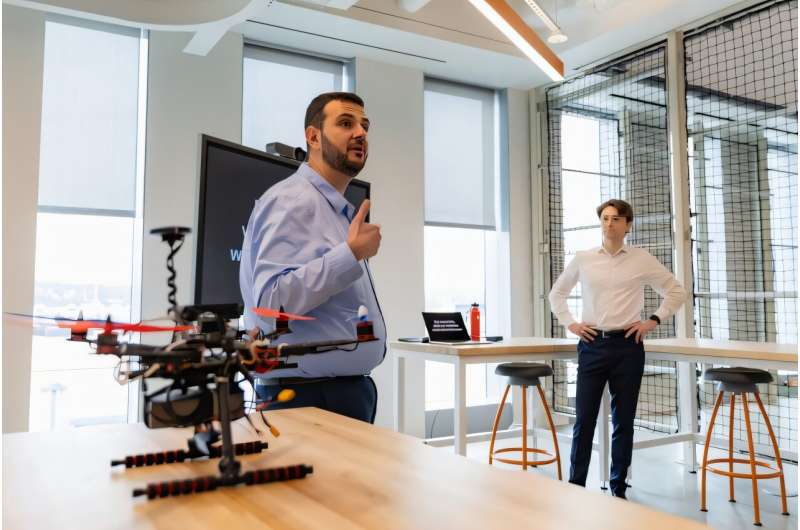
DeRieux and his team demoed their research at the grand opening of Academic Building One in Alexandria back in February, though he cautioned at the time that a deployment for a drone disaster response might still be 10 to 15 years away. But with advancements on both the mathematical side and the real world testing side in the intervening months, quantum’s potential applications are coming quickly into focus.
Potential impact on communication and AI
“While the promise of quantum technologies is widely recognized, how they can fundamentally reshape artificial intelligence and communication systems remains an open question,” said Saad.
“Our research addresses this challenge by exploiting intrinsic quantum properties, such as entanglement, to design learning and communication frameworks that move beyond classical limits while establishing principled co-design approaches in which quantum and classical technologies operate together as a single, coherent system.”
Quantum entanglement offers a range of potential applications because it opens the door to secure communications without relying on fiber optic or wireless networks. Consider a hospital that needs to share medical records. The open internet presents a host of cybersecurity issues that could be circumvented by avoiding the explicit transmission of such information.
While our wireless and artificial capabilities (AI) continue to grow in new and exciting ways, there are limits to classical computing that quantum transcends.
“Those algorithms are just effectively solving an existing problem in a quicker way. They’re not necessarily redefining the way we solve that problem,” said DeRieux. “We wanted to research what other types of advantages quantum can give you that are uniquely quantum, that you can’t get with the type of tech that’s in your smartphone.”
How quantum entanglement works
So how exactly do these two entangled qubits communicate? Essentially, their change in state can be measured and determined by the corresponding effect on the entangled qubit.
When drones experience their environment, including through audio or video, that information gets encoded onto the qubit. Because you can fit so much more information on a qubit, such as amplitudes and phases, simply communicating those changes of state provides a wealth of information.
The way that all gets unpacked on the other end is no different than in current, classical systems, and the processes all pull from well-established quantum physics.
Think of photons as tiny, spinning balls. To entangle them, one must fire one photon very close to another one. In so doing, one can encode information into the state of both photons by modifying the way the little ball spins, essentially putting the two in lockstep.
Once entangled, any modification to one will also happen to the other, no matter how far apart they are—from opposite ends of the same swarm, to opposite ends of the galaxy. In fact, this possibility was tested earlier this year on the International Space Station.
Future applications and possibilities
As quantum computers continue to shrink—from entire rooms, to the size of a station wagon, to more condensed versions that fit on a napkin—that range of potential applications grows exponentially. Whether the quantum supremacy breakthrough comes next week or next decade, the groundwork that DeRieux and Saad have laid could be applicable to anything from federated learning, to data security, data representativeness, AI compression, and less energy-intensive AI.
“We have essentially written an instruction book that says, ‘Yes, this is something you can actually do in entanglement, that proves you can do something uniquely quantum that you cannot do classically,'” said DeRieux.
More information: Alexander DeRieux et al, eQMARL: Entangled Quantum Multi-Agent Reinforcement Learning for Distributed Cooperation over Quantum Channels, arXiv (2024). DOI: 10.48550/arxiv.2405.17486
Journal information: arXiv
Leave a Reply