
December 17, 2025 by Zhang Nannan, Chinese Academy of Sciences
Collected at: https://phys.org/news/2025-12-tillerpet-ai-high-throughput-phenotyping.html
In a new study published in The Crop Journal on November 7, researchers developed an AI model named TillerPET that enables simultaneous in-situ high-throughput phenotyping of tiller number and compactness from post-harvest rice RGB images. It demonstrates stable performance across multi-year, multi-location rice RGB datasets.
The study was a collaboration among the Institute of Genetics and Developmental Biology of the Chinese Academy of Sciences, Huazhong University of Science and Technology and the Yazhou Bay National Laboratory.
Tiller number and plant compactness are pivotal phenotypes determining panicle density, population structure, and yield formation. However, field measurement of these key traits has long been constrained by severe occlusion, uneven illumination, and the inefficiency of traditional manual assessment. High costs and complex workflows of automated or hardware-dependent imaging systems further impede high-throughput acquisition of these traits.
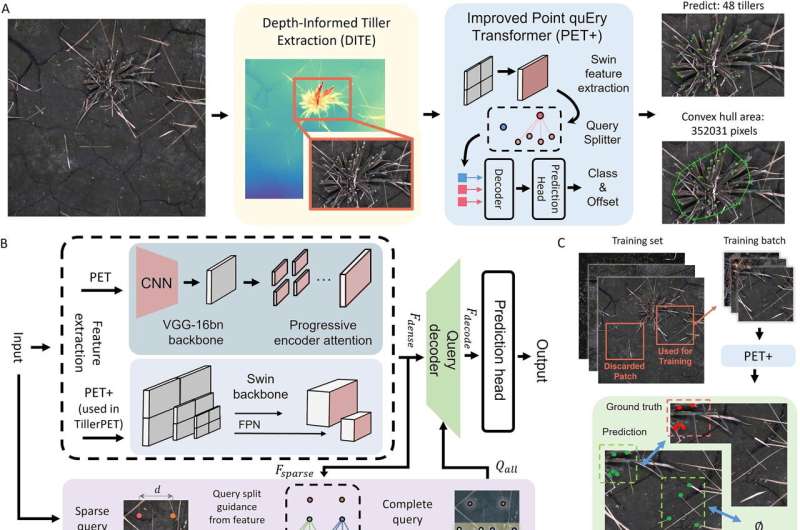
To address these issues, the researchers used a multi-year, multi-location rice RGB image dataset to develop the TillerPET, which adopts a point-query-based transformer architecture and incorporates a depth-aware rice region extraction module to build a lightweight feature extractor.
The researchers replaced the backbone of the point-query transformer with the Swin series, which simplified the original encoder design while substantially reducing computational load and simultaneously improving performance. TillerPET achieves an R² of 0.941 for tiller counting and an R² of 0.978 for measuring tiller compactness.
The tillering and architectural traits extracted by TillerPET further enable the classification and identification of rice varieties with different genotypes. In addition, the multi-year, multi-site phenotypic data on rice tillering and plant architecture provide valuable data support for rice ideotype breeding.
More information: Letian Zhou et al, TillerPET: High-throughput in-situ phenotyping of rice tiller number and compactness from post-harvest stubble, The Crop Journal (2025). DOI: 10.1016/j.cj.2025.09.022
Leave a Reply