
December 17, 2025 by Ingrid Fadelli, Phys.org
Collected at: https://phys.org/news/2025-12-subtle-materials-prompts-electromagnetic-behavior.html
Materials react differently to electric and magnetic fields, and these reactions are known as electromagnetic responses. In many solid materials, unusual electromagnetic responses have been known to only emerge when specific symmetries are broken.
Researchers at Rutgers University, Pohang University of Science and Technology, National Taiwan University and University of Michigan recently observed new electromagnetic effects in ferro-rotational materials, which they reported in a paper in Nature Physics. These are solid materials in which individual crystals collectively rotate, and form ordered rotational domains, without breaking spatial inversion (I) or time-reversal (T) symmetry.
“Twisting is ubiquitous in nature, appearing in DNA structures, climbing vines, and even in quartz crystals that exhibit piezoelectricity. Such twisting is typically three-dimensional and is described by chirality, characterized by left- or right-handedness,” Sang-Wook Cheong, senior author of the paper told Phys.org.
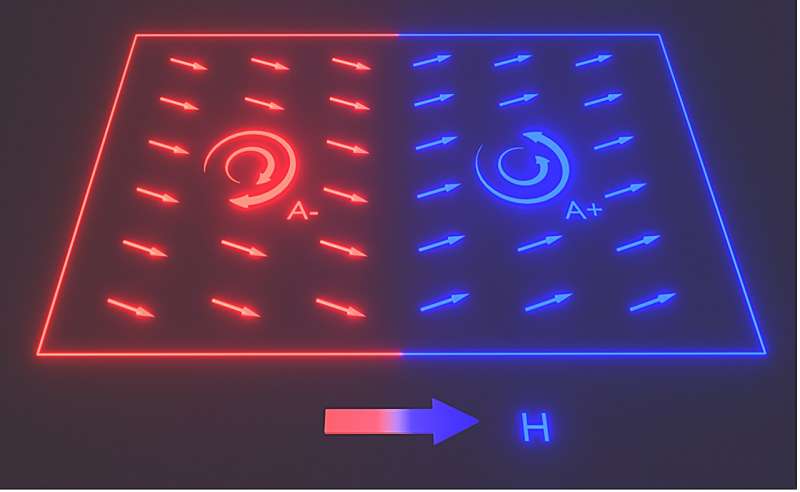
“In contrast, the twisting discussed in our study is planar: all layers of materials rotate coherently in either a clockwise or counterclockwise direction. This collective planar rotation defines a distinct order, which we term ferro-rotation. This ferro-rotation preserves spatial inversion, even though chirality breaks it.”
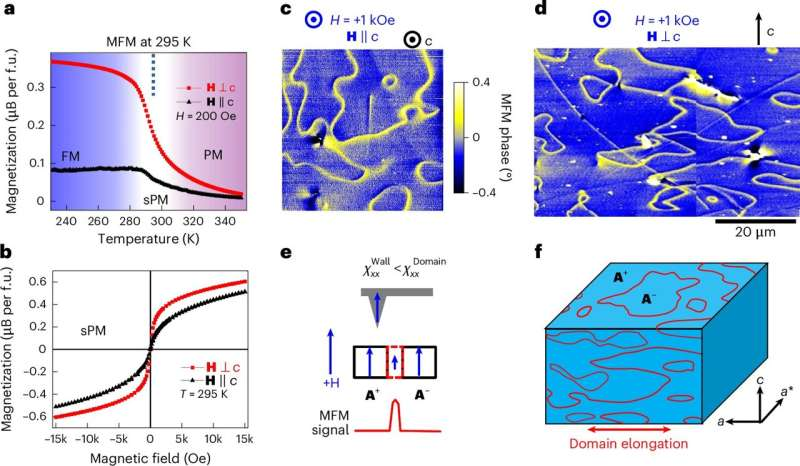
Magnetic properties and reduced diagonal susceptibility at FR domain walls of Fe1.23Ti0.77O3. Credit: Nature Physics (2025). DOI: 10.1038/s41567-025-03100-7
While this specific type of twisting, known as ferro-rotation, is found in many solid materials, its physical effects and implications have remained largely unexplored. This is partly because both I and T symmetries are preserved in ferro-rotational materials, thus no uncommon responses were assumed to arise in response to electromagnetic fields.
“In daily life, we intuitively expect longitudinal responses when a vector field is applied to an object—that is, the object’s reaction tends to be parallel or anti-parallel to the external stimulus,” said Cheong.
“However, in materials with certain broken symmetries, novel transverse electromagnetic responses can emerge even under a longitudinally applied field. These counter-intuitive transverse responses are crucial to various well-known physical effects, such as the polarization rotation of linearly polarized light propagation in chiral or ferromagnetic materials, the Hall effect, and off-diagonal linear magnetoelectricity.”
When reviewing past literature, Cheong and his colleagues realized that unconventional electromagnetic responses were assumed to only emerge when I and/or T symmetries are broken. The first of these symmetries entails that a system looks the same when spatial coordinates are reversed, while the latter entails that the physical laws guiding the system’s behavior remain unaltered if time is running backwards.
“This interesting fact motivated us to think of the question: can transverse electromagnetic responses exist in materials where both I and T symmetries are preserved?” said Cheong. “In this work, we aimed to clarify the symmetry requirements for such distinct transverse electromagnetic responses and to experimentally verify their existence in real materials.”
A new transverse electromagnetic effect
As part of their study, the researchers performed an extensive symmetry analysis focusing on a ferro-rotational material, a solid in which both I and T symmetries are preserved. Through their analysis, they were able to identify a transverse electromagnetic effect that was never observed before.
“This effect is closely tied to the so-called ferro-rotational order,” explained Cheong.
“Ferro-rotational order can be simply represented by an axial vector A consisting of rotating electric dipoles in a plane—similar to the magnetic field created by rotating loop currents, but without breaking T symmetry.”
The team predicted that a previously unobserved electromagnetic effect would arise in ferro-rotational materials when a longitudinal electric or magnetic field is applied to them along particular directions. This effect would be characterized by a characteristic and anomalous susceptibility to transverse electric or magnetic fields.
“Most intriguingly, the opposite in-plane sense of rotation (clockwise or counterclockwise) in two ferro-rotational domains will produce opposite transverse electric/magnetic responses,” said Cheong.
“Through a systematic material selection, careful ferro-rotational domain characterizations, and comprehensive magnetic force microscopy imaging, we successfully observed the contrast of anomalous transverse magnetic susceptibility in ferro-rotational Fe1.23Ti0.77O3 experimentally, which establishes the existence of such new class of transverse electromagnetic effects for the first time.”
Implications for material design and spintronics applications
The researchers’ experimental findings and their study of the material Fe1.23Ti0.77O3 confirmed the emergence of a previously unreported transverse electromagnetic effect in some ferro-rotational materials. This is a surprising observation, given that previously the emergence of transverse electromagnetic effects was assumed to be dependent on the breaking of I or T symmetries, which remain intact in ferro-rotational materials.
“Our work opens a new paradigm for exploring novel transverse electromagnetic responses under conditions where both I and T are preserved,” said Cheong.
“Given that 13 out of the 32 crystallographic point groups—and nearly 40% of known materials—can host ferro-rotational order, our findings suggest that this may be just the beginning of the new era. There could be many more opportunities awaiting ahead to explore new transverse electromagnetic effects in a wide range of ferro-rotational materials.”
The results of this recent study could soon open new possibilities for the engineering of materials that respond to electromagnetic fields in desirable ways. This could in turn pave the way for the development of new symmetry-protected electronic and spintronic devices.
“Looking ahead, we aim to also demonstrate the existence of the other two proposed twin effects—anomalous transverse electric susceptibility and anomalous transverse current flow—in addition to the anomalous transverse magnetic susceptibility shown in this work,” added Cheong.
“Another appealing direction for future research is to investigate how these new transverse electromagnetic effects behave differently in ferro-rotational materials with varying in-plane C2, C3 or C4 symmetries.”
More information: Kai Du et al, Electric toroidal invariance generates distinct transverse electromagnetic responses, Nature Physics (2025). DOI: 10.1038/s41567-025-03100-7.
Journal information: Nature Physics
Leave a Reply