
December 17, 2025 by Sam Jarman, Phys.org
Collected at: https://phys.org/news/2025-12-physicists-superconducting-diodes-high-temperatures.html
For the first time, researchers in China have demonstrated a high-temperature superconducting diode effect, which allows a supercurrent to flow in both directions. Published in Nature Physics, the team’s result could help address the noisy signals that pose a fundamental challenge in quantum computing.
A diode is a device that shows an asymmetric electrical response, allowing current to flow more easily in one direction than the other. Until recently, diode behavior had only been observed in conventional, non-superconducting electrical systems—but in 2020, a team of researchers in Japan became the first to demonstrate the diode effect in a superconductor. Ever since, this effect has gained increasing attention for its potential in practical quantum computing.
“However, most of the reported superconducting diodes work at low temperatures around 10 Kelvin, and often require an external magnetic field,” explains Ding Zhang at Tsinghua University and the Beijing Academy of Quantum Information Sciences, who led the research. “The diode efficiency is also low for many superconducting diodes.”
Challenges in superconductor research
This setback echoes a fundamental challenge in superconductor research: to push their critical temperatures higher, making their use more realistic for practical applications like quantum computing.
Below a superconductor’s critical temperature, an electron traveling through it will slightly distort the surrounding lattice, pulling positive ions toward itself and attracting a second electron. In this way, electrons can bind together to behave like a single particle, named a Cooper pair.
Since these pairs are bosons, many of them can condense into the same quantum state—so that unlike single electrons, they don’t scatter off atoms and impurities within the lattice, allowing currents to flow with zero resistance.
In most superconductors discovered so far, critical temperatures are extremely cold—often just a few degrees above absolute zero. Yet through decades of research, discoveries of new, more advanced materials have pushed them ever higher.
Breakthrough with cuprate superconductors
In their study, Zhang and colleagues used cuprate superconductors: composite materials made from alternating layers of copper oxides and other metal oxides, which have so far achieved the highest critical temperatures to date in recent experiments.
Using stacks of two cuprate flakes, the researchers created a Josephson junction: a structure where two superconductors are separated by a tiny gap, allowing Cooper pairs to pass between them via quantum tunneling, enabling tight control over superconducting voltages.
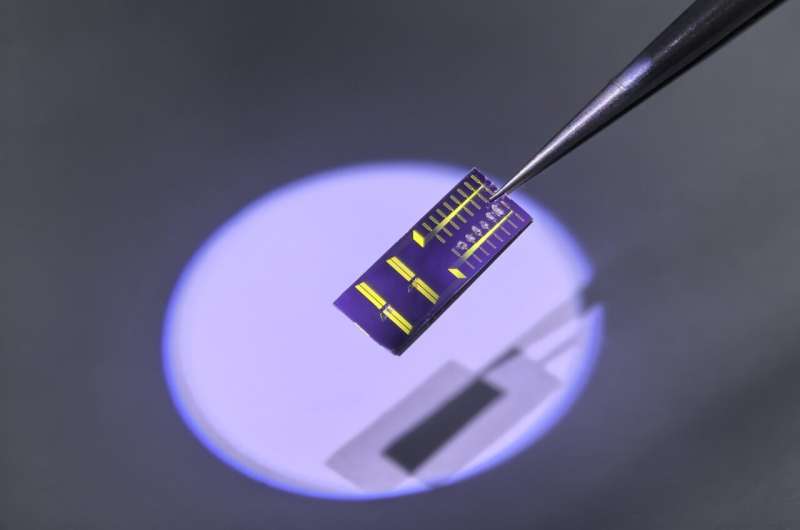
In this case, they twisted the flakes at carefully selected angles relative to each other, and developed a current-pulse technique to create an asymmetry in the Josephson junction. When integrated onto a chip, this setup allowed them to toggle between zero and a discrete finite voltage by irradiating the junction with microwaves, depending on the direction of the applied supercurrent.
“This simple method allows us to realize large diode efficiency at temperatures above a liquid nitrogen temperature of 77 Kelvin, and without the need of a magnetic field,” Zhang describes.
Implications for quantum computing
This improvement could be especially promising for quantum computing. So far, the technology has long been plagued by noisy signal processing—which can destroy the information carried by delicate quantum states. By ensuring the diode’s current is carried entirely by Cooper pairs in both directions, the noise generated by electron scattering within a conventional current could be avoided entirely.
“This is different from the standard superconducting diode effect in which Cooper pairs are responsible only in one direction of current flow,” explains Zhang. “We therefore name this phenomenon the ‘quantum superconducting diode effect.'”
Having achieved the effect in real experiments, the team are now hopeful their result could soon pave the way for more practical demonstrations.
“This technique should be applicable to a wide variety of superconductors,” Zhang continues. “Especially, it could help to realize a superconducting diode effect at even higher temperatures of over 100 Kelvin.”
More information: Heng Wang et al, Quantum superconducting diode effect with perfect efficiency above liquid-nitrogen temperature, Nature Physics (2025). DOI: 10.1038/s41567-025-03098-y. On arXiv: DOI: 10.48550/arxiv.2509.24764
Journal information: Nature Physics , arXiv
Leave a Reply