
December 16, 2025 by Charles Ferrer, University of Colorado at Boulder
Collected at: https://techxplore.com/news/2025-12-real-membrane-imaging-sustainable-filtration.html
CU Boulder researchers have introduced a solution to improving the performance of large-scale desalination plants: stimulated Raman scattering (SRS).
Published in the journal Environmental Science & Technology, the laser-based imaging method allows researchers to observe in real-time membrane fouling, a process where unwanted materials such as salts, minerals and microorganisms accumulate on filtration membranes.
Worldwide, 55% of people experience water scarcity at least one month a year, and that number is expected to climb to 66% by the end of the century.
Desalination—turning saltwater into fresh water—is critical for communities globally as demand increases.
Modern reverse osmosis (RO) plants make up about 80% of the world’s desalination facilities, placing greater importance on having them run efficiently.
“Reverse osmosis membranes are critical for desalination,” said Juliet Gopinath, professor of electrical, computer and energy engineering and physics. “Our work aims to monitor and provide early warning for membrane fouling.”
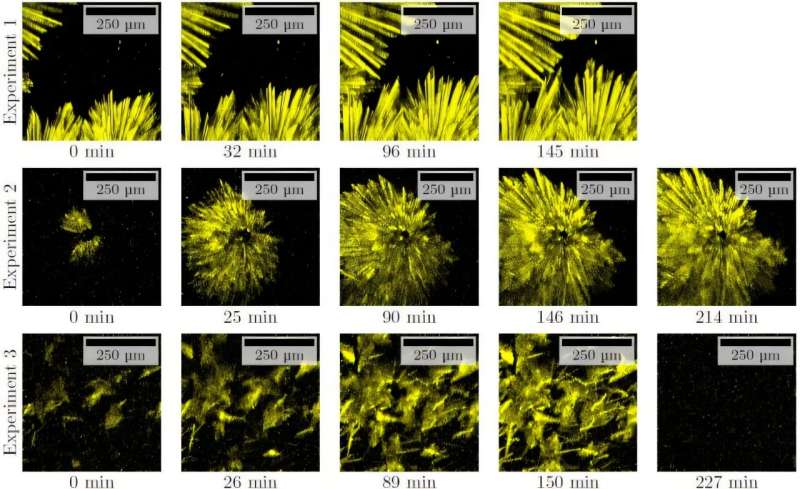
A set of three real-time, in-situ calcium sulfate crystal scaling images. The growth of three unique crystal morphologies over time emphasizes the importance of having both the image along side the chemical identification that stimulated Raman spectroscopy provides. Credit: Lange Simmons and Jasmine Andersen
RO systems rely on thin polymer membranes to filter out buildup. This accumulation reduces filtration efficiency and increases both energy use and operating costs for desalination plants.
Detecting fouling early remains one of the biggest challenges in desalination.
“We can learn a lot about materials and molecules by shining light on them,” said postdoctoral researcher Jasmine Andersen. “Depending on the type of light you use, you’ll get different light coming back, and that tells you what’s inside the material.”
This principle underlies Raman scattering, where the color—or wavelength—of the scattered light shifts in ways that reveal a material’s molecular structure and composition.
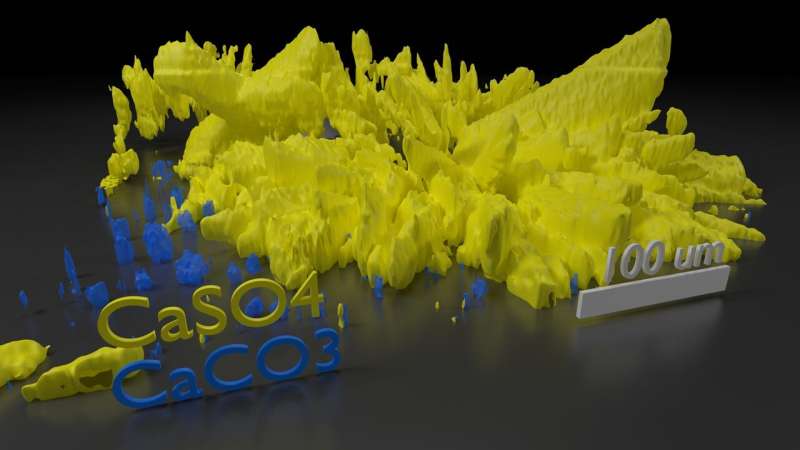
The team used SRS to observe crystal growth on RO membranes, tracking how the molecules vibrated and revealing the chemical makeup of the material.
To test the system, researchers observed calcium sulfate and calcium bicarbonate, ions commonly found in seawater. SRS provided both high-speed imaging and chemical identification.
“Watching these crystals form as it happens, getting volumetric data and identifying the chemical all at once is pretty exciting,” Andersen said. “Previously, you could get volume data or chemical identification, but not at the same time.”
Andersen noted that this level of insight is something industry tools cannot currently provide.
Supporting sustainable water systems
Understanding what forms on a membrane and when can help operators maximize filtration, noted Professor Emeritus Alan Greenberg, an expert in membrane performance and characterization.
“It is well known that RO desalination plants can be more productive and operate at lower cost if fouling is reduced and cleaning is more efficient,” Greenberg said.
Beyond calcium sulfate, the team expects SRS could help study more complex mixtures of organic, inorganic and biological materials that contribute to fouling in both seawater and brackish water systems.
“As our freshwater resources shrink, we’re going to rely more on desalination,” Andersen said. “If we can make that process more efficient and sustainable, we can help ensure people have reliable access to clean water.”
More information: Y. Lange Simmons et al, Stimulated Raman Scattering Microscopy: Real-Time In-Situ Physical and Chemical Characterization of Reverse Osmosis Desalination Membrane Scaling, Environmental Science & Technology (2025). DOI: 10.1021/acs.est.5c10405
Journal information: Environmental Science & Technology
Leave a Reply