
December 13, 2025 by Saint Louis University
Collected at: https://phys.org/news/2025-12-lasing-modes-topological.html
The convergence of non-Hermitian physics and topological photonics has opened exciting research directions in recent years, particularly in the development of robust laser systems.
The guiding principles for building topological lasers are straightforward:
- Design a cavity array that hosts topological modes;
- Implement a pumping scheme that selectively favors the topological edge or surface state; and
- Ensure stable steady-state operation.
Experimental demonstrations in topological insulator photonic arrays and SSH lattices have confirmed the effectiveness of this approach, despite neglecting nonlinear interactions arising from gain saturation. In parallel, theoretical studies that explicitly accounted for these nonlinearities have largely focused on mapping stability and coherence regimes.
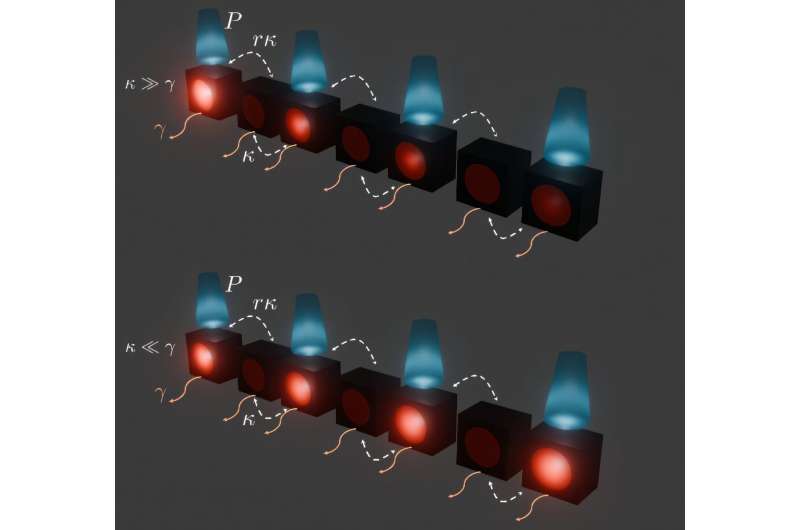
A recent study published in Nature Communications Physics challenges this logic. The authors demonstrated that the lasing zero mode in an SSH array does not always retain the spatial profile of the topological zero mode associated with the underlying passive lattice.
“Our starting point was the intuitive idea that if all couplings between array elements are scaled down to zero (while keeping the ratio between the strong and weak coupling coefficients constant), the pumped sites should emit equal power under equal pump conditions,” said Ramy El-Ganainy, professor of optics and photonics at the department of Electrical and Computer Engineering at Saint Louis University.
“Introducing infinitesimal coupling should not disrupt this uniform intensity distribution. From this perspective, we anticipated a regime in which the lasing zero mode departs from the edge-localized character of the underlying linear mode even for finite, non-zero coupling,” said El-Ganainy.
Unlike earlier works that emphasized stability analysis, this study focuses exclusively on regimes where the zero mode is the only stable lasing solution.
“We show that depending on the balance between inter-site coupling and optical loss, nonlinear gain saturation can drive the zero mode into a delocalized state, distributing its intensity nearly uniformly across the entire array,” said Mohammadmahdi Alizadeh, a doctoral student in El-Ganainy’s group and the paper’s first author.
“Our results provide deeper insight into the interplay between nonlinear dynamics, topological effects, and non-Hermitian physics,” said El-Ganainy. “We also anticipate that these ideas will prove relevant for quantum systems with intrinsic nonlinear—or many-body—losses.”
Other authors include Sahin K. Ozdemir, Ph.D., professor of electrical and computer engineering at Saint Louis University; and Alejandro M. Yacomotti, Center de Nanosciences et de Nanotechnologies, CNRS, Université Paris-Sud, Université Paris-Saclay, Palaiseau, France.
The authors anticipate that these results will be relevant to a wide range of experimental platforms in topological photonics.
More information: Mohammadmahdi Alizadeh et al, Lasing zero modes are not always topological, Communications Physics (2025). DOI: 10.1038/s42005-025-02377-7
Journal information: Communications Physics
Leave a Reply