
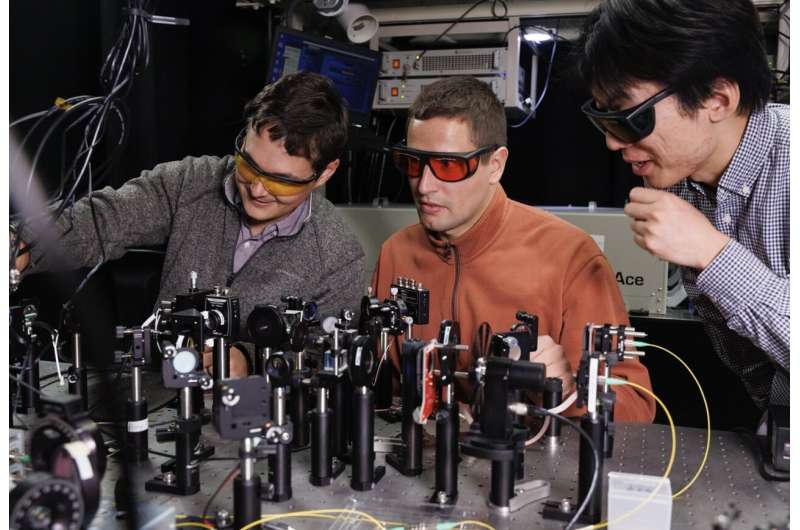
December 11, 2025 by Ingrid Fadelli, Phys.org
Collected at: https://phys.org/news/2025-12-optical-modulation-silicon-electron-avalanche.html
Over the past decades, engineers have introduced numerous technologies that rely on light and its underlying characteristics. These include photonic and quantum systems that could advance imaging, communication and information processing.
A key challenge that has so far limited the performance of these new technologies is that most materials used to fabricate them have a weak optical nonlinearity. This essentially means that they do not strongly change in response to light of different intensities.
A strong optical linearity is of crucial importance for the development of ultrafast optical switches, devices that can control either light or electrical signals by modulating the properties of a light-based signal (e.g. its intensity or path). Notably, these switches are central components of fiber optics-based communication systems, photonic devices and quantum technologies.
In a paper published in Nature Nanotechnology, researchers at Purdue University recently introduced a strategy to control light using only light (i.e., all-optical modulation) in a silicon device leveraging a so-called electron avalanche process. This is a chain reaction in which an energetic electron gains enough energy to free other electrons from atoms, creating a growing cascade (i.e., an avalanche) of energetic electrons.
“For many years, the primary focus of our lab has been the development of ultrafast single-photon sources based on solid-state quantum emitters coupled to plasmonic cavities—systems that could, in principle, generate single photons at terahertz rates,” Demid Sychev, first author of the paper, told Phys.org. “However, in photonic circuits the advantages of such high-speed sources cannot be fully realized without an equally fast single-photon detector, which motivated us to explore this complementary direction.”
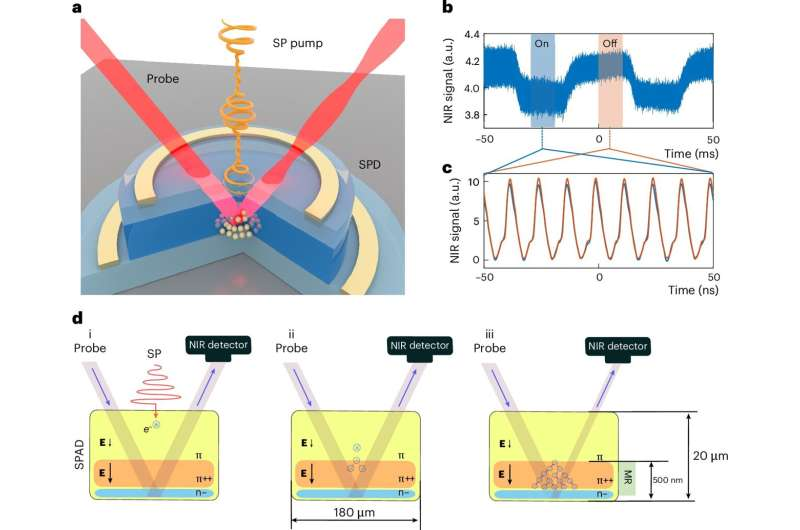
Experimental details. Credit: Nature Nanotechnology (2025). DOI: 10.1038/s41565-025-02056-2
A quest to develop an ultrafast optical modulator
After reviewing previous literature, Sychev and his colleagues realized that while there are well-established methods to detect ultrafast femtosecond pulses at THz frequencies (and even higher rates), these methods have limitations. Specifically, they only work when utilizing high-power beams and are ineffective at the single-photon level.
“This led us to consider whether it might be possible to build an ultrafast modulator capable of switching a macroscopic optical beam in response to just a single photon,” said Sychev. “In such a scheme, a single photon would modulate the macroscopic beam, and the resulting change could be detected using an ultrafast measurement technique. Together, these processes would enable single-photon detection at extremely high rates.”
Upon further consideration, the researchers identified a physical mechanism that could reliably enable all-optical modulation. This is the electron avalanche effect, a physical phenomenon that underpins the functioning of many single-photon detectors. The project, led by Prof. Vladimir M. Shalaev from Purdue University, relates optical modulators to electron transistors.
“The invention of transistors was the most remarkable and impactful discovery of the last century that enabled the current electronic technologies with their numerous applications,” Shalaev explains.
“Photons are superb, unsurpassed units of information—they have zero mass and propagate at the ultimate speed—speed of light. So, if we are able to employ photons for modulation and switching—the function that is currently realized by an electronic transistor—we could process information at higher speeds and thus revolutionize computing, communication, sensing and other related technologies. We believe our work is a step in that important direction.”
Leveraging electron avalanche in silicon
In their experiment, Sychev and his colleagues realized strong optical nonlinearities by shining a beam with a single-photon-level intensity onto silicon. This ultimately resulted in an electron avalanche, with one energized electron prompting other electrons to become free from atoms.
“The process we use is very similar to what occurs in a standard photodiode when measuring the light’s intensity,” explained Sychev. “When light illuminates a semiconductor diode, it generates energetic, so-called free electrons in a conductive energy band of a material that can move freely in it. As a result, the illuminated semiconductor becomes more ‘metallic,’ increasing its electrical conductivity. This change can be detected using external electrical circuitry, which is the basis for photodiode operation.”
The increase in the metal-like behavior of the silicon-based semiconductor they used influences both its electrical and optical properties. As metallic materials are known to reflect light better, illuminating a diode also modifies its reflectivity. Earlier studies showed that this effect could be leveraged to realize all-optical modulation.
“Importantly, the greater the number of free electrons that are generated, the stronger the ‘metallicity,’ meaning the effect scales with the number of absorbed photons,” said Sychev. “However, this approach only works for high-intensity beams and fails completely at the single- photon level. A single photon generates just one electron—far too small a change to measurably affect the device’s optical or electrical response. For this reason, the direct approach is impractical for low-power or quantum applications.”
To overcome the limitations of previously proposed methods and effectively realize all-optical modulation in the single-photon regime, Sychev and his colleagues exploited an electron multiplication process. The avalanche process was prompted by applying high voltage to a diode.
“When a single photon generates one free electron, the strong electric field accelerates it, allowing it to gain even more energy,” said Sychev. “This electron then creates additional energetic electrons, which in turn are accelerated and produce even more electrons, initiating an avalanche process that produces a large population of free electrons from the initial single one.”
The electron avalanche effect leveraged by the researchers was found to rapidly amplify the density of free electrons in silicon, boosting its ‘metallicity’ even if only a single photon was absorbed in it. The team then shone a second beam onto their device and showed that it also experienced the change in reflected intensity triggered by the initial control beam.
“This behavior effectively mimics a photonic transistor, where a single-photon-level signal modulates a macroscopic optical beam,” said Sychev.
Advantages of the new modulation strategy
The optical modulation strategy introduced by the researchers was found to significantly increase the nonlinear refractive index of their silicon device. The material’s reflectivity was found to be significantly higher than that observed in other known materials.
“The principle we outlined is unique in its ability to produce strong interactions between two optical beams, independent of their power or wavelength,” said Sychev. “While many single- photon-level approaches—such as quantum emitters coupled to optical cavities—can mediate interactions between two weak beams, most other methods enable all-optical modulation only at macroscopic power levels. However, there are virtually no approaches in which a single-photon-level beam can reliably control or modulate a high-power, macroscopic beam.”
A further advantage of the team’s approach is that it relies on the intrinsic, local properties of semiconductors. Therefore, it should, in principle, overcome limitations associated with the introduction of external electronic components.
“In future implementations, our principle could enable sub-THz and THz clock rates,” said Sychev. “In addition, our approach works at room temperature, does not require an optical cavity, and is fully compatible with CMOS fabrication.”
Fueling the advancement of photonic and quantum devices
In the future, the electron avalanche-based optical modulation strategy proposed by the researchers could be improved further and used to create new ultrafast optical switches. These switches could in turn be used to scale up photonic circuits and quantum information technologies.
“Taken together, the features of our approach make it ideally suited for building ultrafast, large-scale all-optical photonic circuits,” said Sychev. “Such technologies could find use across a variety of information-processing tasks, including computing and communication. They may also be applicable to other areas that demand strong optical nonlinearities, such as bioimaging, lasing, and related photonic applications.”
The method employed by the researchers does not preserve the coherence between interacting beams. Nonetheless, initial results suggest that it could enable the realization of all-optical quantum circuits operating at extremely high clock rates.
“With appropriate protocols, it may even assist in the implementation of certain photonic quantum gates,” said Sychev. “At this stage, we have demonstrated a proof-of-principle result showing that such modulation is indeed possible. For this initial demonstration, we used a commercial single-photon detector that was not optimized for this purpose in any way. We believe the underlying idea has enormous potential, but realizing a practical single-photon switch will require substantial further development.”
In the future, the researchers hope to build on their proposed strategy to realize a single-photon switch that could be deployed in real devices. To do this, they will first need to carry out further theoretical and experimental studies.
“Fundamentally, we will try to gain a deeper understanding of how the avalanche process evolves in time and space,” added Sychev. “From an engineering perspective, advances will be required in device geometry, diode design, coupling to photonic structures, exploration of different electrical regimes, and evaluation of new materials. We envision that this concept could open an entirely new research direction, ultimately enabling fully optical photonic circuits for both quantum and classical applications.”
More information: Demid V. Sychev et al, All-optical modulation with single photons using an electron avalanche, Nature Nanotechnology (2025). DOI: 10.1038/s41565-025-02056-2.
Journal information: Nature Nanotechnology
Leave a Reply