
December 9, 2025 by The Korea Advanced Institute of Science and Technology (KAIST)
Collected at: https://techxplore.com/news/2025-12-ai-complex-social-group-behavior.html
Professor Kijung Shin’s research team at the Kim Jaechul Graduate School of AI has developed an AI technology that predicts complex social group behavior by analyzing how individual attributes such as age and role influence group relationships.
With this study, the research team won the Best Paper Award at the data mining conference IEEE ICDM 2025, held in Washington D.C. Nov. 12–15. This is the highest honor awarded to only one paper out of 785 submissions worldwide, and marks the first time in 23 years that a Korean university research team has received this award. The paper is available on the arXiv preprint server.
Today, group interactions involving many participants at the same time—such as online communities, research collaborations, and group chats—are rapidly increasing across society. However, there has been a lack of technology that can precisely explain both how such group behavior is structured and how individual characteristics influence it at the same time.
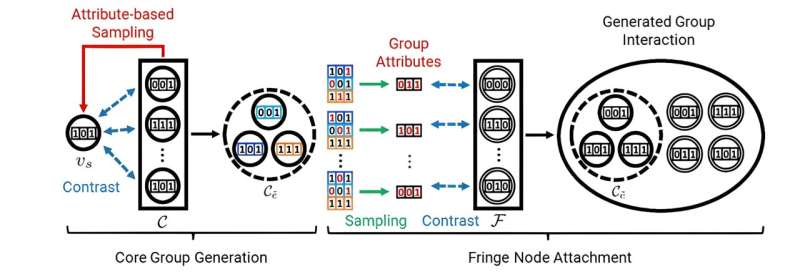
To overcome this limitation, Professor Kijung Shin’s research team developed an AI model called NoAH (Node Attribute-based Hypergraph Generator), which realistically reproduces the interplay between individual attributes and group structure.
NoAH is an artificial intelligence that explains and imitates what kinds of group behaviors emerge when people’s characteristics come together. For example, it can analyze and faithfully reproduce how information such as a person’s interests and roles actually combine to form group behavior.
As such, NoAH is an AI that generates “realistic group behavior” by simultaneously reflecting human traits and relationships. It was shown to reproduce various real-world group behaviors—such as product purchase combinations in e-commerce, the spread of online discussions, and co-authorship networks among researchers—far more realistically than existing models.
Professor Kijung Shin said, “This study opens a new AI paradigm that enables a richer understanding of complex interactions by considering not only the structure of groups but also individual attributes together. Analyses of online communities, messengers, and social networks will become far more precise.”
More information: Jaewan Chun et al, Attributed Hypergraph Generation with Realistic Interplay Between Structure and Attributes, arXiv (2025). DOI: 10.48550/arxiv.2509.21838
Journal information: arXiv
Leave a Reply