
By Rice University December 3, 2025
Collected at: https://scitechdaily.com/quantum-spin-ice-is-real-physicists-confirm-exotic-state-of-matter/
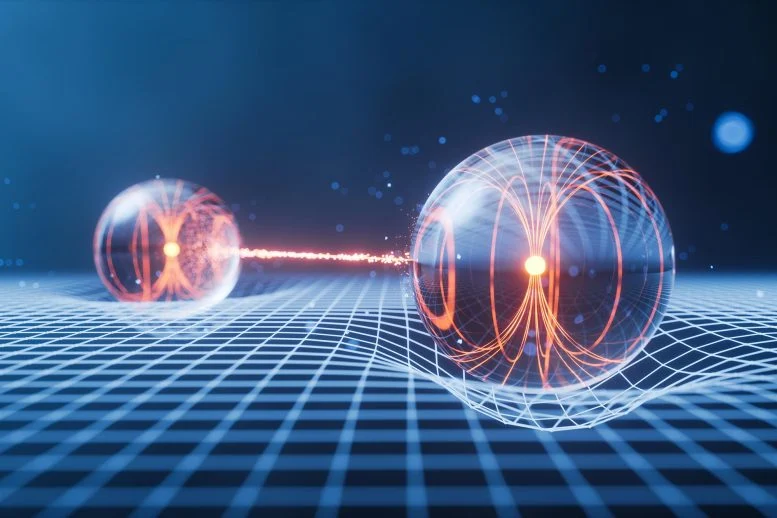
Researchers have uncovered clear evidence of exotic quantum excitations inside a rare 3D spin liquid, validating decades of theory.
An international research group led by Pengcheng Dai of Rice University has now verified the presence of emergent photons and fractionalized spin excitations within a rare quantum spin liquid. Reported in Nature Physics, the study confirms that the crystalline compound cerium zirconium oxide (Ce₂Zr₂O₇) provides a tangible, three-dimensional example of this unusual state of matter.
Quantum spin liquids have fascinated theorists for decades because they could enable transformative technologies such as quantum computing and lossless energy transport. Unlike ordinary magnets, these materials display highly entangled motion among their magnetic moments at temperatures approaching absolute zero, creating conditions where emergent quantum electrodynamics can appear.
“We’ve answered a major open question by directly detecting these excitations,” said Dai, the Sam and Helen Worden Professor of Physics and Astronomy. “This confirms that Ce₂Zr₂O₇ behaves as a true quantum spin ice, a special class of quantum spin liquids in three dimensions.”
Experimental clarity in a noisy field
To reveal these behaviors, the team applied advanced polarized neutron scattering methods that could distinguish magnetic signals from every other kind of scattering, even under near-zero temperature conditions. This approach allowed them to pinpoint the characteristic patterns that mark the presence of a quantum spin liquid.
Meanwhile, the team’s measurements revealed emergent photon signals appearing at nearly zero energy — a hallmark that sets quantum spin ice apart from typical magnetic phases. Additional tests of the compound’s specific heat strengthened this conclusion, indicating that the expected emergent photons spread through the material in a way that resembles how sound waves move through a solid.
Technical noise and incomplete data often hindered earlier efforts to validate such behavior. The Rice-led research team overcame these barriers through refined sample preparation and precision instruments, including international collaboration from major labs in Europe and North America.
A scientific first with a far-reaching impact
Notably, emergent photons and spinons — hallmarks of quantum spin ice — were observed in a 3D candidate material. The researchers’ discovery settles a long-standing debate in condensed matter physics and provides a robust platform for exploring next-generation technologies.
This foundational result validates decades of theoretical predictions, said Bin Gao, a research scientist in the Department of Physics and Astronomy at Rice and the study’s first author.
“This surprising result encourages scientists to look deeper into such unique materials, potentially changing how we understand magnets and the behavior of materials in the extreme quantum regime,” Gao said.
Reference: “Neutron scattering and thermodynamic evidence for emergent photons and fractionalization in a pyrochlore spin ice” by Bin Gao, Félix Desrochers, David W. Tam, Diana M. Kirschbaum, Paul Steffens, Arno Hiess, Duy Ha Nguyen, Yixi Su, Sang-Wook Cheong, Silke Paschen, Yong Baek Kim and Pengcheng Dai, 19 June 2025, Nature Physics.
DOI: 10.1038/s41567-025-02922-9
Co-authors of this study include Félix Desrochers and Yong Baek Kim of the University of Toronto; Rice alumnus David Tam of the Paul Scherrer Institut; Silke Paschen, Diana Kirschbaum and Duy Ha Nguyen of Vienna University of Technology; Paul Steffens and Arno Hiess of the Institut Laue-Langevin; Yixi Su of Jülich Centre of Heinz Maier-Leibnitz Zentrum; and Sang-Wook Cheong of Rutgers University.
The U.S. Department of Energy, the Gordon and Betty Moore Foundation, and the Robert A. Welch Foundation supported this study.
Leave a Reply