
December 5, 2025 by Ingrid Fadelli, Phys.org
Collected at: https://phys.org/news/2025-12-probing-neutron-star-cooling.html
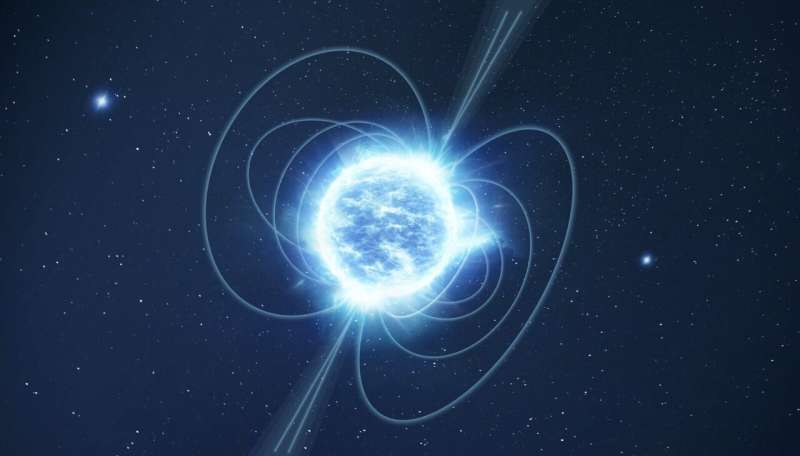
Neutron stars are ultra-dense star remnants made up primarily of nucleons (i.e., protons and neutrons). Over the course of millions of years, these stars progressively cool down, radiating heat into space.
The cooling process of neutron stars could be a promising testbed for various hypothetical particles, including so-called scalar particles. These are particles that do not possess a spin and that, according to some theoretical predictions, could couple to nucleons.
Scalar particles are hypothesized to violate two fundamental laws of gravity, known as the equivalence principle and the inverse-square law. Their observation could thus greatly enrich the present understanding of the universe and its underlying physical forces.
Researchers at Deutsches Elektronen-Synchrotron DESY, the Italian National Institute of Nuclear Physics, the University of Sydney and University of Padua recently carried out a study aimed at exploring the possibility that scalar particles accelerate cooling processes, by comparing theoretical predictions with neutron star simulations. Their paper, published in Physical Review Letters, sets the strictest limits to date on the strength of scalar-nucleon interactions, while also highlighting the potential of neutron star data for probing the existence of a fifth force.
“All the phenomena pertaining to the particles making up ordinary matter (i.e., protons, electrons, and neutrons) are determined by four fundamental forces: the gravitational, electromagnetic, strong nuclear, and weak nuclear forces,” Edoardo Vitagliano, co-author of the paper, told Phys.org.
“The existence of an additional fifth force can signal a paradigm shift in physics, and many experiments have been devoted to the quest for such a fifth force. Deviations from gravitation at the mesoscopic level (between the macroscopic and microscopic worlds) are, however, very challenging to explore.”
Neutron stars as a means to seek new physics
When previous literature and theories pertaining a fifth force, Vitagliano and his colleagues realized that neutron stars could be promising natural laboratories for probing its existence. Known neutron stars, such as the so-called “Magnificent Seven” and the pulsar PSR J0659, could in fact host interactions between scalars and nucleons, which could give rise to such a force.
“Just like the electromagnetic interaction is due to the exchange of photons, the novel force would be mediated by a new scalar particle,” said Vitagliano. “Such a particle is predicted in many extensions of the Standard Model of particle physics, might be associated with the existence of extra-dimensions, and could play the role of dark matter in our universe.”
Scalar particles would be copiously produced in the scattering between neutrons or protons. Notably, these two types of particles are known to be at the core of neutron stars.
“Thanks to their extremely large density, the evolution of neutron stars would be dramatically affected by the existence of new forces,” said Vitagliano. “Neutron stars are like a warm meal that cools down over time, and new particles would cool them down faster.”
To explore this possibility, the researchers ran sophisticated and advanced neutron star simulations. These simulations showed the evolution of neutron stars from their birth up until their current age, showing how hypothetical scalar particles would be produced inside the stars.
“Simulations accounting for the emission of scalar particles mediating a novel fifth force lead to neutron stars which nowadays would be way colder than what our telescopes observe,” explained Alessandro Lella, co-author of the paper. “Therefore, if a fifth force exists it must be weak enough to avoid modifying the observed neutron star evolution.”
Setting record bounds on a fifth force
In their simulations, the researchers found no evidence of an additional loss of energy, suggesting that the neutron stars they examined cooled normally. This allowed them to place new bounds on scalar-nucleon couplings, which could inform future searches for scalar particles and for evidence of a fifth force.
“We reached the striking conclusion that, if a new force acts between particles at a distance smaller than a hair’s thickness, astronomical observations are actually the best probe to find it,” said Vitagliano. “We found that any existing fifth force needs to be way feebler than what was thought before.”
The stringent constraints set by Vitagliano, Lella, and their colleagues Damiano Fiorillo and Ciaran O’Hare could help to refine theories predicting violations of gravity. In the future, the researchers hope to further probe the existence of a fifth force and scalars mediating it using newly gathered astronomical data.
“The physics governing the interiors of neutron stars is still far from fully understood,” added Lella. “It is likely that we have yet to grasp the full range of opportunities that studying these compact objects can offer. Upcoming astronomical observations may hold some surprises. If previously unknown phenomena are discovered in neutron star data, they could open new pathways towards the understanding of the most recondite mysteries of our universe.”
More information: Damiano F. G. Fiorillo et al, Leading Bounds on Micrometer to Picometer Fifth Forces from Neutron Star Cooling, Physical Review Letters (2025). DOI: 10.1103/tlqz-713s
Journal information: Physical Review Letters
Leave a Reply