
December 2, 2025 by Fraunhofer-Gesellschaft
Collected at: https://techxplore.com/news/2025-12-reliable-5g-communication-solution-civil.html
In a disaster, there are often massive network outages. When the Ahr, a small river in Rhineland-Palatinate, burst its banks in July 2021, the entire telephone and mobile network quickly collapsed as the floodwaters and mud destroyed many exchanges. For emergencies like this, researchers at Fraunhofer FIT have developed smart communication solutions for civil protection and disaster relief to address the congestion of public networks.
In the 5G Opportunity project, they joined forces with Friedrich-Alexander-University Erlangen-Nuremberg and Hochschule Bonn-Rhein-Sieg University of Applied Sciences to develop and test a software-based, wireless and ad-hoc-capable communication system for emergency services.
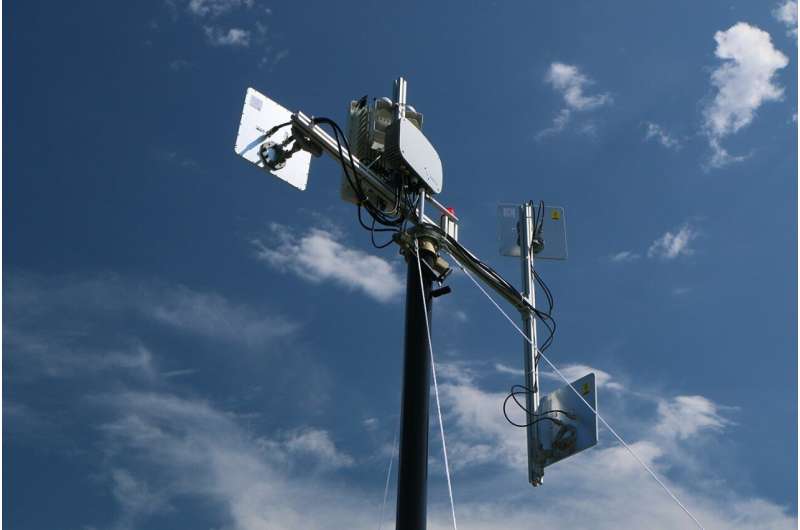
The mobile, self-organizing communication network, based on Fraunhofer WiBACK (wireless backhaul) technology, enables emergency services to connect with each other, the incident command and the internet. The WiBACK communication network uses 5G/Open RAN (radio access network) and WiFi for smartphone access and multi-hop routing for backhaul.
“A WiBACK network can be set up in a very short time and be operated immediately in compliance with regulations,” says Mathias Kretschmer, a research scientist at Fraunhofer FIT in Sankt Augustin who leads the project. “The hardware consists of self-sufficient, portable components. All you need to do is connect the batteries, align the antennas, and the network is ready to go.”
The foundations for WiBACK technology were established ten years ago to connect rural areas with limited or no internet connection to remote network infrastructure. At its core, WiBACK is a self-organizing, self-sufficient multi-hop routing technology.
The cost-effective, wireless backhaul solution comprises small, solar-powered radios equipped with a motherboard, an antenna and a solar-powered charge controller, which connect the emergency vehicles and are characterized by low energy consumption.
The portable radio nodes configure themselves, eliminating the need for IT specialists or network technicians. This makes them ideal for use in disaster-stricken areas, where relief organization staff must quickly establish an alternative communication network in chaotic situations.
Bypassing congested public networks with private 5G cells
“Multi-hop routing is a method for extending the range of radio-relay links. It uses several intermediate nodes (hops) to exchange data between distant points. Once a hop or radio receives a signal, it bundles it and then transmits it to the next node, eliminating the need for a direct line of sight and allowing greater distances to be covered,” Kretschmer explains. “We connect the smartphones through our own small 5G cells and use WiBACK for the vehicles.”
Metal festival as a test environment
The project partners and Malteser Hilfsdienst e. V. successfully tested the innovative communication solution at the Summer Breeze Open Air 2024 metal festival. A 5G campus network was set up to enable network access at the festival site.
The use of this frequency band can be applied in order to operate a private 5G network. These frequencies are currently underused and could be made available to the emergency services in the event of a disaster. The radio and network nodes at the festival were reliably powered with solar panels and batteries, highlighting the potential for energy-self-sufficient communication networks in disaster-stricken areas.
The future of crisis communication
In the meantime, the follow-up project, HiLeit, has already been launched. It is coordinated by Fraunhofer FIT and involves Hochschule Bonn-Rhein-Sieg University of Applied Sciences, Malteser Hilfsdienst e. V. and Deutsche Funktechnik UG (DeFuTech). Plans call for HiLeit to use modular network nodes to enable rapid deployment and adaptation of communication according to the situation at hand.
The researchers want to expand the WiBACK architecture to include a LEO (low Earth orbit) satellite interface for internet connectivity. In HiLeit, the project partners aim to combine several technologies, including public communication networks, fiber optics, LEO/IRIS2 terminals, field cables and WiFi radio-relay systems to create a flexible, highly available network that can be configured according to the location and requirements.
Kretschmer says, “The focus here is on intuitive operation so that emergency services can quickly put the system into operation without in-depth technical knowledge.”
Leave a Reply