
December 2, 2025 by University of Turku
Collected at: https://techxplore.com/news/2025-12-dual-solar-energy-production-cultivation.html
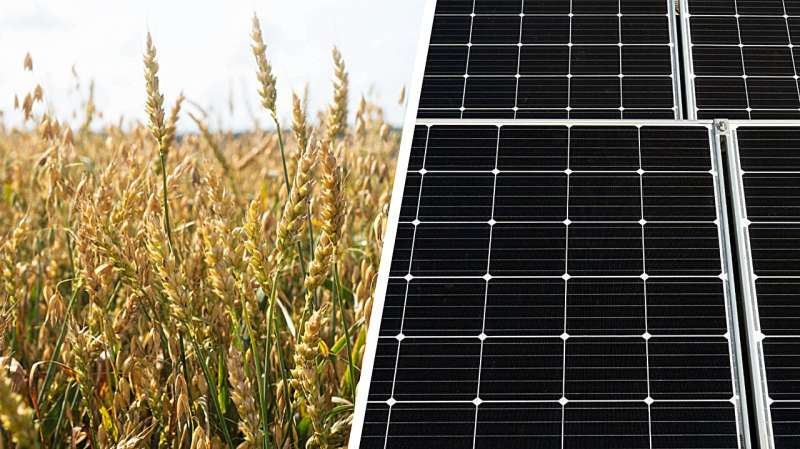
Open farmlands are ideal locations for installing solar panels, but the most common method, which involves covering a large area with south-facing panels, prevents the field from being used for simultaneous farming. The panels can also be installed vertically, allowing crops to be grown in the same field. However, this solution is still rare in Finland.
A joint study by the University of Turku and Turku University of Applied Sciences investigated whether it would be possible to combine solar power production and arable farming in Finland so that it would be economically viable for farmers. While the subject has been studied before in other countries, this was the first study in large-scale agrivoltaic systems in the Nordics.
The message of the study published in Applied Energy is clear: The same field can be used simultaneously for solar energy production and cultivation by utilizing vertically mounted bifacial solar panels. Even if only a small portion of the fields is reserved for solar panels, farmers can economically benefit from solar power with vertical installation.
“With vertical panels, even with only 10% of the land covered, it is possible to get roughly one-third of the amount of energy that a field full of south-facing panels would produce. The advantage of this kind of installation is that it only takes up a small amount of arable land, and the land between the rows of panels can continue to be cultivated as usual,” says Doctoral Researcher Magda Szarek from the University of Turku, who is the lead author of the study.
Self-consumption is key
The researchers investigated how much space must be left between the rows of vertical panels so that the panels do not shadow the crops or each other significantly.
The study recommends leaving at least 8 to 10 meters between the rows of panels, although this depends on the kinds of panel used.
According to previous research by the group, vertical bifacial solar panels work particularly well in northern conditions if the panel surfaces face east and west. In the north, the sun stays low on the horizon for long periods of time during the summer months. The vertical panel surface makes particularly effective use of the sunshine of summer mornings and evenings.
The east–west orientation is also particularly useful because the production of solar power in the mornings and evenings is more in line with electricity consumption patterns. The electricity produced by east and west-facing panels has a higher economic value, as during these times electricity consumption and prices are higher and there is not as much solar power in the energy system at the same time compared to midday.
With this spacing, the modeled 1.6-hectare field installation produced 548 MWh of solar power in a year. This is roughly equivalent to the need of 45 detached houses. The earlier study by the research group indicates that the more you can use the solar energy you have produced yourself, the bigger the financial benefit. Most of the energy produced in a field would therefore have the best value if the farmer used it in their own agricultural processes.
Barley and ley grass increase sun reflection
The study also found that cultivated plants may have an impact on how much solar energy is produced. This is because, in addition to direct sunlight, solar energy production is also affected by how much the terrain around the panels reflects light onto the panels’ surface.
According to the results, barley and ley grass may increase the production of solar energy slightly, but the effect on the total annual production is moderate. Row spacing remains the most important factor influencing the production of solar power.
“It’s good to remember that solar energy can work on the side of tending to livestock as well. In fact, the animals usually enjoy the shade the panels provide,” Szarek says.
Lack of regulation is a challenge
The challenge with vertically mounted bifacial solar panels lies in the fact that they are more sensitive to shading. This means that there must be quite a lot of space left between the panels, which makes integrating them into the urban environment more challenging, at least on a larger scale. In contrast, on an open field there is not only plenty of space but also typically less shading than in cities.
“This is why vertical bifacial panels hold great potential in the context of agriculture specifically. However, the successful combination of solar energy and cultivation requires that the solution is recognized within the framework of agricultural subsidies and environmental legislation. For example, it is currently unclear how much of the farmland can be used to produce solar power without it affecting agricultural subsidies. Clear legislation is needed for this to succeed in Finland,” Szarek says.
More information: Magda Szarek et al, Performance evaluation of high latitude agrivoltaic systems with vertically mounted bifacial panels, Applied Energy (2026). DOI: 10.1016/j.apenergy.2025.127022
Leave a Reply