
December 1, 2025 by Paul Arnold, Phys.org
Collected at: https://phys.org/news/2025-12-digital-state-stable-quantum.html
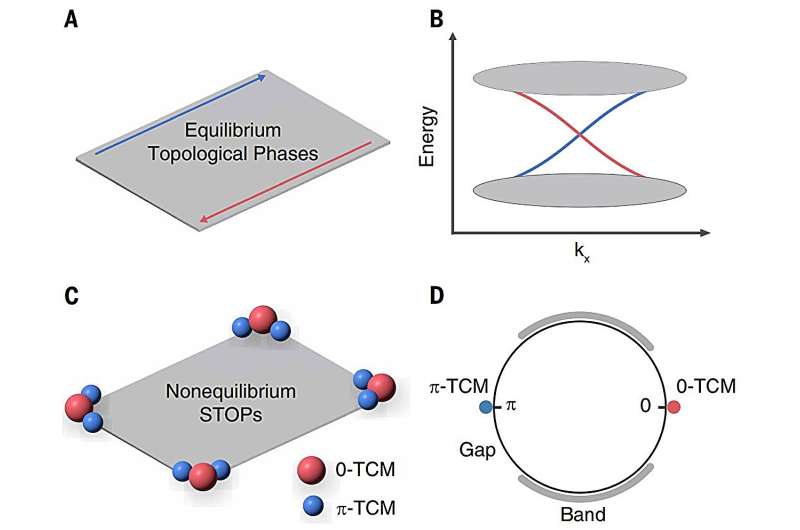
Scientists have taken another major step toward creating stable quantum computers. Using a specialized quantum computer chip (an essential component of a quantum computer) as a kind of tiny laboratory, a team led by Pan Jianwei at the University of Science and Technology of China has created and studied a rare and complex type of matter called higher-order nonequilibrium topological phases.
This digital matter (not conventional physical material) is unique because its key behaviors are super-stable and located only at its corners. But this stability is only maintained when the material is constantly bombarded with energy pulses.
The work is a big deal because it shows that quantum computers can be used as reliable simulators to discover and test new stable forms of matter. This will be necessary if scientists are to create quantum computers that never break down (or are at least highly reliable), because super-stable corner behaviors are the kind of error-proof properties needed to build trustworthy quantum hardware.
Exotic material
In a paper published in the journal Science, the researchers describe using the Zuchongzhi 2.0 superconducting quantum processor (a Chinese quantum computer) to construct an exotic nonequilibrium topological material and test its protective properties.
The term topological means that a material’s stability is guaranteed by its overall structure, not by fragile local details. While scientists have previously studied materials whose stable features lie along the edges, the Chinese team aimed for a higher-order phase in which stability is confined to the corners.
This makes those quantum states even more resistant to disturbance. And instead of studying matter at rest (a steady state), the team focused on nonequilibrium versions of corner states that were constantly evolving or being driven by external forces.
Programming a quantum chip
To bring this exotic material to life, the scientist programmed a quantum chip using a grid of quantum bits (qubits) to simulate the material’s structure. Then they ran a complex set of instructions more than 50 times to create the energy pulse (external force) needed for the exotic state.
Since traditional tools cannot measure quantum matter that’s constantly moving, the scientists developed a new technique that tracks how the qubit’s properties change over time. By analyzing this changing data, they could prove the material was stable and create a map showing exactly where the super-stable corners were located. This confirmed the existence of the predicted stable corner modes, and the exotic corner states that only appear when the material is pulsing.
This successful project is only the start. The researchers believe their demonstration of quantum computers as simulators could enable new quantum discoveries. “Our work may enable the use of programmable quantum processors to explore exotic higher-order nonequilibrium topological phases of matter.”
More information: Haoran Qian et al, Programmable higher-order nonequilibrium topological phases on a superconducting quantum processor, Science (2025). DOI: 10.1126/science.adp6802
Journal information: Science
Leave a Reply