
November 27, 2025 by Ingrid Fadelli, Phys.org
Collected at: https://phys.org/news/2025-11-entanglement-optical-lattice-clock-unprecedented.html
Optical lattice clocks are devices that measure the passing of time via the frequency of light that is absorbed or emitted by laser-cooled atoms trapped in a repeating pattern of light interference known as optical lattice.
These clocks are significantly more precise than classical clocks and could pick up subtle physical phenomena. They could also be used to test the predictions of various physics theories and could help to improve the performance of existing timekeeping, sensing and communication systems.
Researchers at JILA National Institute of Standards and Technology and University of Colorado recently introduced a new strontium atom-based optical lattice clock that achieved unprecedented precision.
This clock, presented in a paper published in Physical Review Letters, leverages entanglement, a quantum phenomenon via which two or more particles become linked and share states with each other, irrespective of the distance between them.
“Over the past decade, optical lattice clocks have reached extraordinary precision, but their performance is fundamentally limited by the so-called standard quantum limit, which comes from the quantum ‘fuzziness’ associated with the quantum measurement process,” Dr. Yang Yang, co-first author of the paper, told Phys.org.
“The use of many uncorrelated atoms helps reduce this noise. In parallel, there has been rapid progress in creating and employing entangled states, not only for quantum information processing, but also for enhanced sensing and metrology. For example, LIGO improves its sensitivity by using squeezed states of light.”
Leveraging entanglement to advance optical lattice clocks
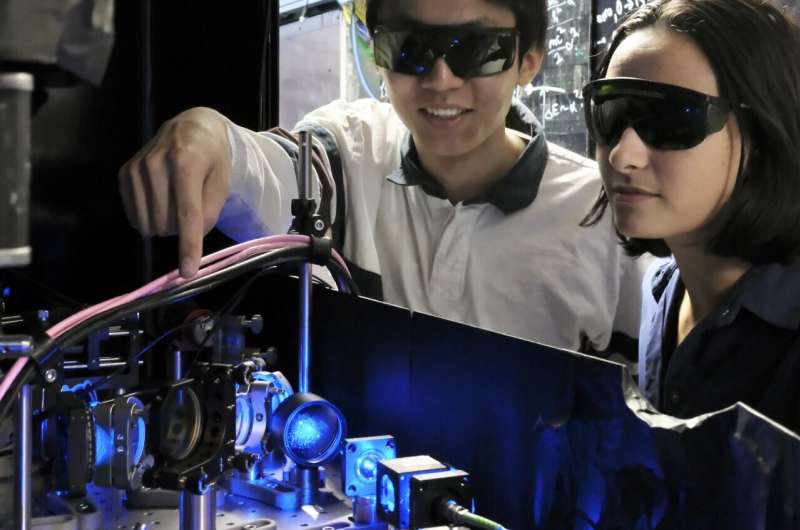
Building on earlier research in the field, Dr. Yang and his colleagues set out to explore the possibility that entanglement could be used to boost the precision of optical lattice clocks. To do this, they developed an optical lattice clock based on entangled strontium atoms and compared its performance to that of conventional optical clocks.The optical cavity for generating squeezed states of atoms. Credit: Carl Sauer.
The new clock consists of approximately 30,000 strontium atoms trapped in a 2D laser light grid (i.e., an optical lattice). The novelty is that they then spin-squeezed two groups of atoms in the lattice, or in other words, entangled them in a way that boosted the clock’s precision.
“Optical atomic clocks measure the frequency of an ultrastable laser using long-lived atomic transitions,” explained Maya Miklos, co-first author of the paper.
“With more precise measurements of the fraction of atoms excited by the laser, the clock stability improves. For samples of independent atoms, each atom is ‘projected’ into a definite state upon measurement—this randomness sets the noise floor, or the standard quantum limit (SQL) of clock performance.”
To realize entanglement in their clock, Dr. Yang, Miklos and their colleagues coupled the trapped strontium atoms to a common optical mode (i.e., light pattern). The generation of entanglement allows noise (i.e., unwanted random fluctuations that reduce the clock’s precision) to be “squeezed,” which in turn leads to more accurate measurements.
Enabling state-of-the-art precision
The researchers compared the measurements taken by their clock to those of a strontium-based optical clock in which atoms are not entangled. They found that their design led to significant improvements, with their clock achieving a remarkable fractional frequency precision of 1.1 × 10⁻¹⁸.
“We demonstrate that the clock performance not only surpasses the standard quantum limit, but also reaches a genuinely state-of-the-art precision level,” said Dr. Yang. “Our results provide a concrete blueprint for turning fragile many-body entanglement into a practical tool for metrology and precision measurement.”
The team’s new optical clock design could soon inspire the development of other entanglement-enhanced optical clocks. Meanwhile, Dr. Yang, Miklos and their colleagues are working on further improving their clock, to facilitate its future deployment in research settings or its integration with existing technologies.
“In this work, we demonstrated that we can resolve the frequency difference between two clocks with a fractional frequency precision at 1.6 x 10⁻¹⁸,” said Dr. Yang. “In the future work, we will carefully evaluate systematic errors and uncertainties to ensure our entanglement-enhanced optical lattice clock ticks at the same rate as a classical one, while still enjoying the quantum gain in stability.”
As part of their next studies, the researchers also plan to start using their optical clock to conduct studies rooted in fundamental physics. For example, by entangling two of their clocks at different heights, they could probe the effects of gravity and time dilation on quantum systems.
“In the long term, we envision quantum networks of optical lattice clocks that could open up new possibilities in geophysics, astronomy, and tests of fundamental physics,” added Dr. Yang.
More information: Y. A. Yang et al, Clock Precision beyond the Standard Quantum Limit at 10−18 Level, Physical Review Letters (2025). DOI: 10.1103/6v93-whwq. On arXiv: DOI: 10.48550/arxiv.2505.04538
Journal information: Physical Review Letters , arXiv
Leave a Reply