
November 26, 2025 by Heriot-Watt University
Collected at: https://phys.org/news/2025-11-bought-cable-power-quantum-networks.html
For decades, physicists have dreamed of a quantum internet: a planetary web of ultrasecure communications and super-powered computation built not from electrical signals, but from the ghostly connections between particles of light.
Now, scientists in Edinburgh say they’ve taken a major step toward turning that vision into something real.
Researchers at Heriot-Watt University have unveiled a prototype quantum network that links two smaller networks into one reconfigurable, eight-user system capable of routing and even teleporting entanglement on demand.
The demonstration, reported this week in Nature Photonics, sets a new benchmark for how large, flexible and capable quantum networks can become.
Professor Mehul Malik from Heriot-Watt’s School of Engineering and Physical Sciences said, “Other teams had already demonstrated that you can build a single quantum network and send entanglement to many users at once.
“But this is the first time anyone has managed to link two separate networks together. It doesn’t just distribute entanglement in different ways, it actually lets one network talk to the other.
“This is a major milestone on the road to a real-world quantum internet.”
Using light’s chaos as a resource
At the heart of the Heriot-Watt prototype, instead of a gleaming quantum chip or custom-engineered device, is a shop-bought optical fiber that costs less than £100.
The team harnessed the scattering behavior of light inside an optical fiber to program their reconfigurable entanglement router.
Dr. Natalia Herrera Valencia, lead author of the study, said, “Light tends to ricochet chaotically through the fibers’ hundreds of internal pathways. We turned that chaos into a resource.”
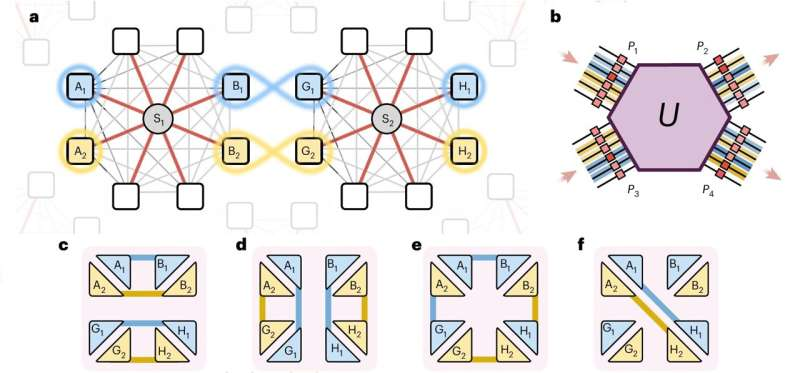
A global, multiplexed quantum network architecture. Credit: Nature Photonics (2025). DOI: 10.1038/s41566-025-01806-x
The result is a reconfigurable multi-port device that can distribute quantum entanglement between users in multiple patterns, switching between local connections, global connections and mixed configurations at will.
Crucially, the system can multiplex these channels, meaning it can serve many users simultaneously, rather than one pair at a time. Multiplexing is what allows classical telecoms networks to send vast amounts of data down a single fiber using different wavelengths; here, a similar concept is deployed in the quantum regime.
Most strikingly, the team achieved multiplexed entanglement teleportation, swapping entanglement between four distant users across two channels at once. Previous demonstrations have teleported entanglement, but not across so many simultaneous users in such a flexible architecture.
Dr. Herrera Valencia said, “By shaping the light at the input, we effectively programmed the fiber, transforming its messy internal scattering into a powerful, high-dimensional optical circuit.”
“That lets us route quantum entanglement wherever we want, even teleport it, using this deceptively simple piece of fiber.”
A leap for quantum computing
Professor Malik says the demonstration has exciting implications for quantum computing. “It’s really exciting. Quantum computing could be world-changing, transforming how we find and develop medicines, create new materials for batteries and supercharge machine learning.
“A promising current approach to building a large-scale, powerful quantum computer is to interconnect lots of smaller quantum processors.
“Our prototype is a network that can flexibly distribute and swap entanglement among many users, or quantum processors—it could be the breakthrough quantum computing has been waiting for. Yes, this is a lab-scale demonstration, but the principle is extendable.”
More information: Natalia Herrera Valencia et al, A large-scale reconfigurable multiplexed quantum photonic network, Nature Photonics (2025). DOI: 10.1038/s41566-025-01806-x
Journal information: Nature Photonics
Leave a Reply