
November 25, 2025 by Paul Arnold, Phys.org
Collected at: https://techxplore.com/news/2025-11-world-efficient-solar-cell-chinese.html
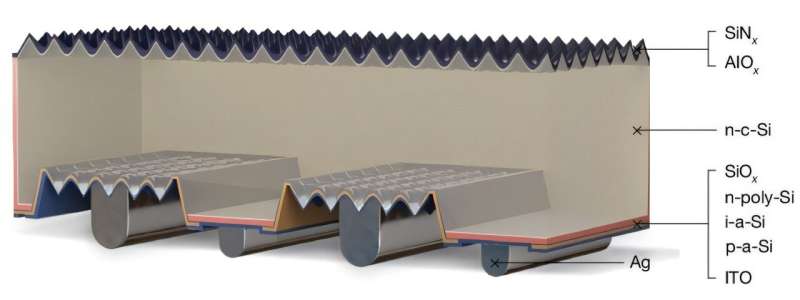
Earlier in 2025, Chinese solar manufacturer Longi announced it had built the world’s most efficient solar cell. The hybrid interdigitated back-contact (HIBC) cell achieved 27.81% efficiency, which was verified by Germany’s Institute for Solar Energy Research Hamelin (ISFH).
Now, in a paper published in the journal Nature, researchers are sharing the technical details of their breakthrough.
For solar technology to deliver on its promise, solar cells and panels must convert as much sunlight as possible into energy. Typically, standard cells achieve up to 26% efficiency, that is, they convert 26% of the sunlight hitting them into electrical energy.
This new research brings the technology closer to what physics will allow. For a single-junction silicon cell, the upper limit is a little under 30%, while the theoretical ceiling, known as the Shockley-Queisser limit, is 33.7%.
Key challenge
The researchers were able to overcome one of the biggest obstacles in improving solar cell efficiency, known as the fill factor (FF). This is the performance score of a solar cell, which measures how much of the power it could theoretically generate is converted into usable electricity.
A high FF means electricity is flowing smoothly and efficiently, while a low FF means it is losing power internally. This is primarily because the electricity-carrying particles are encountering too much resistance in the wiring or crashing into each other (a process called recombination).
Solar cell innovations
The solution to low FF developed by the researchers was a hybrid cell made with two principal innovations. The first was a new design for the back contacts, the electrical terminals that collect current from the cell. The team used a laser to crystallize the contact material, which had the effect of creating fast, conductive pathways for the electricity, reducing resistance and improving the fill factor.
The second innovation was using an advanced surface treatment and a new technology called iPET (in situ passivated edge technology), which made the cell more stable and efficient by suppressing recombination. This included at the edges where electricity is easily lost.
The new cell was independently tested and certified by Germany’s ISFH under strict lab-controlled conditions. The result was an energy efficiency of 27.81% and a fill factor of 87.55%.
“These innovations provide both experimental and theoretical advances toward scalable, high-efficiency silicon photovoltaics,” commented the researchers in their paper.
The next steps for the Longi scientists are to improve the cell’s electrical contacts to reduce resistance further and to optimize the laser process so the technique is scalable for mass production.
More information: Genshun Wang et al, Silicon solar cells with hybrid back contacts, Nature (2025). DOI: 10.1038/s41586-025-09681-w
Journal information: Nature
Leave a Reply