
November 23, 2025 by Chinese Academy of Sciences
Collected at: https://phys.org/news/2025-11-substitution-method-enables-high-precision.html
A joint research team has made important progress in the field of photoneutron cross section measurement. The team proposed a substitution measurement method that avoids the use of expensive and hard-to-prepare high-purity isotope targets, successfully measuring the 65Cu(γ,n)64Cu reaction cross section with high precision. This method only relies on natural copper (natCu) and previously measured copper-63 (63Cu) data, without modifying experimental facility parameters, making it simple, efficient, and low-cost.
The related research results have been published in the journal Nuclear Science and Techniques. The team includes researchers from Henan Normal University, Shanghai Advanced Research Institute of the Chinese Academy of Sciences, Shanghai Institute of Applied Physics of the Chinese Academy of Sciences, and other institutions.
Substitution measurement breaks through isotope target constraints
The 65Cu(γ, n)64Cu reaction is of great significance for both medical applications and nuclear physics research. 64Cu, as a short-lived radionuclide with both β+ and β– emission properties, is widely used in positron emission tomography (PET), single-photon emission computed tomography (SPECT), and radionuclide therapy for tumors, playing an irreplaceable role in clinical diagnosis and treatment. In nuclear physics, this reaction also provides key data for studying nuclear structure, nuclear reaction mechanisms, and stellar nucleosynthesis.
However, traditional measurements of 65Cu(γ, n)64Cu cross sections rely on high-purity 65Cu isotope targets, which are costly to prepare and difficult to obtain, limiting the advancement of related research. Additionally, existing experimental data using bremsstrahlung and positron annihilation in-flight sources show significant discrepancies, especially in the high-energy region, due to systematic errors such as neutron channel misclassification.
The quasi-monoenergetic γ beams generated by laser Compton scattering at SLEGS offer the advantage of high energy resolution, providing an ideal platform to resolve data discrepancies and improve measurement precision.
Sophisticated experimental design and data processing
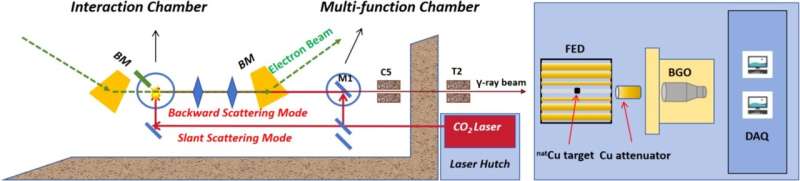
The experiment was conducted at the SLEGS beamline of SSRF, which adopts inverse Compton scattering technology. 3.5 GeV electrons in the storage ring collide with 10.64 μm wavelength CO2 laser photons to generate quasi-monoenergetic γ beams with adjustable energies ranging from 0.66 to 21.7 MeV, and an energy adjustment step as small as 10 keV. The team used a ³He flat-efficiency detector (FED) array consisting of 26 proportional counters to measure neutrons, with a detector efficiency calibrated to 42.10 ± 1.25% using a 252Cf source, ensuring the accuracy of neutron count statistics.
The natCu target used in the experiment had a mass of 3.15 g, a chemical purity exceeding 99.99%, and an isotopic abundance of 69.15% for 63Cu and 30.85% for 65Cu. The team measured natCu(γ, n) cross sections at 44 energy points in the 11.09–17.87 MeV range, with different measurement times set according to different scattering angles to ensure sufficient neutron statistics.
In data processing, the direct unfolding method combined with a Geant4-simulated detector-response matrix was used to reconstruct the incident γ spectrum, and the folding iteration method was employed to solve the unfolding problem, achieving accurate extraction of quasi-monoenergetic and monochromatic cross sections.
The core of the substitution measurement method lies in leveraging the known isotopic abundance of natCu and the previously measured 63Cu(γ,n) cross sections. Within the overlapping energy range of the one-neutron separation thresholds of 63Cu and 65Cu, the neutrons measured by the detector from natCu targets include contributions from both 63Cu(γ, n) and 65Cu(γ, n) reactions.
By subtracting the calculated 63Cu contribution from the total measured neutron count, the team obtained the 65Cu(γ,n)64Cu cross section. The total uncertainty of the measurement results is controlled within a reasonable range, including statistical uncertainty, systematic uncertainty (such as detector efficiency, target thickness), and methodological uncertainty (such as data extraction algorithm, unfolding method).
Significant measurement results and scientific value
The 65Cu(γ, n)64Cu monochromatic cross section data measured in this study show good consistency with the overall trend of existing data, while resolving previous discrepancies.
Among them, the results are closest to those measured by Fultz and team using positron annihilation in-flight sources, and there are significant differences from the data measured by Katz and team and Antonov and collaborators using bremsstrahlung sources, which is attributed to systematic errors in traditional light sources. The integral cross section ratio analysis further confirms the reliability of the measured data: in the energy range from the one-neutron separation threshold (Sn) to 15 MeV, the difference between the results and Fultz’s data is only 0.8%, and the difference from TENDL-2021 theoretical calculations is less than 0.4%.
The study also found that the isotopic abundance of 65Cu in natural copper has a significant impact on the cross section. As the abundance of 65Cu increases, the photoneutron cross section decreases, and this trend is most obvious near the threshold and peak positions of the cross section distribution. This suggests that in substitution measurement, it is necessary to accurately determine the isotopic abundance of the target material, and also provides a new idea: using enriched isotope targets as supplements to further improve measurement precision.
Furthermore, based on the measured 65Cu(γ, n)64Cu cross section data, the team extracted the γ strength function (γSF) of 65Cu using the principle of detailed balance. By comparing and optimizing the γSF model in the TALYS 2.0 toolkit, the team further calculated the 64Cu(n, γ)65Cu radiative neutron capture cross section. This not only verifies the reliability of the substitution measurement method through inverse reaction data but also provides a new approach for measuring the (n,γ) cross section of unstable nuclides that are difficult to directly measure.
Broad application prospects
The substitution measurement method proposed in this study has broad application potential in the field of nuclear data measurement. For nuclides that are expensive to prepare, have low natural abundance, or are unstable, this method can avoid the dependence on high-purity isotope targets, significantly reducing experimental costs and technical thresholds.
In the field of nuclear energy, it can provide accurate cross section data for nuclear reaction model optimization and reactor design; in the field of nuclear waste treatment, it can support research on nuclear waste transmutation efficiency; in the field of neutron activation analysis, it can help improve the sensitivity and selectivity of element analysis.
Particularly in the field of medical isotopes, the accurate measurement of 65Cu(γ,n)64Cu cross sections can optimize the production process of 64Cu, reduce production costs, and promote the widespread application of 64Cu-labeled radiopharmaceuticals in clinical practice, bringing new opportunities for the diagnosis and treatment of tumors and other diseases.
Future directions
The research team plans to further expand the application scope of the substitution measurement method, applying it to the photoneutron cross section measurement of more nuclides with important application value. At the same time, the team will continue to optimize the experimental method, improve the accuracy of isotopic abundance correction and data unfolding, and reduce systematic errors.
In addition, the team will carry out in-depth research on the relationship between the γ strength function and nuclear structure, providing more reliable data support for improving nuclear level density models and perfecting nuclear reaction theories.
More information: Pu Jiao et al, A substitution measurement for cross section of 65Cu(γ,n)64Cu reaction using natCu and 63Cu targets by quasi-monoenergetic γ at SLEGS, Nuclear Science and Techniques (2025). DOI: 10.1007/s41365-025-01829-7
Leave a Reply