
By Institute of High Energy Physics November 22, 2025
Collected at: https://scitechdaily.com/astronomers-solve-70-year-old-cosmic-ray-mystery/
Chinese researchers have identified black holes as the likely source of the high-energy component of the cosmic-ray “knee.”
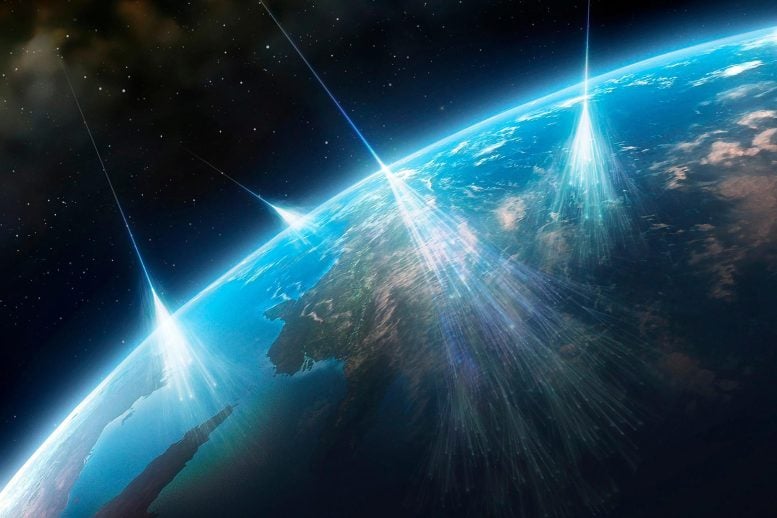
Milestone findings released on November 16 by the Large High Altitude Air Shower Observatory (LHAASO) have provided a major breakthrough in explaining a long-standing puzzle in cosmic ray research. Scientists have spent decades trying to understand why the cosmic ray energy spectrum shows a sudden drop in particle numbers above 3 PeV, a feature commonly referred to as the “knee.”
The reason behind this “knee” has remained unresolved since it was first identified nearly 70 years ago. For many years, researchers have suggested that it might be tied to the maximum energies achievable by astrophysical sources that produce cosmic rays, possibly marking a shift from one power-law pattern in the spectrum to another.
Today, new evidence is pointing to a clearer explanation. Two studies, published in National Science Review and Science Bulletin, show that micro-quasars powered by black hole system accretion act as highly efficient particle accelerators within the Milky Way. These systems now appear to be the most likely contributors to the “knee,” and the findings also shed new light on the extreme physical activity associated with black holes.
Scientists from the Institute of High Energy Physics of the Chinese Academy of Sciences (CAS), Nanjing University, the University of Science and Technology of China of CAS, La Sapienza University of Rome, and several partner institutions participated in the research effort.
First Systematic Detection of Ultra-High-Energy Gamma Rays
Black holes are among the most mysterious objects in the cosmos. When they draw in material from companion stars in binary systems, they produce fast-moving jets that create what are known as “micro-quasars.” In the new study, LHAASO reported the first systematic detection of ultra-high-energy gamma rays from five such micro-quasars: SS 433, V4641 Sgr, GRS 1915+105, MAXI J1820+070, and Cygnus X-1.
In particular, the ultra-high-energy radiation from SS 433 was found to overlap with a giant atomic cloud, strongly suggesting that the high-energy protons are accelerated by the black hole and collide with surrounding matter. The proton energy in this system exceeded 1 PeV, with a total power output of approximately 1032 joules per second, equivalent to the energy released per second by four trillion of the most powerful hydrogen bombs.

The gamma-ray energy from V4641 Sgr was found to reach 0.8 PeV, making it another “super PeV particle accelerator,” while the parent particles generating these gamma rays had energies exceeding 10 PeV.
These results prove that micro-quasars are significant PeV particle accelerators in the Milky Way, addressing a long-standing issue in science: While supernova remnants were historically recognized as cosmic ray sources, both observational and theoretical studies have shown that they cannot accelerate cosmic rays to the energies of the “knee” and beyond.
A Breakthrough in Measuring Proton Spectra
To fully understand this phenomenon, precise measurements of the energy spectra of the various cosmic ray species including their respective “knees” are essential. The first step is to measure the energy spectrum of the lightest nuclei—protons. However, cosmic rays in the “knee” region are sparse and satellite detectors have limited acceptance, making detection akin to finding a needle in a haystack. In ground-based indirect measurements of cosmic ray particles, it is impossible to avoid atmospheric interference. This makes it difficult to distinguish protons from other nuclei. For a long time, this measurement was considered impossible.
In this study, leveraging its world-leading ground-based cosmic ray observational equipment, LHAASO developed multi-parameter measurement techniques and selected a large statistical sample of high-purity protons, allowing for precise measurement of their energy spectrum, with precision comparable to that of satellite experiments. This measurement revealed an energy spectrum structure that was entirely unexpected, clearly displaying a new “high-energy component” instead of a simple transition between power-law spectra.
LHAASO’s new findings, together with the low-energy component measured by the space-borne AMS-02 experiment and the intermediate-energy component measured by the space-borne DArk Matter Particle Explorer (DAMPE) experiment, revealed the existence of multiple accelerators within the Milky Way, with each possessing its own unique acceleration capability and energy range. The “knee” represents the acceleration limit of the sources responsible for generating the high-energy component.
A Unified Scientific Picture Emerges
The complex structure of the proton energy spectrum indicates that cosmic ray protons in the PeV energy range primarily originate from “new sources” such as micro-quasars, which have an acceleration limit significantly higher than that of supernova remnants. This enables them to generate high-energy cosmic rays that exceed the “knee.”
These two discoveries support each other, presenting a comprehensive scientific picture. This not only marks a significant advancement in resolving the long-standing mystery of the “knee” origin, but also offers crucial observational evidence for understanding the role of black holes in the origin of cosmic rays.
LHAASO’s hybrid detector array design allows for the detection of cosmic ray sources through ultra-high-energy gamma rays, while enabling precise measurement of cosmic ray particles in the vicinity of the solar system. This approach offers insights into the acceleration capabilities of sources at PeV energies and the spectral characteristics they contribute to cosmic rays. For the first time, the “knee” structure has been observationally connected to a specific type of astrophysical source—the black hole jet system.
LHAASO, which was designed, constructed, and is operated by Chinese scientists, has taken the lead in high-energy cosmic-ray research due to its sensitivity in both gamma-ray astronomical exploration and cosmic ray precision measurement. It has achieved a series of discoveries that have a global impact, thereby contributing to our knowledge of the extreme physical processes in the universe.
References: “Precise measurements of the cosmic ray proton energy spectrum in the “knee” region” by the LHAASO Collaboration, 12 November 2025, Science Bulletin.
DOI: 10.1016/j.scib.2025.10.048
Leave a Reply