
November 19, 2025 by Hebrew University of Jerusalem
Collected at: https://phys.org/news/2025-11-magnetic-component-faraday-effect-centuries.html
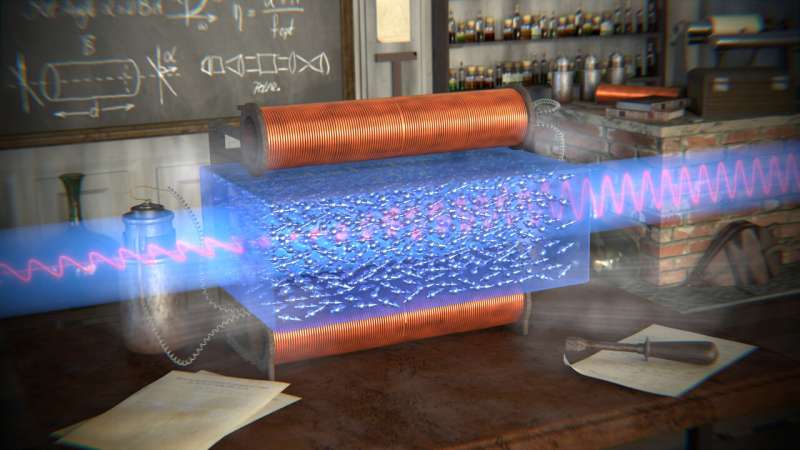
Researchers at the Hebrew University of Jerusalem discovered that the magnetic component of light plays a direct role in the Faraday effect, overturning a 180-year-old assumption that only its electric field mattered.
Their findings, published in Scientific Reports, show that light can magnetically influence matter, not just illuminate it. The discovery opens new possibilities in optics, spintronics, and quantum technologies.
The study was led by Dr. Amir Capua and Benjamin Assouline from the Institute of Electrical Engineering and Applied Physics at the Hebrew University of Jerusalem. It presents the first theoretical proof that the oscillating magnetic field of light directly contributes to the Faraday effect, a phenomenon in which the polarization of light rotates as it passes through a material exposed to a constant magnetic field.
“In simple terms, it’s an interaction between light and magnetism,” explains Dr. Capua. “The static magnetic field ‘twists’ the light, and the light, in turn, reveals the magnetic properties of the material. What we’ve found is that the magnetic part of light has a first-order effect, it’s surprisingly active in this process.”
Since its discovery in 1845 by the British scientist Michael Faraday, the effect has been attributed to the interaction between the electric field of light and the electric charges in matter. However, the new research demonstrates that the magnetic field of light, long thought irrelevant, makes a direct and measurable contribution to this effect whereby it interacts with the spins.
Using advanced calculations based on the Landau–Lifshitz–Gilbert (LLG) equation, which describes the motion of spins in magnetic systems, the researchers showed that the magnetic field of light can generate a magnetic torque inside the material, just like a static magnetic field.
“In other words,” says Capua, “light doesn’t just illuminate matter, it magnetically influences it.”
To quantify this influence, the team applied their model to Terbium Gallium Garnet (TGG), a crystal widely used to measure the Faraday effect. They found that the magnetic field of light accounts for about 17% of the observed rotation at visible wavelengths and up to 70% in the infrared range.
“Our results show that light ‘talks’ to matter not only through its electric field, but also through its magnetic field, a component that has been largely overlooked until now,” says Assouline.
The discovery opens the door to new possibilities in optics and magnetism, including applications in spintronics, optical data storage, and light-based magnetic control. It may even contribute to future spin-based quantum computing technologies.
More information: Faraday Effects Emerging from the Optical Magnetic Field, Scientific Reports (2025). DOI: 10.1038/s41598-025-24492-9
Journal information: Scientific Reports
Leave a Reply