
November 20, 2025 by Graz University of Technology
Collected at: https://techxplore.com/news/2025-11-ai-combines-physics-lab-paper.html
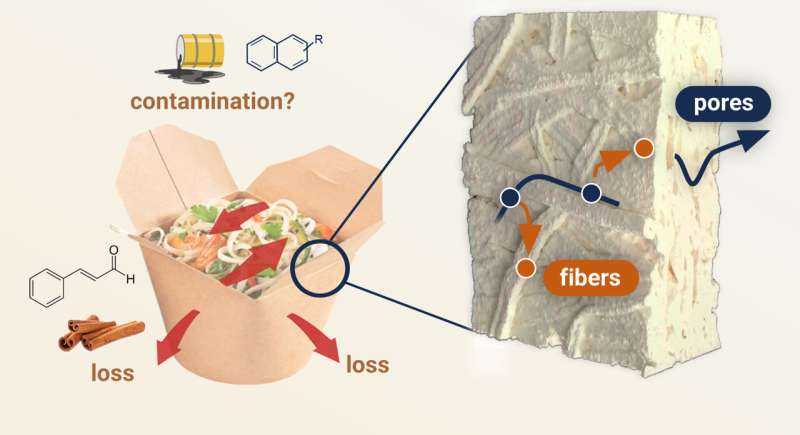
Paper packaging is a sustainable alternative to plastic. However, as it is permeable to air, food packaged in paper loses its flavor over time, and undesirable substances such as solvents can penetrate the packaging. Up to now, extensive tests were necessary for each type of paper to determine to what extent and how quickly this happens.
A research team led by Karin Zojer from the Institute of Solid State Physics at Graz University of Technology (TU Graz) has now developed an AI-based prediction system that calculates how permeable different types of paper are to volatile organic substances. This significantly speeds up the development of new packaging materials.
The work is published in the journal Chemical Engineering Science.
The prediction tool, which was developed as part of the CD Laboratory for Mass Transport through Paper, is already being used by a paper manufacturer.
Laboratory tests as a basis
The prediction system is based on analyses of the microstructure of different types of paper, for which the team has precisely recorded the distribution of the cellulose fibers and the size of the pores. The second step involved months of laboratory tests in which the researchers used gas chromatography to determine how quickly volatile organic substances migrate through different types of paper.
“However, we have reached our limits with these traditional methods,” says Zojer. “The possible combinations of paper types and volatile substances are huge and the experiments are far too time-consuming to develop a comprehensive prediction model from them.”
Neural network combined with physical laws
The researchers achieved the breakthrough by using so-called physics-informed neural networks. This variant of machine learning incorporates physical laws into its calculations as a supplement to the training data. This enables the AI to extract patterns from even a small amount of training data and perform precise calculations.
Among other things, Zojer and her team have provided the AI with the information that volatile organic substances partially adhere to the cellulose fibers as they pass through the paper packaging.
“Such principles narrow the corridor of possible solutions for the calculations that the neural network has to perform and optimize,” says Zojer.
“We then checked the results of our AI in experiments for single and multi-ply papers and were surprised ourselves at how well this prediction model works.”
The paper manufacturer Mondi Uncoated Fine & Kraft Paper, which was involved in the CD lab, is already using the software to select paper grades for special applications.
Zojer will continue to develop the system, for example, to take into account how the permeability changes when the paper fibers absorb solvents and swell as a result.
More information: Alexandra Serebrennikova et al, Physics informed neural networks reveal valid models for reactive diffusion of volatiles through paper, Chemical Engineering Science (2024). DOI: 10.1016/j.ces.2023.119636
Leave a Reply