
Tanya Weaver Thu 20 Nov 2025
Collected at: https://eandt.theiet.org/2025/11/20/fingertip-wearable-brings-lifelike-texture-flat-digital-interfaces
A soft, stretchable fingertip wearable can make smooth screens feel textured, according to a new study.
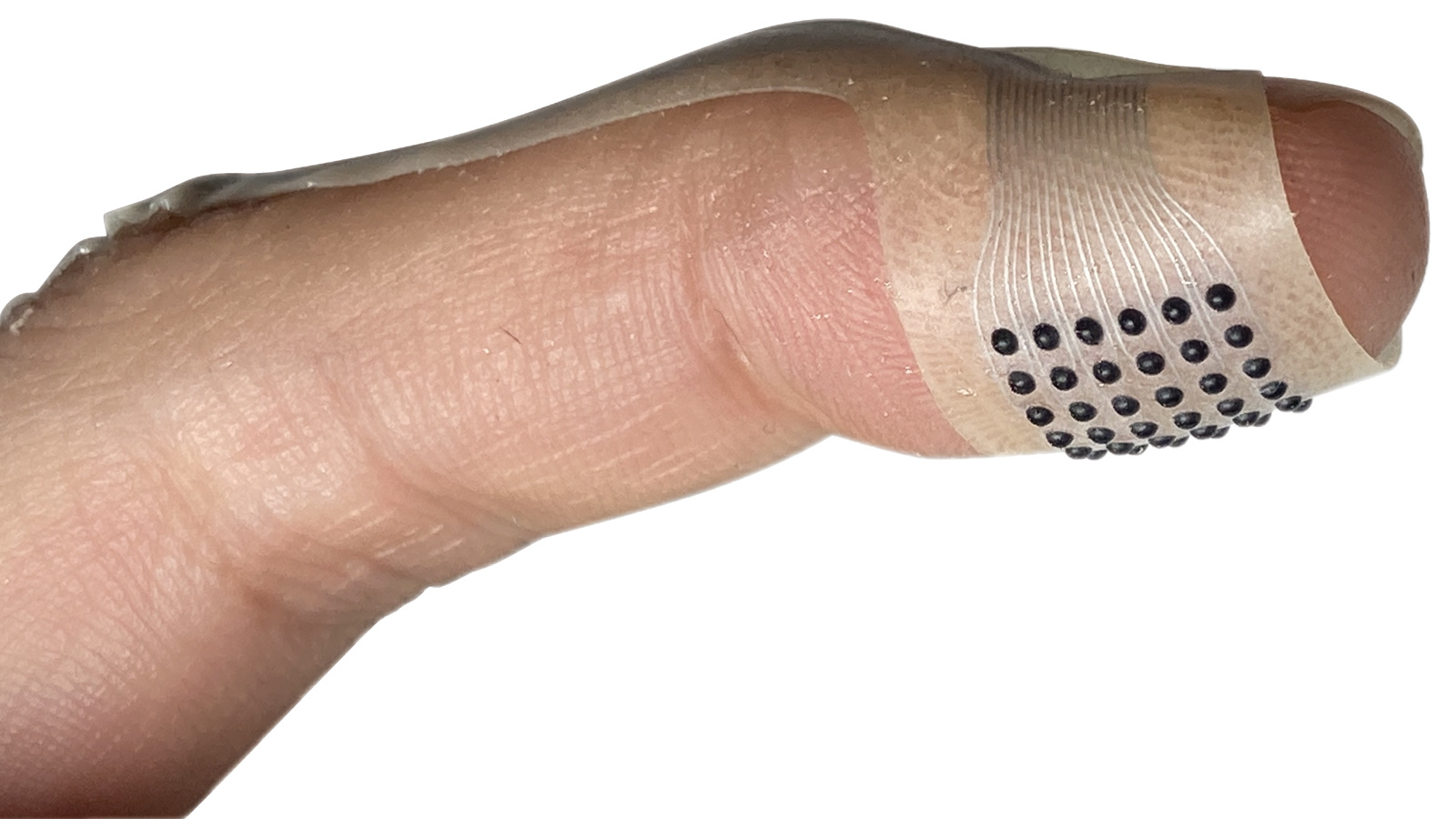
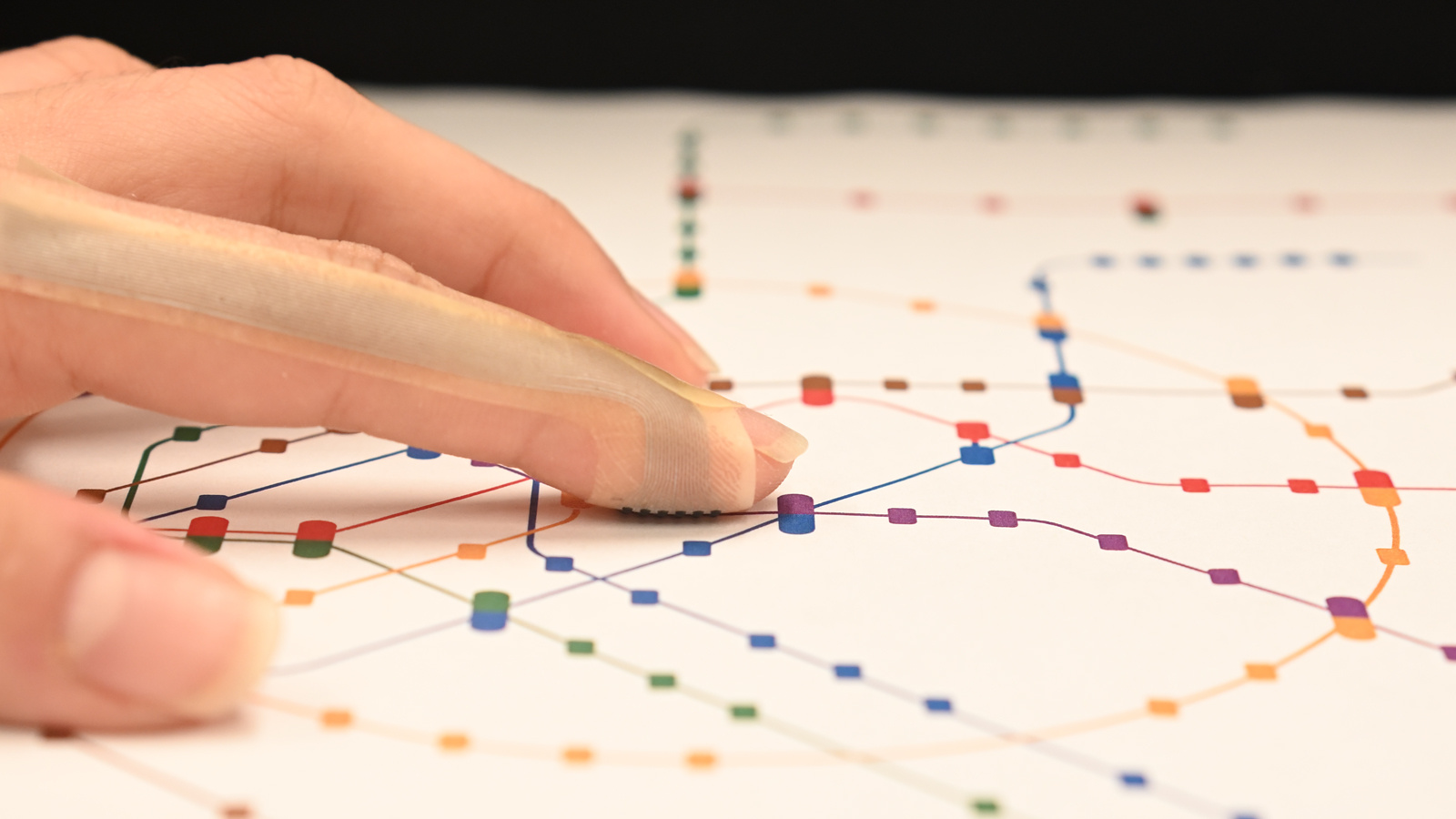
Developed by researchers at Northwestern University, Illinois, US, the ultra-thin wearable device wraps around the user’s fingertip. As they move it across a flat touchscreen, for example, it enables them to feel textures.
According to the researchers, the device represents a “major scientific breakthrough in the field of haptics” as it introduces what they call “human resolution”. In other words, it accurately matches the rich, detailed information the fingertips naturally perceive.
“We also designed it to be comfortable, so people can wear it for long periods of time without needing to remove it to perform other tasks. It’s like how people wear glasses all day and don’t even think about them,” said Sylvia Tan, a PhD student in mechanical engineering at Northwestern, who led the study.
To achieve digital touch, the device features an array of tiny, individually controlled nodes embedded into a paper-thin, stretchable sheet of latex.
These soft nodes function like ‘pixels of touch’, each capable of pressing into the skin at high speeds and in precise patterns.
Each node comprises a soft rubber dome, conductive outer layer and hidden inner electrode. When a slight voltage is applied, it generates electroadhesion, causing each tiny node to ‘grip’ a surface and tilt to press into the skin. That tilting generates a very local mechanical force, so each pixel of touch pushes the skin on a fingertip.
For rougher surfaces, higher voltages increase friction and create more pronounced tactile cues, whereas for smoother surfaces, lower voltages are used.
Northwestern University
The device is also very fast – it can change the pressure of the nodes up to 800 times per second.
To create the human-resolution sensations, the nodes are packed closely together – about 1mm apart.
Tan said: “The density of the nodes really matters for matching human acuity. The nodes need to be far enough apart that your body can tell them apart. If two nodes are less than one millimetre apart, your fingertips only sense one node instead of two. But if nodes are too far apart, they cannot recreate fine details. To make sensations that feel real, we wanted to match that human acuity.”
According to the researchers, during a series of experiments, users accurately and reliably recognised virtual textures, patterns and directional cues.
The experiments also showed how seamlessly users can move between real and digital experiences. Being so thin and light, the device does not interfere with real-world tasks or block the natural sense of touch.
For future iterations, the researchers say the technology could be paired with smartphones and tablets, transforming flat, smooth screens into textured interfaces.
It also has potential in assistive technologies for people with vision impairments: for instance, tactile maps to enable users to feel the bumpy rocks on a cliff.
Tan said: ”What makes this most exciting is combining spatial and temporal resolution with wearability. Now, we’re running studies to understand how humans actually receive and perceive this tactile information.”
Their study – ‘Towards human-resolution haptics: a high bandwidth, high density, wearable tactile display’ – has been published in the journal Science Advances.
Leave a Reply