
November 19, 2025 by Keio University Global Research Institute (KGRI)
Collected at: https://phys.org/news/2025-11-acoustic-key-orbitronic-devices.html
Electronics traditionally rely on harnessing the electron’s charge, but researchers are now exploring the possibility of harnessing its other intrinsic properties. In a Nature Communications study, scientists from Japan demonstrated that sound waves in certain solids can generate orbital currents—flow of electron orbital angular momentum.
Their findings establish a foundation for realizing next-generation “orbitronic” devices using existing acoustic technology.
Since the discovery of electricity, countless advancements in technology have relied on harnessing the electron’s charge, which is the fundamental principle behind most traditional electronics.
Now, as conventional electronic devices approach their practical limits, scientists are turning their attention to manipulating other properties of the electron. For example, the harnessing of electron spin in the field of spintronics promises low-power computing by using spin currents to transfer information.
Orbitronics and the search for new mechanisms
There is yet another untapped property in electrons, namely their orbital angular momentum. This property is the basis of “orbitronics,” a new research frontier seeking to use the flow of orbital angular momentum (orbital currents) as a new medium for information transfer and device functionality.
Despite the potential of orbitronics, there are not many practical and scalable ways to generate and control these orbital currents, and their generation mechanisms remain underexplored. Could sound waves hold the key to producing and controlling them?
To answer this question, a research team from Japan investigated the acoustic generation of orbital currents.
The study was led by Ph.D. student Mari Taniguchi and Professor Kazuya Ando from Keio University, Japan. Their Nature Communications paper explores two new physical phenomena—the acoustic orbital Hall effect and acoustic orbital pumping—that together establish a foundation for integrating sound technology with orbital physics.
How sound waves generate orbital currents
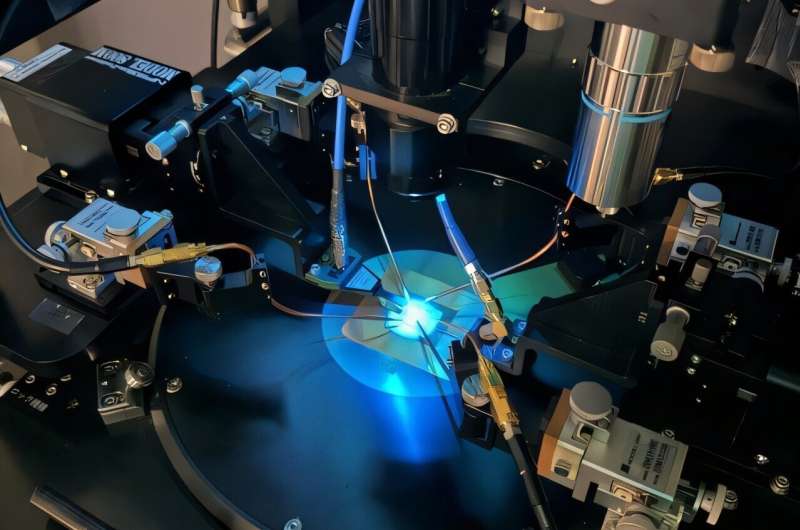
The experiments focused on titanium (Ti)/nickel (Ni) bilayers, a material system known for its robust orbital response. The team fabricated Ti/Ni devices on a special substrate and used surface acoustic waves (SAWs), sound waves confined to the surface of a material, to excite its lattice dynamics.
The use of Ti was key; since it has very weak spin-orbit coupling, any observed signal could be confidently attributed to the orbital degree of freedom rather than spin effects. The goal was to see if the mechanical vibration of the lattice could transfer its angular momentum to the electrons’ orbitals.
The researchers successfully observed the generation of orbital currents through two distinct acoustic mechanisms.
First, they demonstrated acoustic orbital pumping, where a SAW-driven acoustic ferromagnetic resonance (a resonant precession of the magnetization) injected an orbital current from the Ni layer into the Ti layer.
Second, they confirmed the generation of an acoustic orbital Hall effect. By measuring a DC voltage generated by a non-resonant SAW, they showed that the sound wave propagating in one direction generated an orbital current flowing perpendicular to it. This demonstrated that the lattice dynamics along the material’s surface are a direct and effective source of orbital current.
Through systematic measurements and comparison with control samples, the researchers confirmed that the observed voltage signal was significantly larger than anything that could be attributed to the spin Hall effect. This conclusively proved the dominance of the orbital mechanism, validating their conclusion.
Implications for future electronics and research
Taken together, these findings represent a key conceptual breakthrough, as Prof. Ando notes, “Since the orbital current was discovered only a few years ago, its generation mechanisms have remained largely unexplored. Recognizing the strong coupling between the orbital degree of freedom of electrons and the crystal lattice, we investigated and confirmed the possibility of generating orbital currents through phonons—the vibrations of the lattice.”
This work not only clarifies the nature of orbital currents arising in solids, but also lays the foundation for new design principles in future electronic devices.
“Our study marks the first time that SAWs, which are already widely used in various electronic devices such as sensors, touch panels, and filter components, are linked to orbital currents. Thus, our findings open the door to new developments that integrate acoustic technology with orbitronics,” says Prof. Ando.
Future studies will focus on understanding the microscopic mechanisms behind the acoustic orbital Hall effect in greater detail and optimizing device architectures to generate orbital currents more reliably and efficiently. With any luck, this will accelerate the transition of orbitronics from a purely theoretical concept to next-generation technologies.
More information: Mari Taniguchi et al, Acoustic generation of orbital currents, Nature Communications (2025). DOI: 10.1038/s41467-025-62703-z
Journal information: Nature Communications
Leave a Reply