
By Cornell University November 16, 2025
Collected at: https://scitechdaily.com/scientists-create-key-to-find-alien-life-in-clouds/
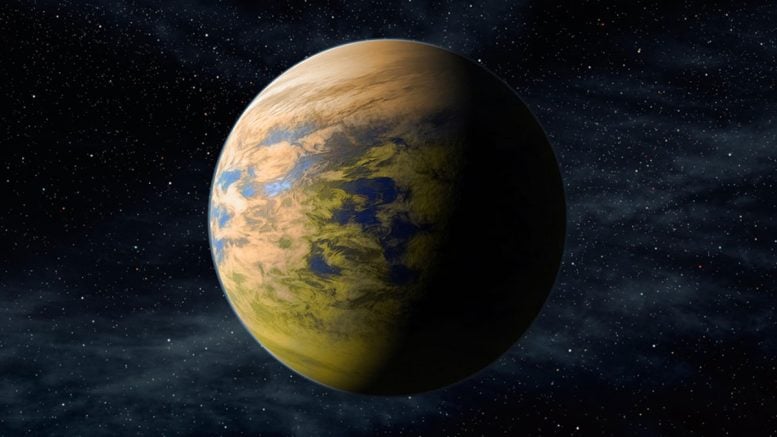
An exoplanet completely or densely covered by clouds could aid astronomers in their search for signs of life beyond Earth.
Cloudy skies may spoil a picnic or block a view of the stars through a telescope, but thick cloud layers on distant worlds could actually help scientists look for life beyond Earth.
A team at Cornell University has produced the first reflectance spectra (a color-coded guide) for a variety of vividly colored microorganisms that inhabit Earth’s atmospheric clouds. It is unknown whether similar microbes exist elsewhere in the universe or in concentrations high enough for telescopes to detect; on Earth, they are not present in such large numbers.
However, this new color guide now offers astronomers a tool they can use when scanning other planets, turning an exoplanet’s cloud layer, along with its surface and atmosphere, into an important place to search for potential signs of life.
“There is a vibrant community of microorganisms in our atmosphere that produce colorful biopigments, which have fascinated biologists for years,” said astrobiologist Ligia Coelho, fellow at the Carl Sagan Institute.
Colorful Life in the Skies
Coelho led the study of “Colors of Life in the Clouds: Biopigments of Atmospheric Microorganisms as a New Signature to Detect Life on Planets Like Earth,” which was recently published in Astrophysical Journal Letters.
“Finding colorful life in Earth’s atmosphere has opened a completely new possibility for finding life on other planets,” said Lisa Kaltenegger, professor of astronomy and director of the Carl Sagan Institute, who is second author of the study. “Now, we have a chance to uncover life even if the sky is filled with clouds on exoplanets. We thought clouds would hide life from us, but surprisingly, they could help us find life.”
She explained that the newly created spectra will allow astronomers to search for biosignatures on exoplanets that are covered in thick clouds, including those with complete cloud cover.
The microbes used to develop these spectra are uncommon in Earth’s atmosphere and required careful methods to obtain. Coelho collaborated with researchers at the University of Florida, who launched a latex sounding balloon to collect biological material from the lower stratosphere at altitudes between 21 and 29 kilometers above Earth’s surface.
Coelho grew the cultures with equipment and expertise from Stephen Zinder, professor of microbiology emeritus in the College of Agriculture and Life Sciences, a CSI Fellow. She then analyzed their reflective spectra in the lab of another CSI Fellow, Bill Philpot, professor of civil and environmental engineering in Cornell Engineering.
What Pigments Reveal About Life
Coelho noted that simply having these bacterial spectra gives scientists a new approach for identifying possible life elsewhere. The color patterns contain additional clues as well. They reveal the environmental conditions the microbes experience, since pigments help shield living organisms from hazards such as radiation, extreme dryness, or very hot and cold temperatures. Many organisms, including bacteria, create pigments to protect themselves from ultraviolet light, which is essential for survival at high altitudes in Earth’s atmosphere, Coelho said.
By modeling possible extremes, the researchers determined that a cloudy planet with widespread colorful bacteria in its clouds would look significantly different than a planet without them, giving colorful bacteria the potential to be a detectable biosignature.
To flourish at a high-enough density that observers could find them, the microbes would need to live in planets with humid conditions. And telescope technology will also have to catch up. Knowing that we can search for life on cloudy worlds is informing the design of future telescopes, including NASA’s space-based Habitable Worlds Observatory, which is in development, and observation strategies for the European Southern Observatory’s Extremely Large Telescope, which is under construction in Chile and scheduled to start science observations in the 2030s.
“Biopigments have a universal character on our planet. They give us tools to fight stresses like radiation, dryness and lack of resources. We produce them, and so do bacteria, archaea, algae, plants, other animals,” Coelho said. “They are powerful biosignatures and we’ve discovered a new way to look for them – through the clouds of distant worlds. And if life looks like this, we finally have the tools to recognize it.”
Reference: “Colors of Life in the Clouds: Biopigments of Atmospheric Microorganisms as a New Signature to Detect Life on Planets like Earth” by Lígia F. Coelho, Lisa Kaltenegger, William Philpot, Adam J. Ellington, Noelle Bryan, Stephen Zinder and Brent C. Christner, 11 November 2025, The Astrophysical Journal Letters.
DOI: 10.3847/2041-8213/ae129a

Leave a Reply