
November 3, 2025 by Giorgia Zucchelli, MathWorks
Collected at: https://www.eeworldonline.com/antennas-to-bits-modeling-real-world-behavior-in-rf-and-wireless-systems/
Engineers combine measured data, multi-level behavioral models, and simulation tools to predict real-world performance across complex RF and wireless systems.
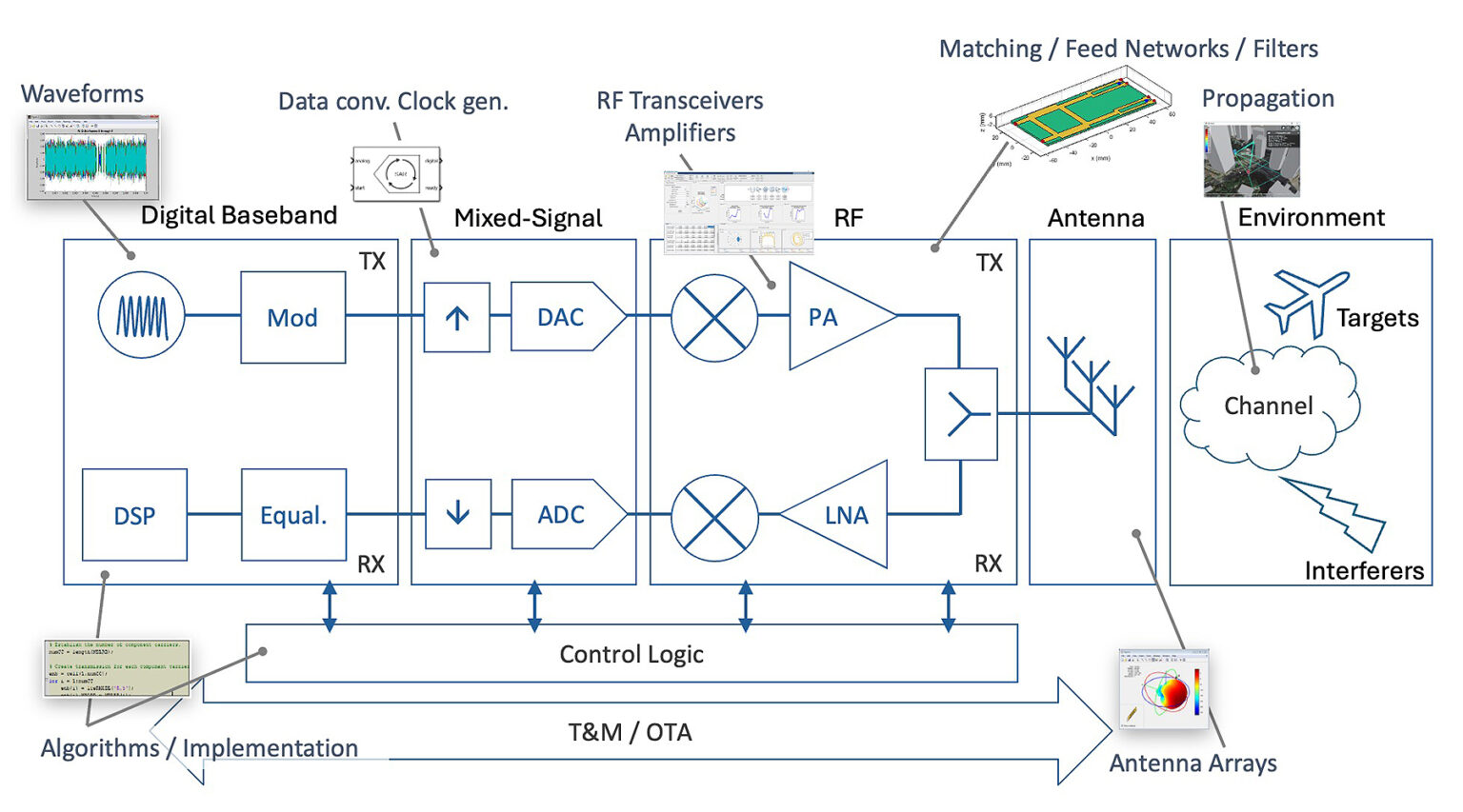
Modern RF and wireless systems push the limits of performance, integration, and frequency. As designs grow more complex (Figure 1), engineers face a central question: how can simulations accurately predict real-world behavior when physical components deviate from ideal conditions? Accounting for imperfections such as impedance mismatches, nonlinearities, coupling, and manufacturing variations is critical to ensure that the system behaves as desired once hardware is built.
The section below addresses common questions engineers ask about tackling these challenges using hierarchical modeling, measured data, and careful control of simulation fidelity. Real-world examples show how combining behavioral models, electromagnetic analysis, and lab measurements can produce more reliable predictions, shorten development time, and improve RF system performance.

Figure 1. Schematic representation of an RF system modeled from antenna-to-bits. Such systems often consist of hundreds of different components, for which different effects and undesired impairments need to be considered. Image: MathWorks
How do engineers account for real-world imperfections in RF components when running simulations?
Wireless communications and radar systems, shown in Figure 2, are inherently complex, comprising hundreds of interconnected components with diverse behaviors and interactions. The primary challenge lies in balancing model fidelity against computational efficiency. High-fidelity models capture intricate device behaviors but significantly increase simulation time and resource consumption, while lower-fidelity models enable faster analysis at the expense of accuracy.
To effectively manage this tradeoff, it is essential to utilize modeling tools that facilitate navigation across multiple layers of abstraction. These tools let engineers selectively adjust the level of detail according to the analysis requirements — ranging from high-level system simulations to detailed circuit-level analyses — thereby optimizing both simulation performance and predictive accuracy. This hierarchical modeling approach is critical for efficient system design, verification, and optimization in complex RF and microwave applications. A digital model of Otava’s beamformer chip is one example, enabling engineers to test designs before hardware is available and demonstrating how simulation accelerates development. This approach allows for efficient design, verification, and optimization in complex RF and microwave applications.

Figure 2. Example of RF budget analysis comparing results from Friis and Harmonic Balance to determine the impact of interfering signals on receiver linearity. Image: MathWorks
Can you share an example of how measured data has improved the accuracy or reliability of a system-level simulation?
In RF system design, measured data is often used to strengthen the accuracy of behavioral models, which in turn makes system-level simulations more reliable. A common challenge is that lab prototypes can only cover a limited set of conditions, while simulations need to predict performance across a much wider range of operating scenarios.
Figure 3 comes from work on power amplifiers (PAs) and beamformers. Engineers measure time-domain I/Q waveforms, AM-AM/AM-PM curves, antenna patterns, and S-parameters, then used those results to build behavioral models that captured device memory effects and nonlinearities. To ensure accuracy, the models were validated against error vector magnitude (EVM) measurements, which helped establish the conditions under which the models could be trusted.
With those validated models, designers could evaluate advanced techniques such as digital predistortion (DPD) directly in simulation – testing different algorithm types, update rates, and hardware tradeoffs without requiring multiple rounds of hardware prototyping. This approach has become increasingly important for 5G and SatCom, where design cycles are short and lab testing alone cannot capture the full range of operating scenarios.

Figure 3. Example of transmitter model in closed DPD loop and simulation to predict out-of-band emissions. Each RF component in the transmitter is modeled using datasheet specifications, measured data, or results from electromagnetic simulation. Image: MathWorks
What’s the typical trade-off between simulation speed and fidelity when modeling complex RF systems with behavioral models?
The central trade-off in modeling complex RF systems with behavioral models is between simulation speed and fidelity. Transistor-level models may capture fine grained behavior, but they are computationally expensive and often impractical for full system analysis. On the other hand, moving to higher levels of abstraction increases speed but raises concerns about losing important effects.
The guiding principle is whether a specific impairment or effect meaningfully influences system-level performance metrics. For example, simulating complex metrics like error vector magnitude (EVM) provides a more complete picture of non-idealities than simpler measurements such as continuous wave (CW) tones or S-parameters. If noise generated intermediate RF stages has negligible impact compared to earlier stages, it can be simplified or excluded without reducing the accuracy of the result.
Figure 4 shows how fidelity can also be maintained through abstraction rather than one-to-one hardware replication. Nonlinearity effects, for example, can be aggregated at the output stage, and noise sources can be consolidated at the input stage. These strategies streamline simulations and reduce runtime while preserving essential system behavior, allowing designers to strike an effective balance between speed and fidelity.

Figure 4. Example of model to anticipate the impact of an interfering signal on a mmWave receiver. A standard compliant 5G FR2 signal is used to measure EVM, and to study finite isolation of the image rejection filter on the system performance. The same waveform can be used in the lab to measure the system behavior. Image: MathWorks
What common modeling oversights lead to performance issues in real deployments, especially at higher frequencies?
Common modeling oversights that can lead to performance issues at high frequencies often arise from simplifying assumptions or incomplete models.
Impedance mismatches are a critical example. In mmWave systems with 40-50 cascaded components (many with tunable parameters) even a small mismatch of half a decibel can have a significant impact (Figure 5). Assuming ideal 50-Ω matching throughout the system can lead to inaccurate power budgets, and in radar applications, it can directly reduce detection range by limiting transmitted power and degrading receiver dynamic range, potentially causing missed targets or reduced reliability.
Coupling and on-board leakage are additional factors that require careful evaluation. While electromagnetic (EM) simulations are powerful for predicting these effects and guiding hardware fixes, relying solely on hardware adjustments can be costly. Behavioral models allow engineers to explore different mitigation strategies, such as comparing hardware modifications to algorithmic compensation. Failing to account for these effects can result in degraded signal quality, reduced system efficiency, and higher design or production costs.
Finally, insufficient integration of data sources is another common oversight. Behavioral models that fail to combine measured data, EM simulations, and algorithmic processing risk missing important impairments. Integrated models provide accurate system-level performance predictions, quantify the impact of specific effects, and guide engineers toward the most effective and cost-efficient design improvements. Overlooking this integration can lead to inaccurate predictions of system performance, sub-optimal design choices, and potentially costly redesigns or field failures.

Figure 5. Examples of sources of dispersion, impedance mismatch, and frequency dependency in a simple eight-channel transmitter. Data used in the model can be measured, fitted, or resulting from EM analysis. Image: MathWorks
As RF systems grow more integrated and complex, what are the emerging best practices for simulating the full signal chain realistically?
As RF systems become more integrated and complex, engineers are adopting best practices that ensure simulations reflect real-world performance across the full signal chain. One key approach is combining static analysis with dynamic simulation, allowing engineers to validate assumptions, spot discrepancies, and understand system behavior under different conditions.
Another best practice is building behavioral models at multiple levels of detail, shown in Figure 6. High-level models let engineers quickly explore system performance, while detailed models capture the nuances of specific components. Comparing results from physical equations, EM simulations, and measured data helps identify impairments and confirm critical design assumptions. For example, the Lifeseeker system turns a cell phone into a locator beacon, and extensive simulations of cellular signals and environments allowed engineers to refine its design and ensure reliable real-world performance.

Figure 6. Results of electromagnetic analysis can be embedded early in system-level simulation to model frequency dependence, dispersion, impedance mismatches, and anticipate leakages and coupling effects at the board level. Image: MathWorks
This multi-layered strategy improves confidence in simulation results, accelerates design iterations, enables early detection of potential issues, and supports robust system optimization. By integrating diverse modeling techniques and data sources, engineers can more accurately predict real-world performance and make better decisions.
Accurately modeling non-ideal effects is critical to predicting real-world RF and wireless system performance. By integrating measured data, EM analysis, and behavioral modeling across multiple abstraction levels, engineers can evaluate key trade-offs early, reduce hardware iterations, and improve confidence in simulation results. This approach enables faster, more reliable design of advanced wireless and radar systems.
Leave a Reply