
October 27, 2025 by Nanyang Technological University
Collected at: https://techxplore.com/news/2025-10-scientists-carbon-neutral-centers-space.html
An out-of-this-world idea: Placing data centers in space could pave the way for sustainable computing with unlimited solar energy and free cooling, say scientists from Nanyang Technological University, Singapore (NTU Singapore). Their study shows how satellites equipped with advanced processors could harness unlimited solar energy and the cold vacuum of space to power a greener digital future.
The researchers outline a practical path to building carbon-neutral data centers in low Earth orbit (LEO), a concept particularly relevant to land-scarce cities like Singapore, where limited land and high real estate costs make conventional data centers increasingly expensive. The study is published in the journal Nature Electronics.
Led by NTU Associate Provost (Graduate Education) Professor Wen Yonggang, who is the Alibaba-NTU President’s Chair in Computer Science and Engineering, the new paper asserts that space offers two unparalleled environmental advantages—virtually unlimited solar energy and natural radiative cooling enabled by extreme cold temperatures.
Together, these conditions could enable orbital data centers to operate with net-zero carbon emissions. The timing is crucial, as AI-driven computing demand is projected to rise by 165% by 2030.
In Singapore, data centers already account for about 7% of national electricity use, a figure expected to reach 12% by 2030.
“Space offers a true sustainable environment for computing. We must dream boldly and think unconventionally, if we want to build a better future for humanity,” said Prof Wen, who also holds the role of Dean, Graduate College and is a faculty member from the College of Computing and Data Science.
“By harnessing the sun’s energy and the cold vacuum of space, orbital data centers could transform global computing. Our goal is to turn space into a renewable resource for humanity, expanding AI capacity without increasing carbon emissions or straining Earth’s limited land and energy resources,” explains Prof Wen, a serial innovator who first invented and demonstrated multi-screen casting technology in 2013, now widely used across computers, tablets, mobile phones and TVs.
Harnessing the physics of space for sustainability
Unlike Earth-based data centers that struggle with cooling and power demand, particularly in dense urban environments where both energy and land are limited, space facilities could rely entirely on sunlight for power and dissipate heat directly into deep space, which has an average temperature of 2.7 Kelvin (−270.45°C).
This makes space an ideal environment for high-performance computing. Low Earth orbit (LEO), located roughly 160 to 2,000 kilometers above Earth, offers a cost-effective altitude already used by many commercial satellite systems.
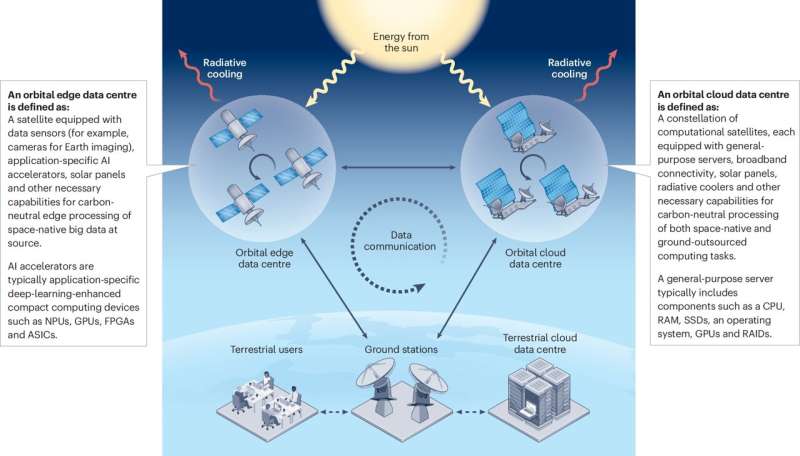
The team has proposed two models in which this concept could work:
- Orbital Edge Data Centers—Imaging or sensing satellites equipped with AI accelerators could process raw data directly in orbit, transmitting only the essential processed information to Earth. This approach can reduce data transmission volumes by over a hundred times, significantly lowering energy consumption and latency.
- Orbital Cloud Data Centers—Constellations of satellites fitted with servers, broadband links, solar panels and radiative coolers could collectively perform complex computing tasks, from scientific simulations to AI model training.
The researchers noted that rather than building a single massive facility in space, these distributed constellations are technologically feasible with today’s satellite and computing advancements and could be scaled up over time.
To validate the carbon-neutral potential of such a system, the team worked with NTU deep tech spin-off Red Dot Analytics—co-founded by Prof Wen—to develop a digital twin model of the space-based data center.
Their virtual model simulated expected power consumption, cooling and solar energy generation, showing that the cold vacuum of space will allow heat to be released more efficiently than on Earth.
Land scarcity and increasing costs of building data centers
The study notes that land and energy constraints make data centers costly in cities like Singapore, the world’s second most expensive market for such facilities, with costs averaging US$13.80 per watt of IT load or about US$11.7 million per megawatt.
High land prices, infrastructure costs and power-supply limits constrain physical expansion, prompting renewed interest in sustainable, space-efficient alternatives.
In contrast, orbital data-center models avoid these constraints, requiring no physical land, minimal cooling infrastructure, and offering global scalability without geographical limitations.
Life-cycle sustainability and technological readiness
While rocket launches remain carbon-intensive, the NTU study introduces a new metric, life-cycle carbon usage effectiveness (CUE), which showed that solar-powered orbital data centers could offset their launch emissions within a few years of operation.
Advances such as reusable rockets, electrical slingshot launchers, radiation-hardened electronics and space-qualified chips are also accelerating progress.
Companies like AMD have already developed space-grade processors, while NTU’s deep-tech spin-off Zero Error Systems provides fault-tolerant semiconductor technology that allows consumer-grade hardware to operate reliably in space.
NTU Vice President (Innovation and Entrepreneurship) Professor Louis Phee said the study reflects the innovative spirit that NTU nurtures in its students and scientists.
“To tackle humanity’s greatest challenges, we need creative and interdisciplinary researchers working hand in hand with entrepreneurs,” said Prof Phee.
“Over the past decade, NTU has built a strong foundation of patents and technology spin-offs that are poised to tap emerging trends such as sustainable computing and the space economy. These efforts are opening new markets for Singapore and reinforcing our leadership in sustainability and advanced computing.”
More information: Ablimit Aili et al, The development of carbon-neutral data centres in space, Nature Electronics (2025). DOI: 10.1038/s41928-025-01476-1
Journal information: Nature Electronics

Leave a Reply