
By University of Liège October 25, 2025
Collected at: https://scitechdaily.com/astronomers-stunned-by-bizarre-three-planet-system-that-rewrites-the-rules-of-space/
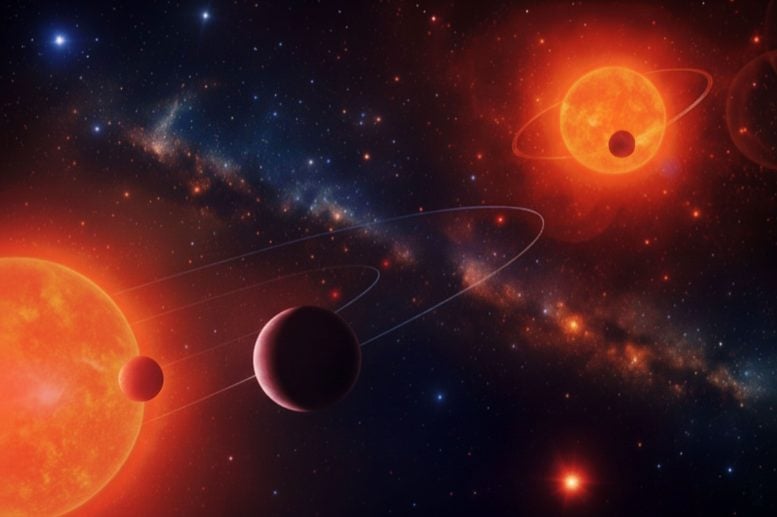
An international team of scientists has announced the discovery of three Earth-sized planets orbiting within the binary star system TOI-2267, located approximately 190 light-years from Earth.
An international group of scientists has announced the discovery of three Earth-sized planets orbiting within the binary star system TOI-2267, located roughly 190 light-years from Earth. The finding, detailed in Astronomy & Astrophysics, provides new insights into how planets can form and remain stable in double-star systems, which were once thought to be too unstable to support complex planetary structures.
“Our analysis shows a unique planetary arrangement: two planets are transiting one star, and the third is transiting its companion star,” says Sebastián Zúñiga-Fernández, researcher and member of the ExoTIC group at the University of Liège (ULiège) and first author of the study. “This makes TOI-2267 the first binary system known to host transiting planets around both of its stars.”
An unusual double-star system
TOI-2267 consists of two closely bound stars orbiting one another in a compact configuration, creating conditions that are typically unfavorable for planet formation. Despite this, astronomers have detected three small, rocky worlds circling the stars in tight, short-period orbits. The discovery challenges long-standing theories about how planets develop in such dynamically unstable environments, suggesting that nature may find ways to build and maintain planetary systems even under extreme conditions.
“Our discovery breaks several records, as it is the most compact and coldest pair of stars with planets known, and it is also the first in which planets have been recorded transiting around both components,” explains Francisco J. Pozuelos, a former member of the ExoTIC group, currently researcher at the Instituto de Astrofísica de Andalucía (IAA-CSIC), and co-leader of the study.
An international, multidisciplinary effort
While NASA’s TESS space telescope provided the data, the initial identification of two of the three planets was first achieved by ULiège and IAA-CSIC astronomers using their own detection software, SHERLOCK. This early discovery allowed the team to trigger ground-based follow-up observations well in advance.
The subsequent confirmation of the planetary nature of these signals required an intensive campaign with several observatories. Among them, the SPECULOOS and TRAPPIST telescopes, led by ULiège (PI: Michaël Gillon), played a central role. These robotic facilities, optimized for studying small exoplanets around faint, cool stars, were crucial in confirming the planets and characterizing the system.
A natural laboratory for planet formation
“Discovering three Earth-sized planets in such a compact binary system is a unique opportunity,” explains Sebastián Zúñiga-Fernández. “It allows us to test the limits of planet formation models in complex environments and to better understand the diversity of possible planetary architectures in our galaxy.”
Francisco J. Pozuelos adds: “This system is a true natural laboratory for understanding how rocky planets can emerge and survive under extreme dynamical conditions, where we previously thought their stability would be compromised.”
Opening the door to future research
This discovery raises many questions about planet formation in binary systems and paves the way for new observations, notably with the James Webb Space Telescope (JWST) and the next generation of giant ground-based telescopes. These instruments will enable precisely measure the masses, densities, and perhaps even the atmospheric composition of these distant worlds.
Beyond its spectacular nature, this discovery highlights the power of combining space missions with specialized ground-based telescopes, such as SPECULOOS and TRAPPIST, to push the frontiers of exoplanetary science.
Reference: “Two warm Earth-sized exoplanets and an Earth-sized candidate in the M5V-M6V binary system TOI-2267” by S. Zúñiga-Fernández, F. J. Pozuelos, M. Dévora-Pajares, N. Cuello, M. Greklek-McKeon, K. G. Stassun, V. Van Grootel, B. Rojas-Ayala, J. Korth, M. N. Günther, A. J. Burgasser, C. Hsu, B. V. Rackham, K. Barkaoui, M. Timmermans, C. Cadieux, R. Alonso, I. A. Strakhov, S. B. Howell, C. Littlefield, E. Furlan, P. J. Amado, J. M. Jenkins, J. D. Twicken, M. Sucerquia, Y. T. Davis, N. Schanche, K. A. Collins, A. Burdanov, F. Davoudi, B.-O. Demory, L. Delrez, G. Dransfield, E. Ducrot, L. J. Garcia, M. Gillon, Y. Gómez Maqueo Chew, C. Janó Muñoz, E. Jehin, C. A. Murray, P. Niraula, P. P. Pedersen, D. Queloz, R. Rebolo-López, M. G. Scott, D. Sebastian, M. J. Hooton, S. J. Thompson, A. H. M. J. Triaud, J. de Wit, M. Ghachoui, Z. Benkhaldoun, R. Doyon, D. Lafrenière, V. Casanova, A. Sota, I. Plauchu-Frayn, A. Khandelwal, F. Zong Lang, U. Schroffenegger, S. Wampfler, M. Lendl, R. P. Schwarz, F. Murgas, E. Palle and H. Parviainen, 24 October 2025, Astronomy & Astrophysics.
DOI: 10.1051/0004-6361/202554419
Leave a Reply