

By Matthew Williams – October 26, 2025
Collected at: https://www.universetoday.com/articles/galactic-empires-may-live-at-the-center-of-our-galaxy-hence-why-we-dont-hear-from-them
For over half a century, scientists have struggled to answer Fermi’s time-honored question: “Where is Everybody?” Answering this question is extremely difficult, partly because of the data-poor nature of the Search for Extraterrestrial Intelligence (SETI) itself, due to a historical lack of funding and resources. However, there are also the inherent assumptions involved that make it difficult to arrive at a simple answer. The way “Fermi’s Paradox” is framed (by its chief proponents, Michael Hart and Frank Tipler), it is assumed that advanced civilizations will naturally seek to expand beyond their home planet and colonize other star systems.
But many researchers have criticized this outlook, emphasizing the difficulties of establishing footholds in environments entirely “alien” to them (e.g., Percolation Theory and the Aurora Hypothesis). There’s also the problem of General Relativity (GR), which establishes that faster-than-light travel is not possible without the existence of exotic physics that is yet unknown to us. In a recent paper, a team of researchers considered several scenarios in which a civilization could expand in a relativistic Universe and concluded that it could be done within (what can be reasonably assumed to be) a civilization’s lifetime.
The study, titled “Redshifted civilizations, galactic empires, and the Fermi paradox,” was conducted by Chris Reiss, an Independent Researcher, and Justin C. Feng, a postdoctoral researcher at the Central European Institute for Cosmology and Fundamental Physics (CEICO) at the Institute of Physics of the Czech Academy of Sciences. As they argue, the rules of General Relativity, combined with a little input from the Kardashev Scale and some other theories related to SETI research, allow for the existence of a Type II Civilization inhabiting the galactic core region, and could also explain why we haven’t heard from them.
Fermi and Drake
Given the number of stars in the Milky Way (100 to 200 billion), the number of galaxies in the Universe (last count, more than two trillion!), and that most stars have at least one planet orbiting them (based on the current exoplanet census), it only seems natural that life would have emerged beyond Earth. Considering the age of the Universe (13.8 billion years) and the fact that the Solar System has only been around for the last third of that time (4.6 billion years), it’s also reasonable to assume that life would have emerged many times by now.
According to Hart and Tipler’s analysis (aka. the Hart-Tipler Conjecture), if advanced civilizations have already emerged in our galaxy, then they would have surely developed the technology for advanced communications, space travel, and self-replicating (Von Neumann) probes as well. By their estimates, a civilization that had achieved this level of technical development would only need 650,000 to 2 million years to colonize the entire galaxy and have been to Earth several times. Given the complete lack of evidence for extraterrestrial civilizations, they argued, they must not exist.
But as Carl Sagan famously argued in a paper he co-authored with fellow astrophysicist William Newman, “The Solipsists Approach to Extraterrestrial Intelligence” (aka. “Sagan’s Response”), “absence of evidence is not evidence of absence.” In addition, Hart and Tipler assumed that once civilizations had established a foothold on other worlds, their colonies would endure for millions or even billions of years. Aside from being a pretty blatant assumption (on top of many others), this thinking is inconsistent with what legendary SETI astronomer Frank Drake proposed with his famous Drake Equation.
While often interpreted as a method for calculating the number of extraterrestrial civilizations in our galaxy (that humanity could communicate with at any given time), the equation is actually a thought experiment that summarizes the challenges facing SETI researchers. And it went a little something like this:
*N = R* x fp x ne x fl x fi x fc x L*
Whereas N is the number of civilizations in our galaxy that we might able to communicate with, R is the average rate of star formation in our galaxy, fp is the fraction of those stars which have planets, ne is the number of planets that can actually support life, fl is the number of planets that will develop life, fi is the number of planets that will develop intelligent life, fc is the number civilizations that would develop transmission technologies, and L* is the length of time that these civilizations would have to transmit their signals into space.
According to Dr. Rebecca Charbonneau, a science historian and Jansky Fellow at the National Radio Astronomy Observatory, Frank Drake considered L to be the most important parameter in his equation. During a lecture delivered at the 2023 Penn State SETI Symposium, titled “Frank Drake and his Place in History,” she summarized the context in which the Drake Equation emerged and the implications it had.
“Suddenly, with the development of the atom bomb and the Cold War, we were for the first time capable of not just destroying our civilization,” she said. “This is not about the Fall of Rome; this is about the end of our entire species, and indeed, perhaps our entire planet. And because of that, L is what really changed he character of how we think about SETI. And I think that Frank agreed with that.”
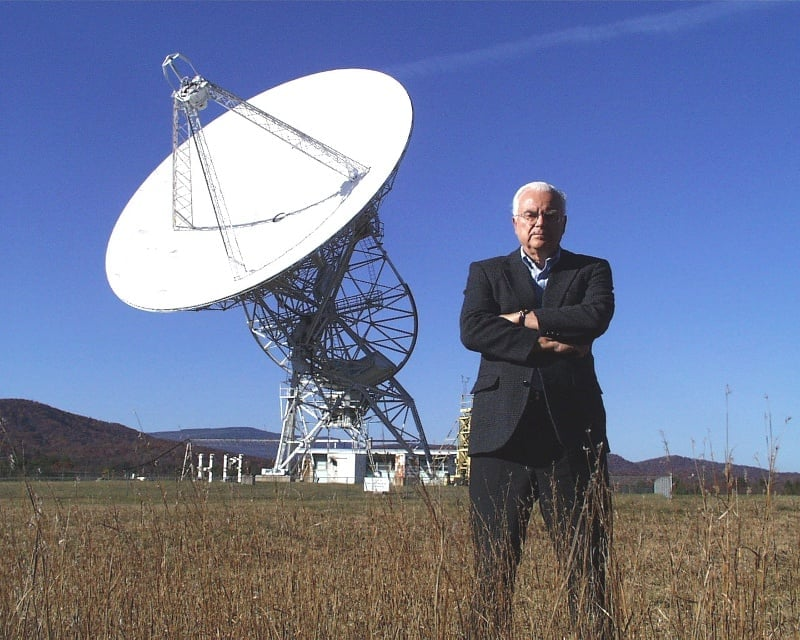
Dr. Frank Drake standing in front of the Tatel Telescope at the Green Bank Observatory. Credit: NRAO
Dr. Charbonneau further elaborated on this point in an interview with the Stories from Space podcast (hosted by yours truly!):
We’ve developed these tools, these weapons, nuclear bombs, that are capable of destroying our entire world as we know it. And so it becomes an existential problem, literally existential. Our existence is on the line. And I think that shift changed the way we think about the problem of communicating and seeking extraterrestrial life. And that’s Frank’s big innovation: he includes the variable L in his equation about longevity, because it’s the first time we’re wrestling with [the possibility that] maybe civilizations don’t last forever.
That Darn Relativity!
One of the biggest sticking points with SETI and the Fermi Paradox is the question of faster-than-light travel. Simply put, it’s not possible, not unless everything we’ve learned about the physical Universe to this point is wrong (or at least, incomplete). In accordance with Einstein’s Theory of Relativity (E=mc2), which is foundational to our understanding of the Universe, objects accelerating towards the speed of light will experience an increase in their inertial mass. This essentially means that as the speed of light approaches, objects feel heavier and require more and more energy to accelerate further.
As a result, the energy required to achieve even a small fraction of the speed of light is extremely high and beyond the capabilities of conventional propulsion. As we explored in a previous article, multiple theoretical concepts have been proposed since the dawn of the Space Age. These include nuclear pulse propulsion (NPP), fusion reactions, and antimatter annihilation, but all suffer from the same drawbacks. Specifically, they all require an absurd amount of propellant to maintain continuous acceleration, which means the vessels themselves must be immense.
This means that such ships would be prohibitively expensive and extremely challenging to build. In addition, the physical stress on the crew from all this acceleration would be considerable. As Reiss and Feng told Universe Today via email, the challenges of relativistic travel are legion and have implications for the Fermi Paradox:
The timescales for interstellar travel exceed present human lifetimes unless one travels at ultrarelativistic velocities (or velocities very close to the speed of light). The intolerance of human biology to high acceleration increases the time required to reach such ultrarelativistic velocities. Moreover, the amount of energy required to propel a vessel to such ultra-relativistic velocities is extremely high, far above the rest energy of the vessel. These problems are perhaps anthropocentric, arising from our limited lifespans and limited tolerance to high acceleration and long periods of social separation.
Leave a Reply