
October 22, 2025 by National Institute of Information and Communications Technology (NICT)
Collected at: https://techxplore.com/news/2025-10-ground-satellite-laser-communications-generation.html
The National Institute of Information and Communications Technology (NICT) and the Nagoya Institute of Technology (NITech), collaborating with the Japan Aerospace Exploration Agency (JAXA), have achieved the world’s first successful demonstration of next-generation error correction codes, mitigating the impact of atmospheric turbulence on ground-to-satellite laser communications.
The work is presented at the International Conference on Space Optical Systems and Applications (ICSOS) 2025.
Atmospheric turbulence in ground-to-satellite laser links is known to cause fading, resulting in burst data errors. Error correction codes are one of the key technologies to mitigate such effects.
In this experiment, the team transmitted next-generation error correction codes with high correction capability (5G NR LDPC and DVB-S2) and successfully corrected burst data errors caused by atmospheric turbulence in the laser link. This result confirmed that both codes can significantly improve communication quality compared to conventional schemes.
This achievement is expected to contribute to the practical implementation of ground-to-satellite laser communications by applying these codes.
NICT has been conducting research and development to implement practical ground-to-satellite laser communications. NICT recognizes overcoming atmospheric turbulence as one of the technical challenges for practical implementation.
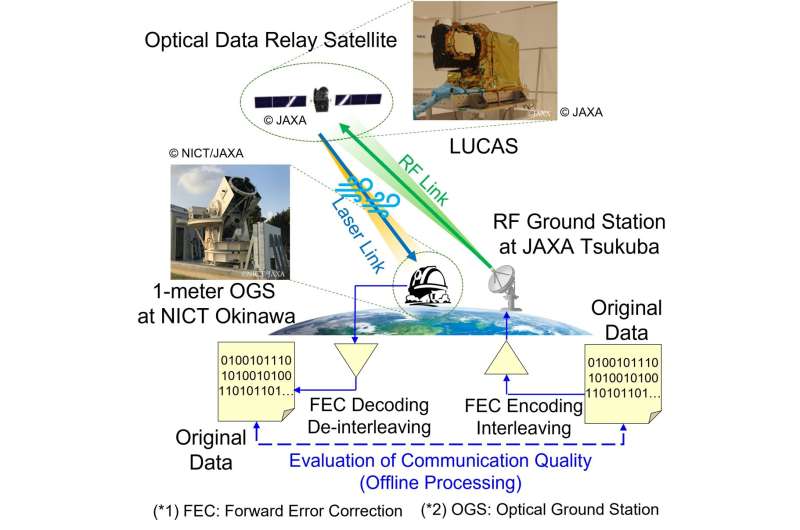
To address this challenge, NICT has carried out ground-to-geostationary (GEO) satellite laser communication experiments using NICT’s 1-meter optical ground station and JAXA’s Laser Utilizing Communication System (LUCAS) onboard the optical data relay satellite, in order to investigate the impact of atmospheric turbulence on communication quality.
This investigation revealed that atmospheric turbulence causes fading lasting from several milliseconds to several tens of milliseconds, which generates burst data errors. These errors lead to degraded and unstable communication quality. Currently, two approaches are available to overcome these effects: optical compensation schemes and error correction codes.
Focusing on the advantage of eliminating control systems of optics, NICT adopted error correction codes. The team has been working on a plan to demonstrate error correction using next-generation codes with higher correction capability than conventional Reed-Solomon codes, including 5G NR LDPC for 5G applications and DVB-S2 for satellite broadcasting.
In this experiment, NICT, in collaboration with NITech, conducted data transmission with next-generation error correction codes, including 5G NR LDPC and DVB-S2, using a 60 Mbps downlink on the ground-to-GEO satellite laser communication link between NICT’s 1-meter optical ground station and LUCAS.
Utilizing NICT’s experiences acquiring atmospheric turbulence, the parameters involved with the interleaving method and error correction code were optimized to address burst errors caused by fading.
Analyzing these experimental data successfully demonstrated the correction of burst data errors caused by atmospheric turbulence-induced fading, marking the world’s first confirmation that 5G NR LDPC and DVB-S2 can significantly improve communication quality compared to conventional codes.
These advanced codes not only offer high error correction capability but are also expected to assist in practical application in ground-to-satellite laser communications due to achieving easily implementable hardware and potential interoperability with future 5G communication systems.
This achievement leads to the improvement of communication quality for ground-to-satellite laser links and accelerates their practical implementation.
It also enables applying existing terrestrial 5G communication protocols and satellite broadcasting standards to space communication network systems. In the future, this technology is expected to play a key role in ground-to-satellite laser communication systems.
Leave a Reply