

By Karlsruhe Institute of Technology October 16, 2025
Collected at: https://scitechdaily.com/scientists-forge-new-superalloy-that-could-revolutionize-jet-engines-and-power-plants/
A newly developed material with exceptional high-temperature resistance shows strong promise for use in energy-efficient aircraft turbines.
Metals that can endure extremely high temperatures are essential for technologies such as aircraft engines, gas turbines, and X-ray equipment. Among the most heat-resistant are refractory metals like tungsten, molybdenum, and chromium, which melt at or above 2,000 degrees Celsius.
Despite their impressive thermal stability, these metals face major drawbacks. They become brittle at room temperature and oxidize rapidly when exposed to oxygen, leading to material failure at only 600 to 700 degrees Celsius. Because of this, they can be used effectively only under complex vacuum conditions (for example, as X-ray rotating anodes).
To overcome these obstacles, engineers have long relied on nickel-based superalloys for components that must function in air or combustion environments at high heat. These alloys have become the standard choice for gas turbine construction and similar high-temperature applications.
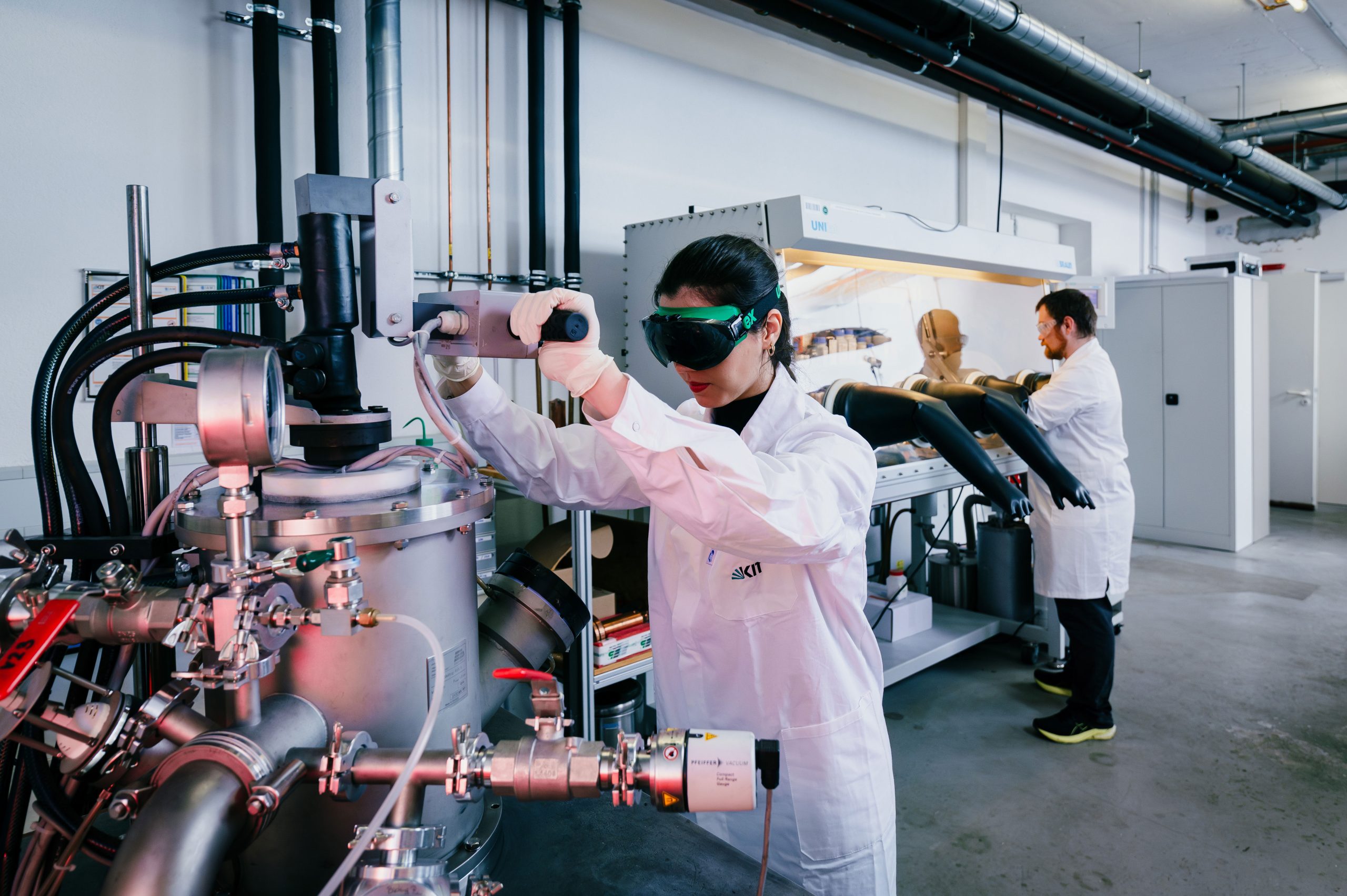
“The existing superalloys are made of many different metallic elements including rarely available ones so that they combine several properties. They are ductile at room temperature, stable at high temperatures, and resistant to oxidation,” explains Professor Martin Heilmaier from KIT’s Institute for Applied Materials – Materials Science and Engineering.
“However – and there is the rub – the operating temperatures, i.e., the temperatures in which they can be used safely, are in the range up to 1,100 degrees Celsius maximum. This is too low to exploit the full potential for more efficiency in turbines or other high-temperature applications. The fact is that the efficiency in combustion processes increases with temperature.”
A Chance for a Technological Leap
This limitation existing with the materials available today was the starting point for Heilmaier’s working group. Within the “Materials Compounds from Composite Materials for Applications in Extreme Conditions” (MatCom-ComMat) research training group funded by the German Research Foundation (DFG), the researchers succeeded in developing a new alloy made of chromium, molybdenum, and silicon.
This refractory metal-based alloy, in whose discovery Dr. Alexander Kauffmann, now professor at the Ruhr University Bochum, played a major role, features hitherto unparalleled properties.
“It is ductile at room temperature, its melting point is as high as about 2,000 degrees Celsius, and – unlike refractory alloys known to date – it oxidizes only slowly, even in the critical temperature range. This nurtures the vision of being able to make components suitable for operating temperatures substantially higher than 1,100 degrees Celsius. Thus, the result of our research has the potential to enable a real technological leap,” says Kauffmann.
This specifically remarkable as resistance to oxidation and ductility still cannot be predicted sufficiently to allow a targeted material design – despite the great progress that has been achieved in computer-assisted materials development.
More Efficiency, Less Consumption
“In a turbine, even a temperature increase of just 100 degrees Celsius can reduce fuel consumption by about five percent,” explains Heilmaier.
“This is particularly relevant to aviation, as airplanes powered by electricity will hardly be suitable for long-haul flights in the next decades. Thus, a significant reduction of the fuel consumption will be a vital issue. Stationary gas turbines in power plants could also be operated with lower CO₂ emissions thanks to more robust materials. In order to be able to use the alloy on an industrial level, many other development steps are necessary,” says Heilmaier.
“However, with our discovery in fundamental research, we have reached an important milestone. Research groups all over the world can now build on this achievement.”
Reference: “A ductile chromium–molybdenum alloy resistant to high-temperature oxidation” by Frauke Hinrichs, Georg Winkens, Lena Katharina Kramer, Gabriely Falcão, Ewa M. Hahn, Daniel Schliephake, Michael Konrad Eusterholz, Sandipan Sen, Mathias Christian Galetz, Haruyuki Inui, Alexander Kauffmann and Martin Heilmaier, 8 October 2025, Nature.
DOI: 10.1038/s41586-025-09516-8
Leave a Reply