
By University of Tsukuba October 18, 2025
Collected at: https://scitechdaily.com/lunar-radio-telescopes-could-finally-reveal-the-secrets-of-dark-matter/
Japanese scientists simulated faint 21-centimeter radio waves from the Universe’s “Dark Ages,” offering a potential way to detect dark matter.
About 13.8 billion years ago, the Universe emerged in a sudden burst of expansion known as the Big Bang. Roughly 400,000 years after this event, it entered a long, lightless stretch called the “Dark Ages.”
This era continued for about 100 million years, until the first stars and galaxies ignited and began to illuminate the cosmos. During this silent period, hydrogen atoms are believed to have released faint radio signals at a wavelength of 21 centimeters. These ancient waves may contain valuable clues about the Universe’s earliest stages.
Scientists from the University of Tsukuba and the University of Tokyo have used advanced computer simulations to explore how strong this 21-centimeter signal might have been under various dark matter scenarios. Dark matter, the unseen substance making up roughly 80% of all matter in the cosmos, continues to puzzle researchers.
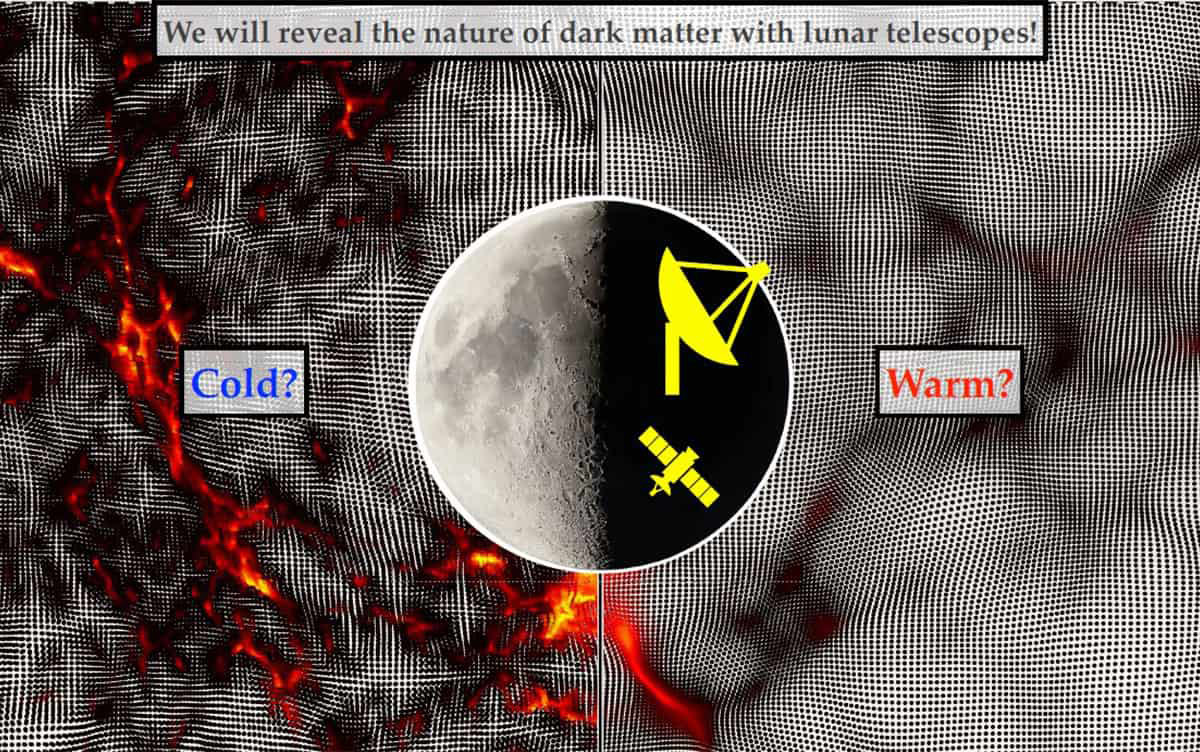
By recreating the distribution of gas and dark matter in the young Universe with powerful supercomputers, the team was able to calculate the intensity of these radio emissions during the Dark Ages with remarkable accuracy.
A Signal Hidden in the Darkness
The results imply that hydrogen gas in the dark ages produced a characteristic signal of about 1 millikelvin (one-thousandth of a degree) in the brightness temperature of sky-averaged radio emission. Crucially, dark matter is expected to produce variations of similar magnitude in this signal. Observing the global signal across a broad frequency band (~45 MHz) could therefore reveal the mass and velocity of dark matter particles.
Several lunar missions, including Japan’s Tsukuyomi Project, are now aiming to build radio telescopes on the Moon. If such telescopes can detect this faint signal, they will help unlock the mystery of dark matter.
Reference: “The signature of subgalactic dark matter clumping in the global 21-cm signal of hydrogen” by Hyunbae Park, Rennan Barkana, Naoki Yoshida, Sudipta Sikder, Rajesh Mondal and Anastasia Fialkov, 16 September 2025, Nature Astronomy.
DOI: 10.1038/s41550-025-02637-0
H.P. was supported in part by grant NSF PHY-2309135 to the Kavli Institute for Theoretical Physics (KITP). N.Y. acknowledges financial support from JSPS International Leading Research 23K20035. R.B. and N.Y. acknowledge JSPS Invitational Fellowship S24099.
Leave a Reply