
October 13, 2025 by Yale Cancer Center
Collected at: https://medicalxpress.com/news/2025-10-google-approach-cell-tumor-personalized.html
Researchers have developed a way to predict how lung cancer cells will respond to different therapies, allowing people with the most common form of lung cancer to receive more effective individualized treatment.
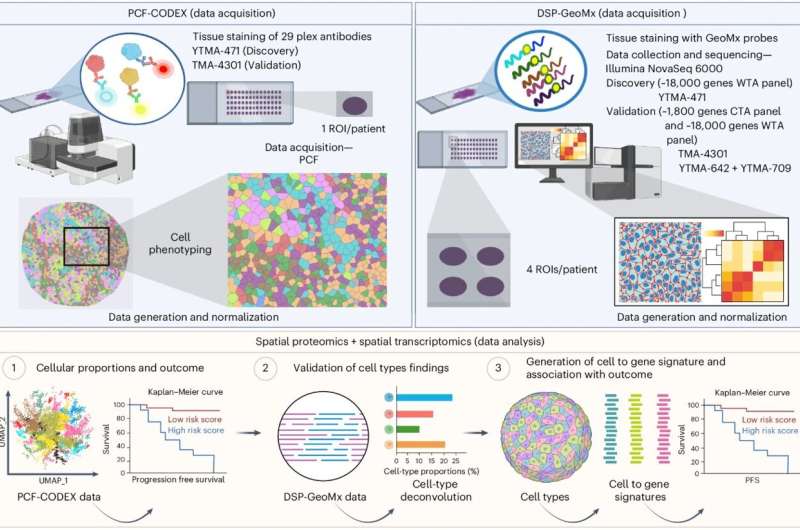
The research, published Oct. 10 in Nature Genetics, was led by Thazin Aung, Ph.D., in the laboratory of Yale School of Medicine’s David Rimm, MD, Ph.D., in collaboration with scientists at the Frazer Institute at the University of Queensland. Researchers studied the tumors of 234 patients with non-small cell lung cancer (NSCLC) across three cohorts in Australia, the United States, and Europe.
“Using AI and spatial biology, we mapped NSCLC, cell-by-cell, to understand and predict its response to drug treatment,” Aung says. “This ‘Google Maps’ approach can pinpoint areas within tumors that are both responsive and resistant to therapies, which will be a gamechanger for lung cancer treatment. Rather than having to use a trial-and-error approach, oncologists will now know which treatments are most likely to work with new precision medicine tools.”
The work “provides a road map for a new diagnostic test that could optimize treatment choice in lung cancer,” says Rimm, Anthony N. Brady Professor of Pathology and professor of medicine (medical oncology) at Yale School of Medicine.
Lung cancer is the leading cause of cancer death in the world, with an estimated 1.8 million deaths annually, and non-small cell lung cancer makes up 85% of all cases. Immunotherapy treatments cost between $400,000 and $500,000 per patient per year and are effective in only 20%–30% of patients.
“These therapies also carry significant risks for patients receiving them, including severe immune-related toxicity that can be fatal,” says Arutha Kulasinghe, Ph.D., the lead author at University of Queensland. “These challenges highlight the critical need to classify patients according to their likelihood of benefiting from treatment.
“By integrating data on the molecular geography of cancer and machine learning techniques, we can improve treatment decision-making and improve patient outcomes for lung cancer patients. This same approach can also be used to inform treatments for other malignancies where immunotherapies are used, for example melanoma, head and neck, and bladder cancer.”
More information: Thazin N. Aung et al, Spatial signatures for predicting immunotherapy outcomes using multi-omics in non-small cell lung cancer, Nature Genetics (2025). DOI: 10.1038/s41588-025-02351-7
Journal information: Nature Genetics


I have been exploring for a bit for any high quality articles or weblog posts in this sort of house . Exploring in Yahoo I at last stumbled upon this web site. Studying this information So i?¦m glad to express that I’ve a very just right uncanny feeling I came upon just what I needed. I such a lot indubitably will make sure to do not overlook this web site and give it a look on a constant basis.
Leave a Reply