
October 13, 2025 by University of Borås
Collected at: https://techxplore.com/news/2025-10-textile-nerves-thread-future-wearable.html
What if your clothes could sense, respond, and even help you move? That’s the vision behind the doctoral project on “textile nerves”—conductive fibers designed for electronic and ionotronic textiles. Claude Huniade, who was behind an innovative project, has woven together chemistry, mechanics, and sustainability to rethink how textiles and electronics can merge.
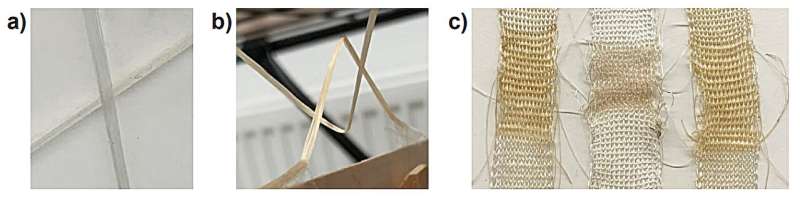
The project had two main goals: first, to replace metals with alternative conductive materials like electronically conductive carbons, doped conducting polymers, and ionically conductive mediums; second, to lay the cornerstone for scalable production and realistic characterization of textile nerves—especially for use in textile muscles. All of this was approached from a textile manufacturing standpoint, ensuring compatibility with weaving looms and knitting machines.
Improved properties of textile fibers
Among the most striking findings was the use of ionic liquids—liquids that are comprised entirely of ions—as electrical conductors in textiles. When applied to commercial fibers, they improved flexibility and stretchability, resulting in fabrics that were not just soft, but “conformal,” meaning they adapt closely to the body’s shape and movement.
“Our modern society has been shaped by textiles and electronics. When we think of the greatest example of an electronic device, a computer, at a point in time it helped to bring the first men to the moon in Apollo 11. Now, ionotronics—where electric currents are controlled by ions—open new doors for interfacing with biological systems like the human nervous system,” explained Huniade.
Though these materials may not match metals in conductivity, their softness makes them ideal for wearable devices. The result? Electronics that feel more like clothing—and less like hardware.
“The potential uses are vast: bioelectrodes, sensors, heaters, lights, even textile-based batteries. But the most transformative application may be in rehabilitation—textile muscles could enable more accessible exoskeletons and prosthetics, giving people greater autonomy and mobility,” he said.
This research aligns with the UN’s Sustainable Development Goal 12: Responsible Consumption and Production. By avoiding metals and embracing green chemistry principles, the project offers a more sustainable path forward for two of the world’s most waste-intensive industries combined—textiles and electronics.
More information: Textile Nerves: Conductive Fibres for E- and I-Textiles. hb.diva-portal.org/smash/recor … sf?pid=diva2:1959233
Leave a Reply