
By University of Bern October 12, 2025
Collected at: https://scitechdaily.com/ai-reveals-mars-hidden-storms-racing-at-160-km-h/
Mars may appear calm from afar, but scientists have discovered it’s alive with fast-moving winds and swirling towers of dust.
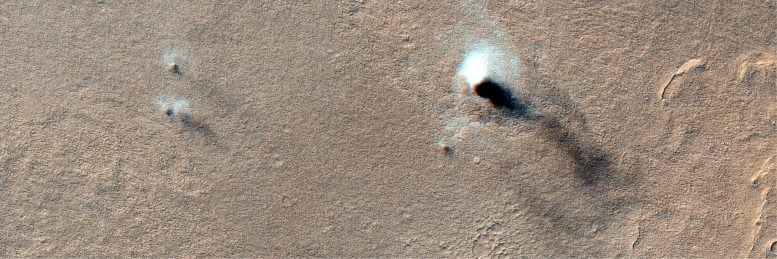
Using deep learning on tens of thousands of satellite images from European orbiters, researchers found that Martian dust devils and the winds driving them can reach speeds up to 160 km/h—much stronger than once believed. These powerful air currents are a key force shaping Mars’ weather and climate by lifting massive amounts of dust into the atmosphere.
Mysterious Winds and Whirling Dust on Mars
Winds and swirling dust devils on Mars can reach speeds of up to 160 km/h, much faster than scientists once believed. This discovery comes from an international research team led by the University of Bern, which used advanced machine learning to analyze images captured by the Bernese Mars camera CaSSIS and the HRSC stereo camera. The findings provide valuable data that will help researchers better understand how the Martian atmosphere works, improving climate models and supporting the planning of future missions to the Red Planet.
Even though Mars has an extremely thin atmosphere, it still experiences winds that play a key role in shaping its climate and moving dust around the planet. These winds lift fine particles into swirling columns known as dust devils—rotating towers of dust and air that travel across the surface. While the winds themselves cannot be seen in images, dust devils stand out clearly, making them important tools for scientists studying otherwise invisible atmospheric motion.

The research, led by Dr. Valentin Bickel from the Center for Space and Habitability at the University of Bern, revealed that dust devils and the surrounding winds are far stronger than previously estimated. These high-speed winds are likely responsible for much of the dust that is constantly stirred into the Martian atmosphere, influencing both the planet’s weather and long-term climate. The study, conducted with collaborators from the University of Bern’s Department of Space Research and Planetology, the Open University in the UK, and the German Aerospace Center (DLR), was recently published in Science Advances.
Deep Learning Reveals Thousands of Dust Devils
“Using a state-of-the-art deep learning approach, we were able to identify dust devils in over 50,000 satellite images,” explains first author Valentin Bickel. The team used images from the Bern-based Mars camera CaSSIS (Color and Stereo Surface Imaging System) and the stereo camera HRSC (High Resolution Stereo Camera). CaSSIS is on board the European Space Agency’s (ESA) ExoMars Trace Gas Orbiter, while the HRSC camera is on board the ESA orbiter Mars Express. “Our study is therefore based exclusively on data from European Mars exploration,” Bickel continues.

Next, the researchers examined stereo images of about 300 identified dust devils to determine their directions and speeds. Co-author Nicolas Thomas, who led the development of the CaSSIS camera system at the University of Bern and whose work is funded by SERI’s Swiss Space Office through ESA’s PRODEX program (see info box), explains: “Stereo images are images of the same spot on the surface of Mars, but taken a few seconds apart. These images can therefore be used to measure the movement of dust devils.”
Bickel adds: “If you put the stereo images together in a sequence, you can observe how dynamically the dust devils move across the surface.”
Record-Breaking Wind Speeds Across the Red Planet
The results show that the dust devils and the winds surrounding them on Mars can reach speeds of up to 44 m/s, i.e. around 160 km/h, across the entire planet, which is much faster than previously assumed (previous measurements on the surface had shown that winds mostly remain below 50 km/h and – in rare cases – can reach a maximum of 100 km/h).
The high wind speed in turn influences the dust cycle on the Red Planet: “These strong, straight-line winds are very likely to bring a considerable amount of dust into the Martian atmosphere – much more than previously assumed,” says Bickel. He continues: “Our data show where and when the winds on Mars seem to be strong enough to lift dust from the surface. This is the first time that such findings are available on a global scale for a period of around two decades.”

Preparing for the Future: Safer and Smarter Mars Missions
The results obtained are also particularly important for future Mars missions. “A better understanding of the wind conditions on Mars is crucial for the planning and execution of future landed missions,” explains Daniela Tirsch from the Institute of Space Research at the German Aerospace Center (DLR) and co-author of the study. “With the help of the new findings on wind dynamics, we can model the Martian atmosphere and the associated surface processes more precisely,” Tirsch continues.
These models are essential to better assess risks for future missions and adapt technical systems accordingly. The new study thus provides important findings for a number of research areas on Mars, such as research into the formation of dunes and slope streaks, as well as the creation of weather and climate models of Mars.
Toward a Global View of Martian Weather
The researchers plan to further intensify the observations of dust devils and supplement the data obtained with targeted and coordinated observations of dust devils using CaSSIS and HRSC. “In the long term, our research should help to make the planning of Mars missions more efficient,” concludes Bickel.
Reference: “Dust devil migration patterns reveal strong near-surface winds across Mars” by Valentin T. Bickel, Miguel Almeida, Matthew Read, Antonia Schriever, Daniela Tirsch, Ernst Hauber, Klaus Gwinner, Nicolas Thomas and Thomas Roatsch, 8 October 2025, Science Advances.
DOI: 10.1126/sciadv.adw5170
Leave a Reply