
October 6, 2025 by Carly Thompson, New York University
Collected at: https://phys.org/news/2025-10-climate.html
Scientists are increasingly turning to AI to model future changes in the climate. However, existing approaches often face a trade-off between accuracy, speed, and computational cost.
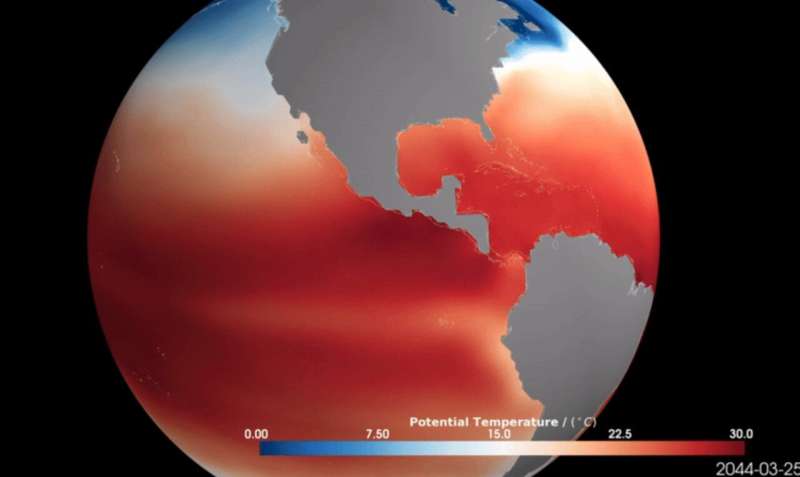
Researchers at NYU’s Courant Institute of Mathematical Sciences and Center for Data Science have now developed a first-of-its-kind neural network—Samudra—that emulates the ocean in 3D.
Samudra (Sanskrit for “ocean”) reproduces key ocean model variables, including sea surface height, ocean currents, temperature, and salinity throughout the ocean’s depth, offering a detailed look at Earth’s vast waterways. Moreover, it does so at a rate that is 100 times faster than many existing methods—and is conducted at a lower computational cost.
Samudra’s creators see the breakthrough as significantly advancing our present and future understanding of the world’s oceans, which absorb more than 90% of excess heat and 25% of carbon dioxide emissions and are essential for predicting climate change impacts.
“We try to learn from ocean data—similar to AI weather forecasts,” explains Laure Zanna, a professor at NYU’s Courant Institute of Mathematical Sciences and NYU’s Center for Data Science.
“Once trained, you can unleash it and run it for years and years, giving you a reasonable long-term simulation,” adds Carlos Fernandez-Granda, director of NYU’s Center for Data Science.
Zanna describes Samudra’s workings in greater detail in this video:
https://www.youtube.com/embed/C5CQtjtU–E?color=white
Credit: New York University
Provided by New York University
Leave a Reply