
September 15, 2025 by Institute of Electrical and Electronics Engineers
Collected at: https://techxplore.com/news/2025-09-advanced-broadband-optical-filtering-chirped.html
Optical signal transmission can be significantly improved by limiting the wavelength of transmitted signals. Fiber Bragg grating (FBG) is a technique widely used in optical communication, sensing, and laser technologies for selectively blocking certain wavelengths of light. In optical fibers, FBG functions as a band-rejection filter that reflects specific light wavelengths, but allows others to pass unimpeded, offering advantages such as improved signal transmission quality, reduced signal loss, and high signal specificity for sensing applications.
There are several types of FBG, including uniform FBG (UFBG), chirped FBG (CFBG), tilted FBG (TFBG) and long-period fiber grating (LPFG). However, these techniques are unsuitable for filtering optical signals with large bandwidths efficiently. For instance, UFBG and CFBG have narrow and limited filtering bandwidths.
Although TFBG and LPFG are suitable for filtering broadband optical signals, TFBG tend to have low filtering slope-efficiency, which can result in slow signal transitions and reduced filtering precision. Meanwhile, LPFG is highly sensitive to the external environment, leading to unstable filtering performance.
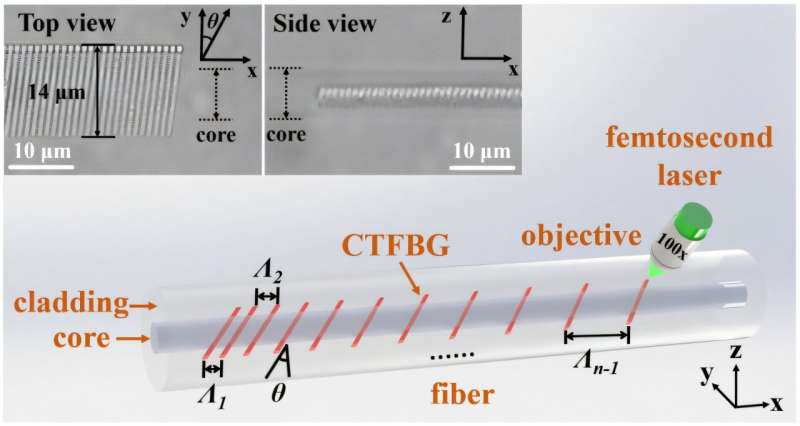
Researchers from Shenzhen University have now experimentally demonstrated the viability of chirped and tilted fiber Bragg grating (CTFBG) for flexible and adjustable wavelength filtering in broadband optical signals. Published in Journal of Lightwave Technology, their findings suggest that this type of band-rejection filter could offer several advantages in a wide range of applications.
“The CTFBGs have the advantages of large filtering bandwidth (up to more than 100 nm), high filtering slope efficiency and exceptional broadband tunability, which makes them increasingly used in high-quality band-rejection filtering, edge filtering, and gain equalizers,” explains Dr. Fan.
The researchers fabricated the CTFBG using the femtosecond laser line-by-line technology, which allowed them to precisely control optical filtering characteristics of the FBGs such as tilt angle, chirp rate, and pitch. Their study demonstrated that CTFBGs of sufficiently large length are capable of flexibly filtering large bandwidth signals at ultra-high efficiency. The study also showed that CTFBGs can be customized for filtering specific wavelengths in the 51 nanometer to 112 nanometer range.
“The experimental results show that CTFBGs combine the characteristics of wide bandwidth, high transmission loss, and smooth spectral envelope. The spectral characteristics, such as wavelength, bandwidth, and transmission loss, could be customized by CTFBG fabrication parameters such as initial pitches, tilt angles, and chirp rates,” Dr. Fan notes.
“By increasing the grating lengths of CTFBGs, large bandwidth and ultra-high filtering efficiency could be simultaneously realized at selected wavelengths,” he observes.
Overall, the findings suggest that CTFBGs have several advantages as a band-rejection filter for broadband optical signals besides flexibility and precise filtering performance. The researchers have shown that these FBGs have low insertion loss, high filtering efficiency, and negligible back-reflection. Furthermore, they demonstrated high resilience to changes in the environment and stress in these FBGs.
“The CTFBGs fabricated by LBL technology show significant improvements in spectral tailoring and coating maintaining, making it a great candidate for high-quality band rejection filtering, edge filters and gain equalizers,” Dr. Fan concludes.
More information: Yu Fan et al, Broadband and High-Filtering-Efficiency Band-Rejection Filters Fabricated Using Femtosecond Laser Line-by-Line Technology, Journal of Lightwave Technology (2025). DOI: 10.1109/JLT.2025.3577737
Leave a Reply