
September 11, 2025 by RFrank
Collected at: https://www.eeworldonline.com/how-do-restrooms-get-smarter/
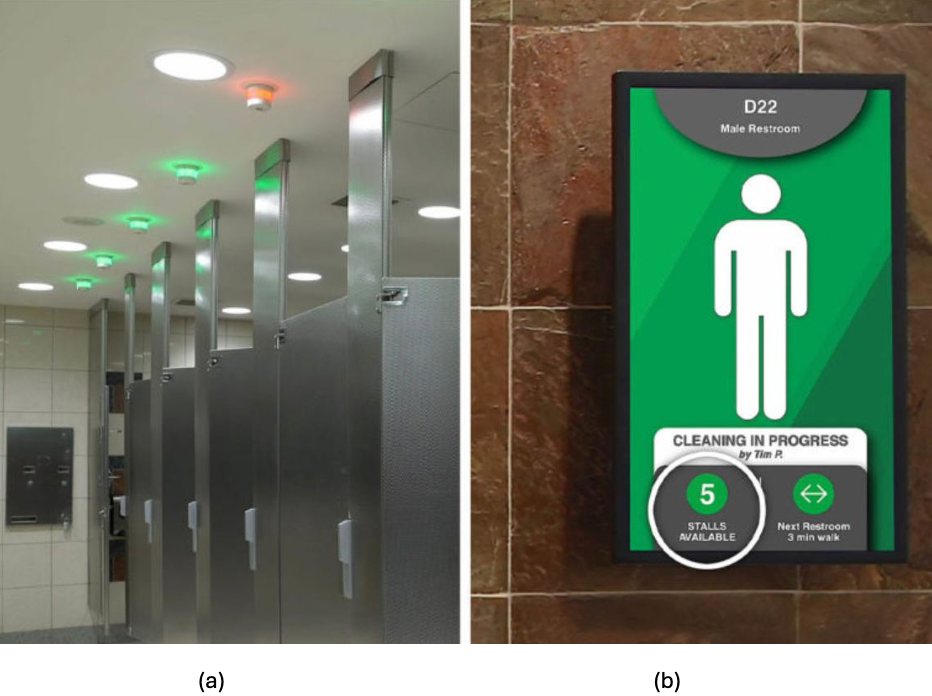
In a busy airport, if you’re making the long trek from where you are to the gate you depart from, a WOW! moment can occur when a digital display informs you of an available restroom stall along the way and removes one source of frustration and anxiety.
In a public restroom, sensors provide several automatic and non-touch features from sensor flushometers, sensor faucets, sensor soap dispensers, and sensor hand dryers. Some or all of these sensor-based products can be found in various public restrooms. Sensors also provide the starting point for the “available stalls” display.

In a restroom, cameras are not permitted. An alternative approach might be motion sensors. However, one company’s prototype, while promising, had some issues. The motion sensors used to detect occupancy would frequently register movement in adjacent stalls, causing false positives.
One way to consistently acquire the information that stalls are available is a patented approach used in the Tooshlights Restroom Traffic Management System (RTMS). In this design, the movable latch between the locked position and the unlocked position has a sensor integrated in it that responds to the selected position. The sensor could be something as straightforward as a snap-action microswitch. A transmitter in the battery-powered latch assembly communicates that the latch is in the locked position or in the unlocked position to the stall’s associated indicator light that turns red or green depending on the latch’s position.
Finally, a hub, required for data and power, (1) collects data from lights and sends the data to a cloud server, and (2) powers the lights using power over Ethernet (PoE) technology. Once the stalls’ accumulated data is available in the cloud, it can also be wirelessly transmitted to a display outside of the restroom and used for additional purposes that benefit users and the facility as well.
Other improvements that can result
With data from the RTMS and other sources, a facility’s management can keep track of how often a bathroom is used and when it needs to be cleaned.
In one approach, facility managers can upgrade their availability system with a software subscription to view stall, restroom, and facility usage information and analytics. With this information, maintenance teams and building owners can see stall usage, track how long each stall is occupied, generate tracking reports per stall and per restroom, and receive alerts when a stall has been occupied for more than a predetermined length of time.

Another system had 8 different features and sensor types for throughput counting, stall occupancy, staff monitoring, passenger digital signage, connected dispensers, connected plumbing, and a smart restroom platform to manage restroom staff and analyze data.
It all starts with the sensor
While there are many aspects to smart restrooms and other smart products, they all start with the right sensor or sensors.
References
Tooshlights Restroom Stall Indicator — Creative Engineering
US20150233146A1 – Restroom stall occupancy indicator system – Google Patents
Tooshlights Go To Market Plan
Sloan, Modus Systems Partner to Deliver Smart Restroom Traffic Management System
TRAX Analytics: Transforming Digital Restrooms
Leave a Reply