
September 2, 2025 by David Bradley, Inderscience
Collected at: https://phys.org/news/2025-09-ocean-motion-coastal.html
Computational modeling could improve how scientists and planners understand and prepare for natural disasters on our coasts and even inland. In an article published in the International Journal of Mathematical Modelling and Numerical Optimisation, the team explains how they used MATLAB to develop a model to simulate the movement of water in shallow regions, along coastlines, in rivers, and reservoirs.
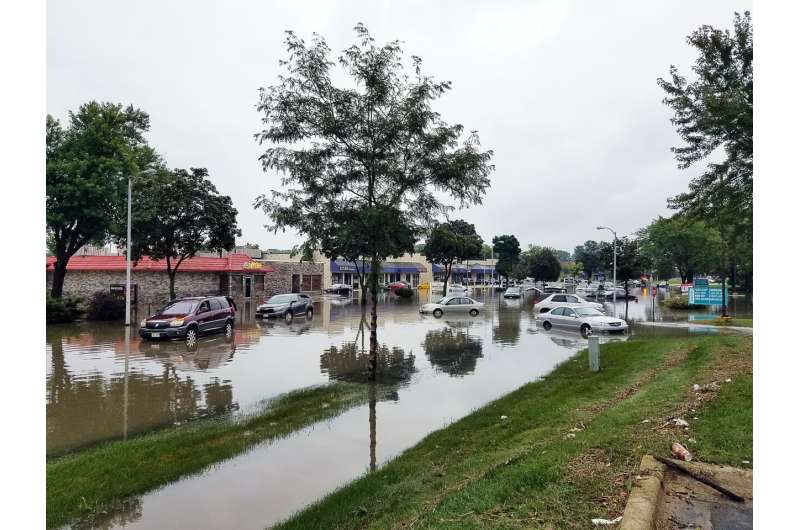
The model offers a clearer, more adaptable way to anticipate the consequences of dam failures and natural hazards such as tsunamis and storm surges.
Low-lying regions and islands are increasingly vulnerable to flooding and extreme weather events, compounded by climate change and expanding populations. Existing early-warning systems rely heavily on models that can simulate water flow with high precision. However, capturing the complexity of wave behavior in shallow water is problematic. The new model aims to overcome the problems with a flexible, computationally efficient approach.
The team explains that their model uses shallow water equations, a set of mathematical formulas derived from the principles of conservation of mass and momentum in fluid dynamics. These equations describe how water behaves when its depth is relatively low compared to the wavelength of the waves, a condition common in estuaries, floodplains, and near the shoreline. In such settings, water waves tend to grow steeper and taller as they slow down. This can lead to powerful surges capable of overwhelming infrastructure and communities.
To solve these equations, the research used a numerical technique known as the finite difference method. This involves overlaying a grid onto the simulation area and calculating how water levels and flow velocities change over time at each grid point. The result is a dynamic simulation that captures the evolution of wave patterns under different conditions.
The model is highly flexible, which means it can be customized for different simulation areas and physical boundary conditions, such as whether wave energy dissipates on the shoreline or is reflected by sea defenses, harbor walls, and other solid structures. The scientists can thus model a variety of real-world scenarios, from the breaching of a dam to the arrival of a tsunami in a harbor. The model can also produce an animated visualization so that researchers and emergency managers can see how events might unfold.
More information: Vetrichelvan Pugazendi et al, Numerical modelling of wave propagation in shallow water, International Journal of Mathematical Modelling and Numerical Optimisation (2025). DOI: 10.1504/IJMMNO.2025.148206
Leave a Reply