
August 27, 2025 by Ingrid Fadelli, Phys.org
Collected at: https://techxplore.com/news/2025-08-electro-optical-mott-neurons-niobium.html
Over the past decades, engineers have introduced a wide range of computing systems inspired by the human brain or designed to emulate some of its functions. These include devices that artificially reproduce the behavior of brain cells (e.g., neurons), by processing and transmitting signals in the form of electrical pulses.
Most neuron-inspired devices developed so far use either electrons or photons to process and transmit information, rather than integrating the two. This is because photonic and electronic systems typically have very different architectures, and converting the signals they rely on can be challenging and lead to energy losses.
Researchers at Stanford University, Sandia National Laboratories, and Purdue University recently developed new electro-optical devices that can mimic neuron-like electrical pulses and simultaneously emit oscillating light. These devices, referred to as electro-optical Mott neurons, were introduced in a paper published in Nature Electronics.
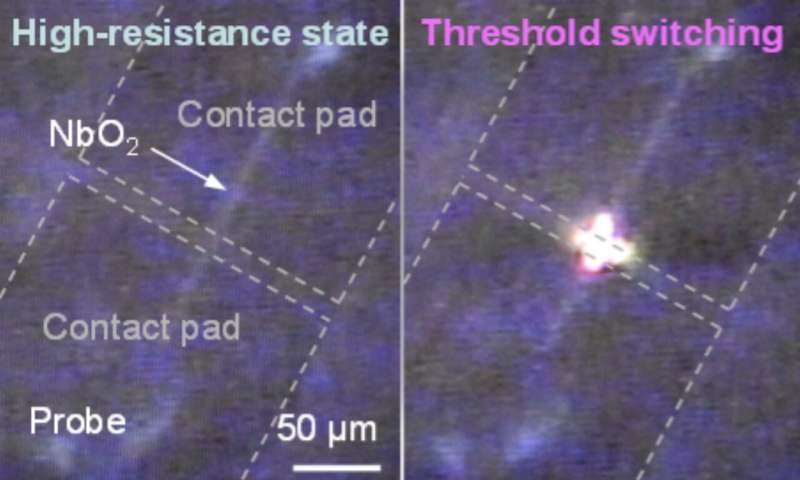
“This work began as a simple study of switching in niobium dioxide (NbO2) devices,” Eric Pop, co-senior author of the paper, told Tech Xplore. “While optically monitoring them for signs of electrical breakdown, we noticed an unexpected, bright visible glow from the NbO2 channel. The light emission occurred only during electrical resistance switching of the devices, and this had never been reported before, to our knowledge. Thus, we decided to study it further to understand its origins.”
The first objective of this recent work by Pop and his colleagues was to determine the spectral range of the emission they noticed in NbO2 devices. In addition, the researchers hoped to determine whether this observed emission would oscillate in sync with electrical oscillations, which is something such NbO2 devices are already known for. Finally, they also wanted to better understand the origins of the unexpected light emission they had observed.
“We started with thin films of NbO2 deposited by sputtering, then used standard fabrication techniques to make micrometer-scale devices with two metal contacts,” explained Mahnaz Islam, first author of the paper.
“These devices operate through neuron-like switching, where the resistance changes abruptly and reversibly once a threshold voltage is exceeded. This change is accompanied by an electronic instability which can drive self-sustained oscillations in the device, enabling them to mimic the dynamic spiking activity of biological neurons.”
Interestingly, the researchers observed that during the electrical switching process, the NbO2 channel in their devices also emitted visible light, meaning that each spike carried both an electrical and an optical signature that were perfectly synchronized in time. This was the first time that this electro-optical synchronization was observed in an electronic neuron-inspired device.
“The observed light emission in these devices occurs in the visible-range wavelengths and is perfectly synchronized with the electrical oscillations in NbO2,” said Islam.
“By combining our experimental results with prior literature, we were able to propose an electronic origin for this emission, completing the proof-of-concept demonstration. The key advantage is that these electro-optical Mott neurons merge computation and communication into a single element, avoiding the need for separate light sources or optical transducers.”
Previous efforts aimed at connecting electrical processors with optical interconnects relied on several different components and costly energy conversion strategies. In contrast, the device developed by this research team produces electrical spikes with simultaneous visible light pulses, a phenomenon that could be leveraged to realize long-range optical signaling that is synchronized with local electrical processing.
“This dual-domain capability has major implications,” said Islam. “For example, in metrology, synchronized optical and electrical spikes offer a new way to probe correlated electron systems in real time. In computer vision, these neurons could integrate directly with optical sensors for compact, in-sensor processing.
“As for electro-optical computing and communication, eliminating separate transducers could enable dense neuromorphic systems where optical pulses handle high-speed, long-range connections while electrical states perform local computation and memory.”
This recent paper could open new possibilities for the realization of neuron-inspired devices, as it could allow engineers to reliably combine electrical and optical functions in a single system without the need for expensive equipment or signal conversion strategies. The researchers are now hoping to continue improving the artificial neurons they developed and broadening their capabilities.
“In future work, we plan to scale and integrate NbO2 electro-optical neurons into larger arrays where devices can communicate optically with each other, enabling the study of light-mediated signaling in neuromorphic networks,” said Islam.
“Our current devices are not yet optimized for capturing or guiding light efficiently, so we aim to apply optical engineering strategies, such as patterning on-chip waveguides to channel the emitted light.”
Islam and her co-authors would also like to improve the quality of the material samples used to create the electro-optical Mott neurons, as this could further boost the devices’ conversion efficiency. This could be achieved by passivating non-radiative defects, incorporating luminescence centers to tune emission wavelengths, optimizing the overall geometry of the devices and outcoupling structures to enhance light extraction efficiency.
“Optical computing has come a long way in the last few decades, by enabling types of information processing with light that is not easy with traditional pure electronics,” said Suhas Kumar, co-senior author of the paper. “However, their integration into prevailing electronic circuits is still challenging. Our solution may bridge this challenging gap, which we plan to explore, and hope that many groups around the world will do so as well.”
More information: Mahnaz Islam et al, An electro-optical Mott neuron based on niobium dioxide, Nature Electronics (2025). DOI: 10.1038/s41928-025-01406-1.
Journal information: Nature Electronics


I would like to thnkx for the efforts you have put in writing this blog. I am hoping the same high-grade blog post from you in the upcoming as well. In fact your creative writing abilities has inspired me to get my own blog now. Really the blogging is spreading its wings quickly. Your write up is a good example of it.

What i do not understood is actually how you’re not actually much more well-liked than you may be right now. You are so intelligent. You realize therefore considerably relating to this subject, made me personally consider it from numerous varied angles. Its like men and women aren’t fascinated unless it’s one thing to do with Lady gaga! Your own stuffs great. Always maintain it up!


Leave a Reply