
August 26, 2025 by Krystal Kasal, Phys.org
Collected at: https://phys.org/news/2025-08-cars-cities-significantly-contributing-urban.html
The urban heat island effect describes the way urban areas get significantly warmer than the surrounding rural or suburban areas. There are a number of reasons why this occurs, although it can mostly be boiled down to the fact that there are fewer green spaces containing plants that cool off the surrounding air by evapotranspiration and more buildings and roads, which all have a tendency to hold more heat from the sun and keep the city warmer.
Most scientific studies on urban heat islands have focused on the heating effects of buildings, roads, and air pollution, but the effects of the massive number of cars existing in dense urban centers have not been looked at closely. The materials cars are made from tend to heat up easily and many cars are darker in color—a factor that can significantly impact how a material heats up. So, it seems likely that cars are contributing a significant amount to urban heat island effects.
To determine just how much heat cars contribute, a group of researchers recently conducted a study measuring the temperatures of areas surrounding cars after a long, sunny day and analyzed the impact of these heated vehicles in Lisbon. Their research is published in the journal City and Environment Interactions.
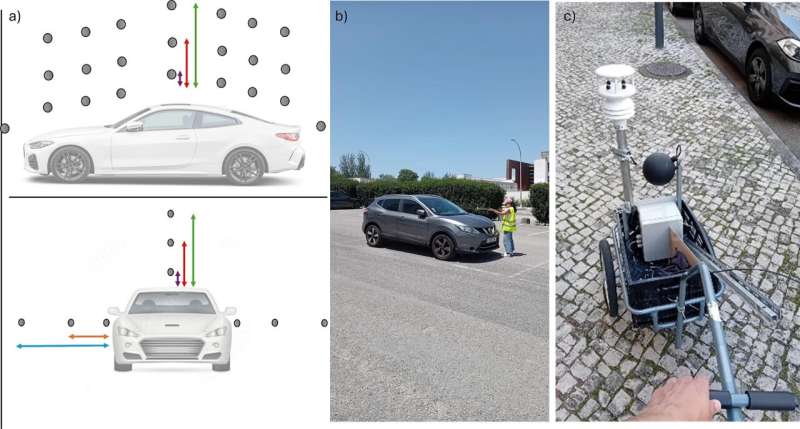
The researchers parked one black car and one white car on an asphalt parking lot and left them there throughout the sunniest part of the day. Then, they came back to measure the temperature at different points around both cars and above the asphalt. They also analyzed parking and traffic data from Lisbon to estimate the spatial distribution and coverage of parked vehicles across the city in order to calculate warming effects.
The temperature measurements revealed a significant difference between the effects of the two cars and the asphalt. They found that the black car raised the air temperature by 3.8°C, compared to adjacent asphalt. The white car also raised the temperature in many areas, but to a much lower degree.
The study authors write, “The largest differences were observed above the black car; just above the center of the roof (20 cm), ΔT ranged from 3.39◦ to 3.79◦C, approximately 1◦C warmer than the same spot over the roof of the white car. ΔT values around the white car are noticeably smaller and often negative. These observations demonstrate that vehicle color can significantly influence the surrounding air temperature.”
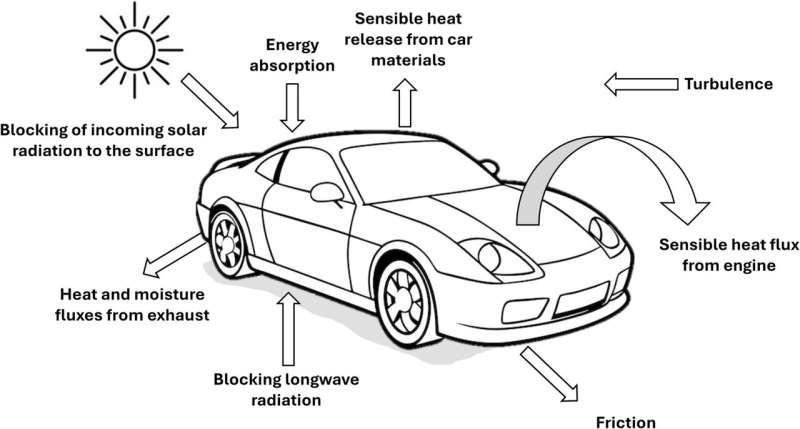
Car impacts on urban environments (adapted from Chapman & Thornes [2] and Prusa et al. [23]). Credit: City and Environment Interactions (2025). DOI: 10.1016/j.cacint.2025.100232
This effect is not too surprising, as darker colors are known to absorb more light from the sun, while lighter colors reflect more light. White cars can reflect up to 85% of sunlight, and black cars only reflect around 5–10%. In addition, most of a vehicle’s exterior is typically made of a thin layer of metal, which absorbs heat much faster than asphalt.
Often, parked cars can cover much of the road surface and fill up parking lots in dense urban areas. Of course, there are generally more cars during the day, as many people commute from suburban areas for work during this time. Ultimately, this significantly alters local heat absorption. Interestingly, though, the researchers calculated that the solar radiation absorption could be considerably reduced if all cars in the city were lighter in color by almost doubling the collective albedo (the ability of a material to reflect light) in some parts.
They explain, “If all the vehicles were colored white (α = 0.8), then in these parts of the city the reflectivity of the roads would be raised from α = 0.2 to α ≥ 0.28–0.39, reducing solar radiation absorption considerably. On the other hand, if these vehicles were colored black, the albedo effect would be α ≤ 0.19–0.18.”
While getting everyone to switch to light colored cars might be a bit much to ask, there are ways to gradually shift toward lighter vehicles or to employ other reflective structures to cover parking areas to reduce urban heat island effects.
The study authors outline several suggestions for urban planning and heat mitigation strategies: “From an urban planning perspective, it may be important to consider color-based parking restrictions in heat-sensitive zones, such as prohibiting dark-colored vehicles in the hottest areas or incentivizing the use of reflective coatings.
“Additionally, promoting shading structures in open parking lots can help mitigate heat exposure. Complementary measures may include the use of high-reflectance pavement materials (noting potential glare issues), street tree planting, and enhanced green infrastructure (e.g.: vegetated roofs, façade greenery, and urban corridors) to increase evapotranspiration, shading, and ventilation.”
Written for you by our author Krystal Kasal, edited by Gaby Clark, and fact-checked and reviewed by Robert Egan—this article is the result of careful human work. We rely on readers like you to keep independent science journalism alive. If this reporting matters to you, please consider a donation (especially monthly). You’ll get an ad-free account as a thank-you.
More information: M. Matias et al, The underestimated impact of parked cars in urban warming., City and Environment Interactions (2025). DOI: 10.1016/j.cacint.2025.100232


Thank you a lot for providing individuals with remarkably pleasant possiblity to discover important secrets from this blog. It’s always so ideal and as well , jam-packed with fun for me personally and my office peers to search your blog the equivalent of three times per week to study the new guides you have. Of course, I’m just actually amazed with the tremendous tips you serve. Some 4 areas on this page are rather the most efficient I have ever had.


Hi! I know this is kind of off topic but I was wondering which blog platform are you using for this website? I’m getting tired of WordPress because I’ve had issues with hackers and I’m looking at options for another platform. I would be fantastic if you could point me in the direction of a good platform.
Leave a Reply