

By University of Vermont August 20, 2025
Collected at: https://scitechdaily.com/scientists-solve-90-year-old-mystery-in-quantum-physics/
Scientists have discovered a solution to the “damped quantum harmonic oscillator,” paving the way for what could become the world’s tiniest measuring device.
A plucked guitar string rings for a few seconds before the sound fades away. A swing on a playground, once its rider steps off, will slowly stop moving. Physicists refer to these types of fading motions as “damped harmonic oscillators,” and they are well explained by Newton’s laws of motion.
At the scale of atoms, however, behavior does not follow these familiar rules. Instead, it is governed by the unusual principles of quantum physics. This led University of Vermont professor Dennis Clougherty and his student Nam Dinh to ask whether an atomic system could show the same kind of vibration seen in everyday objects like strings and swings. “If so, can we construct a quantum theory of the damped harmonic oscillator?” Clougherty asked.
In research published on July 7, 2025, in the journal Physical Review Research, the pair presented an answer. They discovered an exact solution for a model that functions as a “damped quantum harmonic oscillator,” a quantum-scale version of a guitar string’s motion.
It turns out that for roughly 90 years, theorists have tried to describe these damped harmonic systems using quantum physics—but with limited success. “The difficulty involves preserving Heisenberg’s uncertainty principle, a foundational tenet of quantum physics,” says Clougherty, a professor of physics at UVM since 1992. Unlike the human-scale world of, say, bouncing balls or arcing rockets, the famed Heisenberg uncertainty principle shows that there is a fundamental limit to the precision with which the position and momentum of a particle can be known simultaneously. At the scale of an atom, the more accurately one property is measured, the less accurately the other can be known.
Lamb Chopped
The model studied by the UVM physicists was originally constructed by British physicist Horace Lamb in 1900, before Werner Heisenberg was born, and well before the development of quantum physics. Lamb was interested in describing how a vibrating particle in a solid could lose energy to the solid. Using Newton’s laws of motion, Lamb showed that elastic waves created by the particle’s motion feed back on the particle itself and cause it to damp—that is, to vibrate with less and less energy over time.
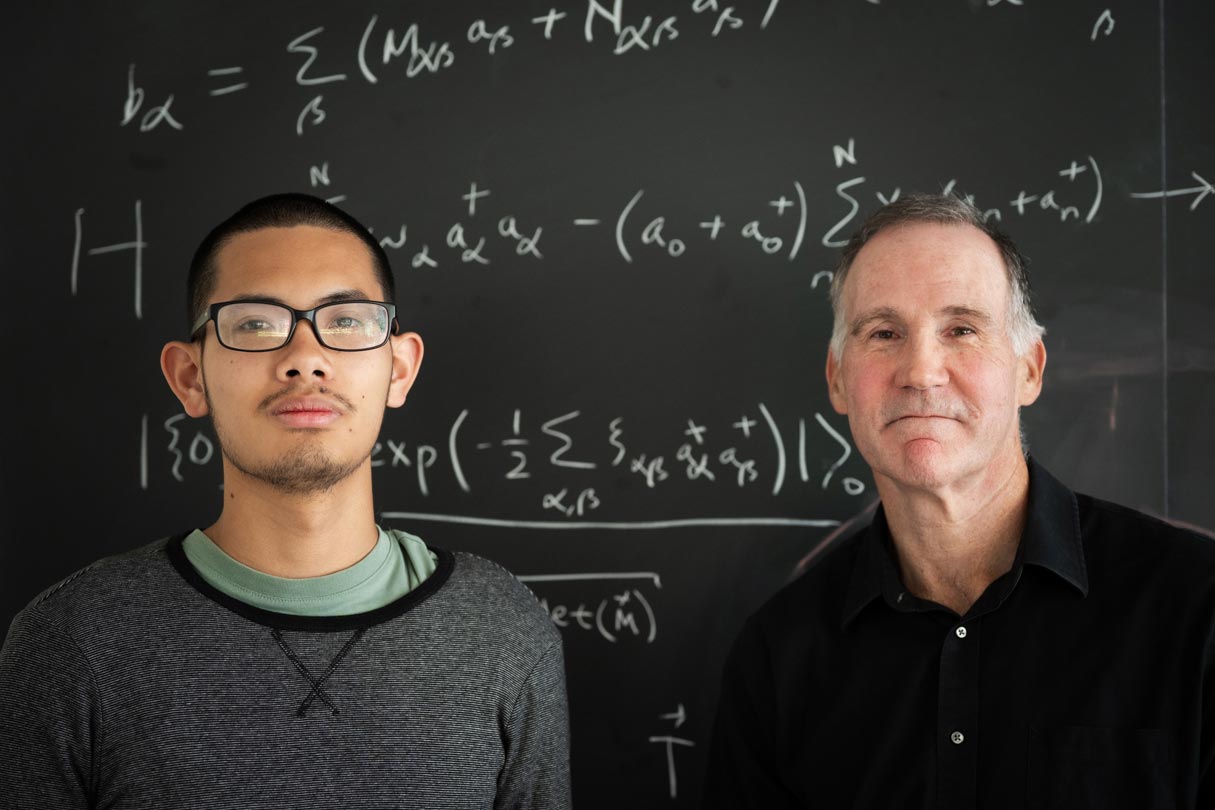
“In classical physics, it is known that when objects vibrate or oscillate, they lose energy due to friction, air resistance, and so on,” says Dinh. “But this is not so obvious in the quantum regime.”
Clougherty and Dinh (who graduated from UVM in 2024 with a BS in physics, in 2025 with a master’s degree, and is now pursuing a PhD in mathematics at UVM)—with support from the National Science Foundation and NASA—reformulated Lamb’s model for the quantum world and found its solution. “To preserve the uncertainty principle, it is necessary to include in detail the interaction of the atom with all the other atoms in the solid,” Clougherty explains, “it’s a so-called many-body problem.”
Tiny Tools?
How did they solve this problem? Hold onto your seat. “Through a multimode Bogoliubov transformation, which diagonalizes the Hamiltonian of the system and allows for the determination of its properties,” they write, yielding a state called a “multimode squeezed vacuum.” If you missed a bit of that, suffice it to say that the UVM researchers were able to mathematically reformulate Lamb’s system so that an atom’s oscillating behavior could be fully described in precise terms.
And precisely locating the position of one atom could lead to something like the world’s tiniest tape measure: new methods for measuring quantum distances and other ultra-precision sensor technologies. These potential applications emerge from an important consequence of the UVM scientists’ new work: it predicts how the uncertainty in the position of the atom changes with the interaction to the other atoms in the solid.
“By reducing this uncertainty, one can measure position to an accuracy below the standard quantum limit,” Clougherty says. In physics, there are some ultimate limits, like the speed of light—and that Heisenberg’s uncertainty principle prevents perfect measurement of a particle. But this uncertainty can be reduced beyond normal limits by certain quantum tricks—in this case, calculating the particle’s behavior in a special “squeezed vacuum” state which reduces the noise of quantum randomness in one variable (location) by increasing it in another (momentum).
This kind of mathematical maneuver was behind the creation of the first successful gravitational wave detectors, which can measure changes in distance one thousand times smaller than the nucleus of an atom—and for which the Nobel Prize was awarded in 2017. Who knows what the Vermont theorists’ discovery of a new quantum solution to Lamb’s century-old model might reveal.
Reference: “Quantum Lamb model” by Dennis P. Clougherty and Nam H. Dinh, 7 July 2025, Physical Review Research.
DOI: 10.1103/9fxx-2x6n
Funding: U.S. National Science Foundation, NASA Headquarters


Awesome blog you have here but I was curious about if you knew of any forums that cover the same topics talked about here? I’d really like to be a part of group where I can get responses from other experienced people that share the same interest. If you have any suggestions, please let me know. Many thanks!


Leave a Reply