
August 24, 2025 by University of Minnesota
Collected at: https://phys.org/news/2025-08-alien-aurora-plasma-jupiter.html
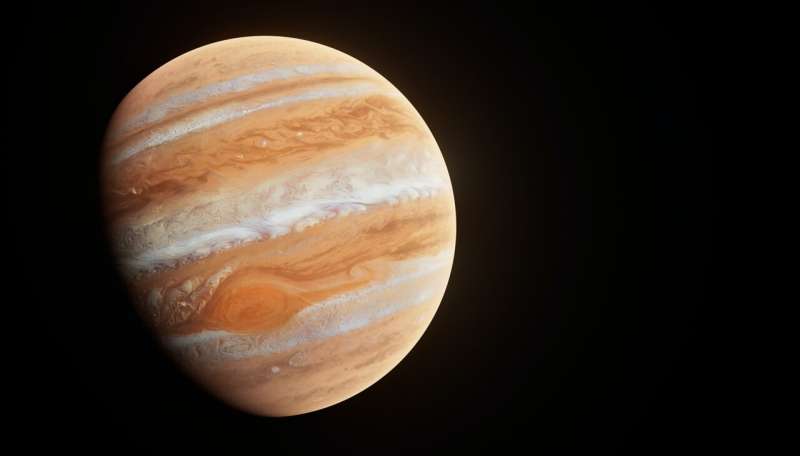
Researchers at the University of Minnesota Twin Cities have made a new discovery by observing and analyzing the first new type of plasma wave in Jupiter’s aurora. This research helps us understand “alien aurora” on other planets, which in turn teaches us more about how Earth’s magnetic field protects us from the sun’s harmful radiation.
The observation is based on data from NASA’s Juno spacecraft, which made a historic low orbit flight over Jupiter’s north pole, where the team was able to use their expertise in data analysis to study data from the northern polar regions of Jupiter for the first time. The research is published in Physical Review Letters.
“The James Webb Space Telescope has given us some infrared images of the aurora, but Juno is the first spacecraft in a polar orbit around Jupiter,” said Ali Sulaiman, an assistant professor in the University of Minnesota School of Physics and Astronomy.
The space around magnetized planets like Jupiter is filled with plasma, a superheated state of matter where atoms break into electrons and ions. These particles are accelerated toward the planet’s atmosphere, causing the gases to light up as an aurora. On Earth, this is visible as familiar green and blue lights. However, Jupiter’s aurora is typically invisible to the naked eye and can only be observed using UV and infrared instruments.
The team’s analysis revealed that due to the extremely low density of Jupiter’s polar plasma combined with its powerful magnetic field, the plasma waves have a very low frequency, unlike anything previously observed around Earth.
“While plasma can behave like a fluid, it is also influenced by its own magnetic fields and external fields,” said Robert Lysak, a professor in the University of Minnesota School of Physics and Astronomy and an expert on plasma dynamics.
The study also sheds light on how Jupiter’s complex magnetic field allows particles to flood into the polar cap, unlike Earth where the aurora forms a donut pattern of auroral activity around the polar cap. The researchers hope to gather more data as Juno continues its mission to support further research into this new phenomenon.
In addition to Lysak and Sulaiman, the research team included Sadie Elliott, a researcher with the School of Physics and Astronomy, along with researchers from the University of Iowa and the Southwest Research Institute.
More information: R. L. Lysak et al, New Plasma Regime in Jupiter’s Auroral Zones, Physical Review Letters (2025). DOI: 10.1103/fn63-qmb7
Journal information: Physical Review Letters


Thank you for every one of your labor on this web page. My daughter takes pleasure in setting aside time for investigation and it is easy to see why. I hear all concerning the dynamic form you deliver efficient solutions via the blog and as well as invigorate response from website visitors on the area then our daughter is certainly studying a great deal. Take pleasure in the remaining portion of the new year. Your conducting a superb job.


Leave a Reply