
Arezki Amiri Published on August 14, 2025
A newly spotted interstellar comet is passing through our solar system at a blistering speed of 130,000 miles per hour, raising both scientific interest and speculative questions about where it came from — and what else might be out there. Named 3I/ATLAS, it’s only the third object ever confirmed to have entered our system from beyond, following ʻOumuamua in 2017 and Comet Borisov in 2019.
3I/ATLAS Could Be Massive — or Maybe Not
The most recent NASA Hubble Space Telescope observations, published ahead of peer review in Astrophysical Journal Letters, narrowed the size estimate of 3I/ATLAS’s nucleus to between 320 meters (1,000 feet) and 5.6 kilometers (3.5 miles) across. This new range is far smaller than initial estimates that reached up to 20 kilometers (12 miles) — but still possibly hundreds of times larger than ʻOumuamua, which measured roughly 100 meters long.
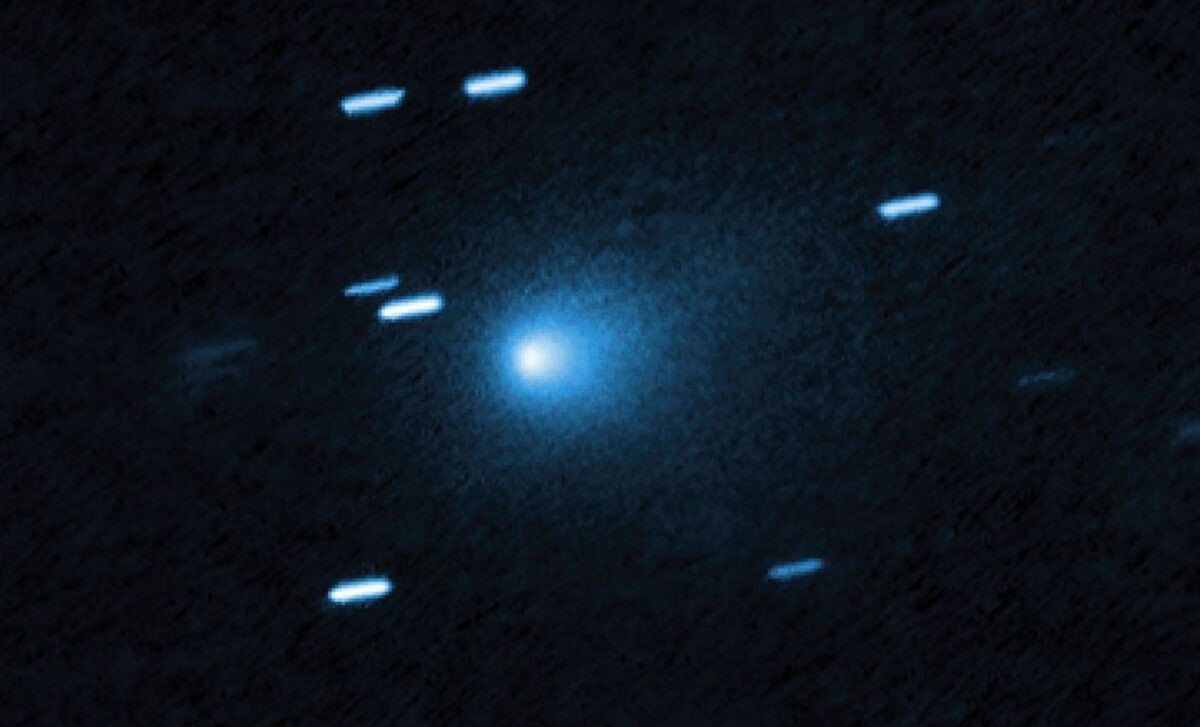
The comet, captured by Hubble on July 21, 2025, was over 277 million miles from Earth at the time. According to lead scientist David Jewitt of UCLA, the object exhibits a teardrop-shaped coma and dust tail, typical of many icy comets warmed by the Sun. “Hubble gives us the best estimate yet,” Jewitt said. Still, the object’s core remains hidden beneath that haze of dust and gas, preventing scientists from measuring its exact size or composition — for now.

Where Did It Come From? Astronomers Say: No One Knows
Despite its high visibility and speed, scientists still can’t determine the origin of 3I/ATLAS. Jewitt explains the challenge plainly: “It’s like glimpsing a rifle bullet for a thousandth of a second. You can’t project that back with any accuracy to figure out where it started on its path.”
At a speed of 130,000 mph, 3I/ATLAS is moving too fast to be captured by the Sun’s gravity, meaning it’s not from the Oort Cloud or anywhere within the solar system. Most likely, it was ejected from a faraway planetary system after billions of years drifting through interstellar space — possibly picking up momentum from the gravitational fields of stars and nebulae along the way.
NASA astronomers believe this could be just the beginning. Jewitt noted: “This latest interstellar tourist is one of a previously undetected population of objects bursting onto the scene. We’ve crossed a threshold” — referring to powerful new survey tools like ATLAS and the Vera Rubin Observatory, which are now able to detect faster, fainter objects from deep space.
Harvard’s Avi Loeb Stokes the Alien Probe Debate — Again
Harvard astrophysicist Avi Loeb, known for controversial claims regarding ʻOumuamua’s origin, has added 3I/ATLAS to his list of objects worth scrutinizing. In comments to MailOnline, Loeb drew a parallel between 3I/ATLAS and Arthur C. Clarke’s 1973 novel Rendezvous with Rama, which imagines a massive alien spacecraft entering the solar system unnoticed.
Loeb points out a statistical anomaly: if 3I/ATLAS is as large as it appears, then hundreds of thousands of smaller ʻOumuamua-sized objects should have already been observed — yet they haven’t. “That’s very strange,” he said. While he stops short of calling it alien, Loeb suggests any unusual interstellar object deserves scrutiny. “The response has to depend on its properties and its intent. It’s just like having a visitor in your backyard,” he said.
What’s Next for 3I/ATLAS
3I/ATLAS is expected to reach its closest point to the Sun on October 30, about 130 million miles away, between the orbits of Earth and Mars. The object will remain visible to ground-based telescopes until September, after which it will pass behind the Sun and become briefly hidden, reemerging by early December.
While it’s not headed for Earth and poses no threat, the object’s size, speed, and mysterious origin are pushing astronomers — and a few bold theorists — to look deeper.
Leave a Reply